When someone asks ChatGPT, Gemini or Claude about your company, what does it say, and which sources does it cite? That question has a name in PR now: LLM visibility. According to Muck Rack’s 2026 State of PR Measurement report, released Nov. 18, 55% of PR professionals have taken steps to measure it, nearly double last year’s 28%.
The catch is in the details. Many teams are still measuring loosely, with inconsistent prompts and irregular checks. If you have read our guide to generative engine optimization, this is the measurement side of the same shift. Here is what the survey found and how to measure LLM visibility in a way you can defend.
Key takeaways
- 55% of PR pros have taken steps to measure LLM visibility, and another 23% plan to start.
- In 37% of those teams, PR or communications owns it, ahead of SEO or digital at 19%.
- Fewer than half use consistent prompts, and only 31% retest on a regular schedule.
- Muck Rack sells LLM visibility tools, and most respondents came from its own database.
55%
Share of PR professionals who have taken steps to measure LLM visibility in 2026, up from 28% in 2025, according to Muck Rack.
What the Survey Found
PR is taking ownership
Among teams measuring LLM visibility, 37% give primary responsibility to PR or communications and 19% to SEO or digital. Earlier this year, Muck Rack’s State of PR survey found 29% saying no one in their organization owned it. Muck Rack CEO Greg Galant summed it up: “Comms plays a big role when it comes to LLM visibility.”
AI is now part of measurement
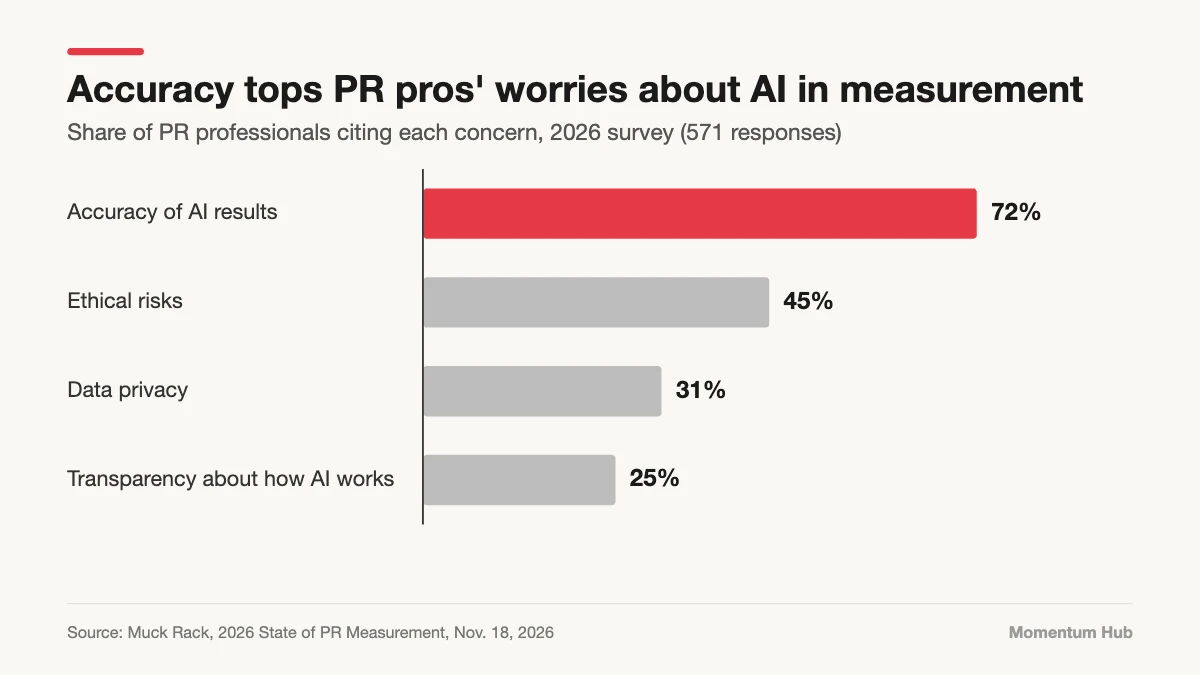
54% of PR pros use AI or AI-powered tools in measurement and reporting. Concerns remain, led by the accuracy of AI results.
Confidence is mixed
51% are very or extremely confident in the metrics they report. Yet 63% say they must report metrics they do not consider meaningful or reliable at least sometimes, most often because of client expectations (38%) or executive expectations (28%).
How Teams Measure LLM Visibility Today
This is where the survey gets uncomfortable. Among teams measuring LLM visibility, fewer than half use consistent prompts, and only 31% repeat their tests on a regular schedule. Nearly four in ten teams have no formal method for connecting PR activity to outcomes, 46% find it hard to connect PR with outcomes, and 39% lack access to business-outcome data.
On the positive side, 62% changed their media outreach targets in the last year based on what measurement showed them. Measurement is already changing what PR teams do.
This Hootsuite tutorial shows one way to monitor what AI tools say about a brand. Like most videos on this topic, it comes from a vendor, so watch it for the method rather than the product.
A Simple Way to Measure LLM Visibility Credibly
You do not need an expensive platform to start. You need consistency.
- Write a fixed prompt set. Pick 15 to 25 questions your audience actually asks, and keep the wording identical every time.
- Test the same models on a schedule. Monthly works for most teams. Note the model and date, because answers change as models update.
- Record three things per answer. Whether you are mentioned, how you are described, and which sources are cited.
- Track sources, not just mentions. If AI answers keep citing the same publications, that tells you where earned media matters most.
- Tie it to an outcome. Compare visibility changes with branded search, referral traffic from AI tools or inbound inquiries.
For step 5, our guide to tracking AI search traffic shows how to find AI referrals in your analytics. A simple log keeps results comparable over time:
date,model,prompt_id,mentioned,tone,sources_cited
2026-11-25,chatgpt,P07,yes,positive,"afr.com; reuters.com"
Muck Rack’s own Generative Pulse demo shows what a commercial dashboard tracks. It is a product video, so compare it with the free method above.
Read the Numbers With Care
Muck Rack surveyed 697 PR professionals from Sept. 22 to Oct. 19, 2026, mostly by email to its own database and contacts. After cleaning, 571 responses remained. That is a useful snapshot, but not a random sample of the profession, and it comes from a company that sells LLM visibility tracking. The direction of travel is believable. Treat the exact percentages as estimates.
Quick Questions, Answered
What is LLM visibility? How often and how favorably a brand appears in answers from large language models such as ChatGPT, Gemini or Claude, along with the sources those answers cite.
Who should own it, PR or SEO? In the survey, PR leads more often. In practice, it works best as a shared job, with PR shaping the sources and SEO handling the technical side.
How often should I test? Monthly is a sensible start. What matters most is using the same prompts and models each time.
Final Thoughts: Treat It Like Any Other Metric
LLM visibility went from experiment to expectation in a year. The next step is the one Galant points to: holding it to the same standard as any other PR metric. Consistent prompts, regular testing and a link to outcomes will tell you far more than a one-off screenshot of a chatbot answer. For related reading, see our look at AI-written press releases and our guide to internal communications metrics.