- Why LLM Text Annotation Took Off
- What the Follow-Up Studies Found
- The Accuracy Trap
- Stability: Does the Same Prompt Give the Same Answer?
- Reproducibility and Privacy
- When Humans Still Win
- The Six Rules for LLM Text Annotation
- What This Means Outside Academia
- Key Terms in LLM Text Annotation
- Quick Questions, Answered
- Final Thoughts: A Fast Assistant, Not an Oracle
LLM text annotation means asking a large language model such as ChatGPT, Claude, or an open model to label text the way a trained human coder would: is this post hostile, does this article mention immigration, which frame does this headline use? Three years ago this was a curiosity. Today it is standard practice in computational communication, and it has changed how fast a content analysis can be done.
The honest answer to “can ChatGPT code your data?” is yes, often, and not safely on its own. The research since 2023 tells a consistent story: language models can match or beat non-expert human coders on many tasks, their performance varies a lot from task to task, and high accuracy does not guarantee correct conclusions. This guide, part of our Computational Communication section, covers what the evidence says and how to do it responsibly.
Key takeaways
- LLM text annotation is fast and cheap, and on many tasks it rivals crowd workers.
- Performance is uneven. The same model can be excellent on one category and poor on the next.
- Even small error rates can bias your final results if the mistakes are not random.
- A human-coded gold sample is still required, both to test the model and to correct your estimates.
Why LLM Text Annotation Took Off
The turning point was a 2023 study in PNAS by Fabrizio Gilardi, Meysam Alizadeh, and Maël Kubli. Using 6,183 tweets and news articles, they found that ChatGPT’s zero-shot accuracy beat crowd workers by about 25 percentage points on average. Each annotation cost less than $0.003, around thirty times cheaper than the crowd platform they compared it with.
Other teams reported similar results. One preprint found that GPT-4 outperformed both experts and crowd workers at guessing the party of US politicians from their tweets. For researchers used to spending months and thousands of dollars on manual coding, the appeal was immediate.
What the Follow-Up Studies Found
Then came the stress tests. A team at the University of Pennsylvania replicated 27 annotation tasks from 11 data sets used in recent social science articles. Their conclusion was more cautious: performance was promising overall but depended heavily on the task and the data, and it could not be predicted in advance. Their title says it plainly: automated annotation with generative AI requires validation.
This is the pattern to remember. Averages across studies look impressive. Your particular task may sit anywhere on the range, and you will not know where until you test it against human labels. This seminar gives a balanced tour of both the potential and the challenges.
The Accuracy Trap
Here is the part many people miss. Suppose your model is 90% accurate. It is tempting to treat the labels as good enough and move on to the analysis. That can be a mistake.
A 2023 paper by Naoki Egami and colleagues showed that using imperfect machine labels in later statistical analysis can produce biased estimates and misleading confidence intervals, even when label accuracy is in the 80 to 90% range. The problem is that errors are rarely random. If the model mislabels sarcastic posts more often, and sarcasm is more common in one group, your comparison between groups is distorted.
A more recent preprint on annotation for strategy research makes the same point: when annotation errors are correlated with the variables you care about, they bias results “regardless of average accuracy.” Because it is a preprint, treat the details as provisional, but the logic is well established.
Stability: Does the Same Prompt Give the Same Answer?
Human coders are tested for reliability, meaning whether two people, or the same person on two days, give the same label. Language models need the same test.
Models can return different answers when you run the same prompt twice, and small changes in wording can shift results more than you would expect. Researcher Christopher Barrie and colleagues have proposed measuring this directly, by rewording a prompt many times and checking how much the labels move. If a label flips when you swap “classify” for “categorize,” it is not a measurement you can rely on.
Reproducibility and Privacy
Two practical issues deserve a place in any plan for LLM text annotation.
The first is reproducibility. Commercial models are updated and retired on the provider’s schedule. A study run today may be impossible to repeat exactly next year. Political scientist Arthur Spirling has argued in Nature that open models are the more defensible choice for science for this reason. Open models can be downloaded, versioned, and rerun. We looked at the current options in our guide to open models.
The second is privacy. Sending interview transcripts, private messages, or sensitive posts to an outside service may breach consent agreements or data protection rules. Running a model locally avoids that.
When Humans Still Win
Language models tend to do well on concrete, clearly defined categories. They do less well when a category depends on deep context, local knowledge, or contested judgment. Irony, coded language, and culturally specific references are common trouble spots, as are languages and communities that are thinly represented in training data.
There is also a quieter risk. If everyone uses the same few models, everyone inherits the same blind spots. Human coders disagree with each other in informative ways. A single model, run a million times, mostly agrees with itself.
The Six Rules for LLM Text Annotation
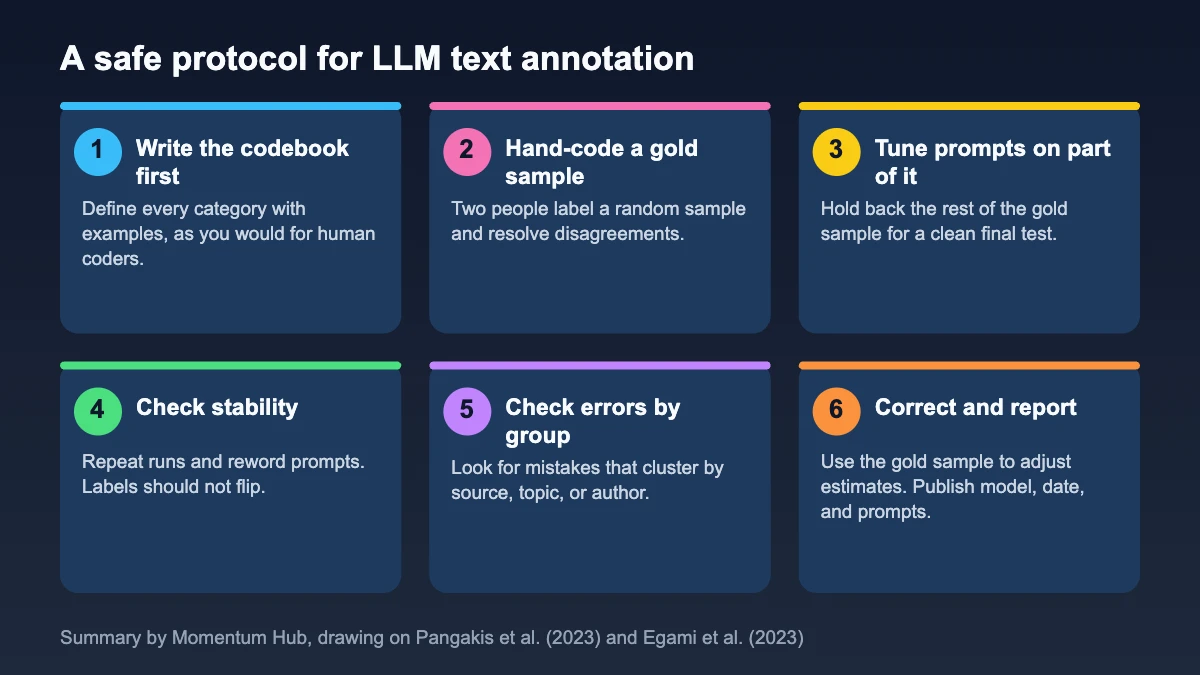
- Write a real codebook before you write a prompt. If people cannot apply your categories consistently, a model will not either.
- Build a gold sample. Have at least two people code a random sample of a few hundred items and settle disagreements.
- Split the gold sample. Tune prompts on one part and keep the rest untouched for the final test.
- Test stability with repeated runs and reworded prompts.
- Inspect errors by subgroup, source, and topic, not just overall.
- Report everything: model name and version, date, settings, full prompts, and validation scores.
One more habit helps. Use the gold sample to correct your final estimates, as Egami and colleagues recommend, so that a known error rate is built into your results and not ignored.
What This Means Outside Academia
The same logic applies if you use AI to sort customer feedback, tag support tickets, or monitor brand mentions. A model that is “pretty accurate” can still steer a decision the wrong way if its mistakes lean in one direction. A few hours of careful human checking is cheap insurance, a point that also runs through our piece on AI and decision making.
Key Terms in LLM Text Annotation
A few terms will help you read, or write, the methods section of any LLM text annotation project.
- Zero-shot and few-shot. Zero-shot means instructions only. Few-shot means the prompt also includes a handful of labeled examples.
- Temperature. A setting that controls how much randomness the model adds. Lower values give more repeatable labels.
- Gold sample. A set of items coded carefully by people and used as the reference for testing the model.
- Measurement error. The gap between a label and the truth. It becomes dangerous when it is linked to the things you are comparing.
- Prompt stability. How much labels change when the prompt is reworded without changing its meaning.
- Model pinning. Recording, and where possible fixing, the exact model version so a study can be repeated.
Good LLM text annotation reports all six. Missing details are a reason to ask questions before trusting the numbers.
Quick Questions, Answered
How big should the human-coded sample be? There is no universal number, but a few hundred items per task is a common starting point, with more for rare categories.
Which model should I use? The one that passes validation on your task, fits your privacy needs, and can be rerun later. Bigger is not automatically better.
Does this replace human coders? It changes their job. People move from labeling everything to designing categories, building gold samples, and auditing the machine.
Final Thoughts: A Fast Assistant, Not an Oracle
LLM text annotation is one of the most useful things to happen to content analysis in decades. It lets small teams ask big questions. But the research is clear that speed without checking produces confident, wrong answers. Treat the model as a fast research assistant whose work you always spot-check, and it will serve you well. For the wider toolkit this sits in, see our overview of AI and big data in communication research.