- What Just Happened: The Third Google Core Update of 2026
- Don't Panic While It Rolls Out
- AI Overviews and AI Mode: What Google Actually Says
- Query Fan-Out: Why Depth Wins
- The Basics Google Lists
- Measuring It: The New Generative AI Reports
- Controls: Choosing What AI Can Show
- Quick Questions, Answered
- Final Thoughts: Boring Wins
Another Google core update is rolling out, and AI answers keep taking up more of the results page. If your traffic chart looks jumpy this month, you are not imagining it.
Here is the calm version of what is happening, built from primary sources: Google’s Search Status Dashboard and its official guidance on AI features. The short story is that the fundamentals from our SEO strategies guide still carry most of the weight.
Key takeaways
- Google’s November 2026 core update began on November 10, the third core update of the year.
- Google says no special markup or “AI files” are needed to appear in AI Overviews or AI Mode.
- A page must be indexed and eligible for a snippet. Beyond that, standard SEO applies.
- Search Console now has dedicated generative AI reports, so you can see how often your pages appear in AI features.
What Just Happened: The Third Google Core Update of 2026
Google’s dashboard lists a core update starting November 10, 2026. It follows core updates in March and May, which each took about twelve days to finish, plus spam updates in March, June, August, and September.
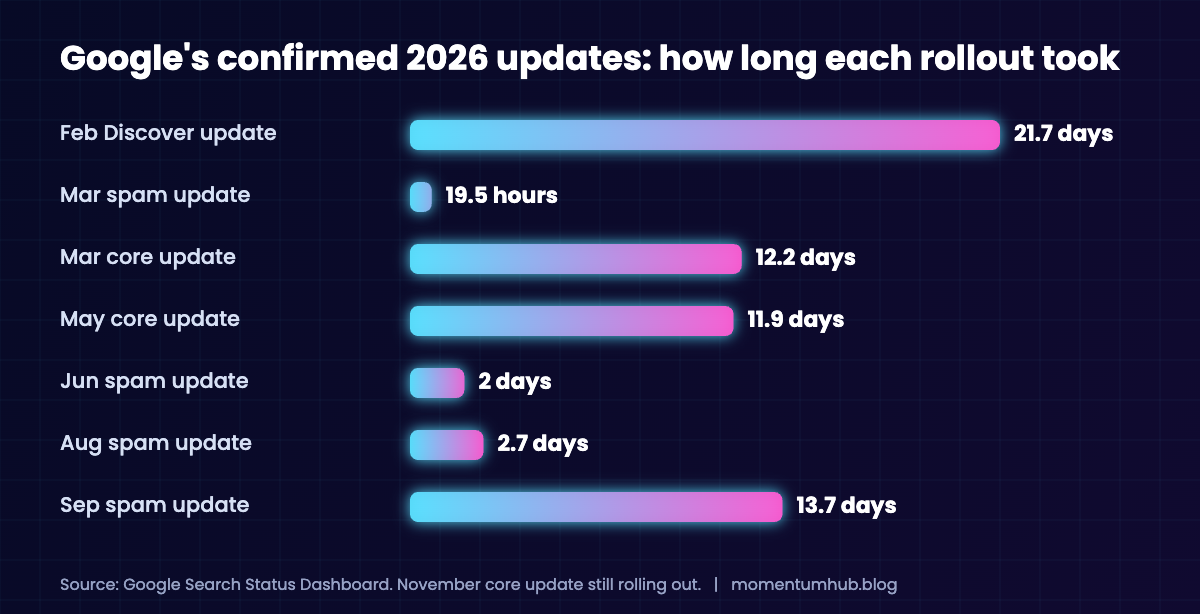
Core updates are broad changes to how Google assesses content overall. They are not penalties aimed at individual sites, which is why a drop does not always mean you did something wrong.
Don’t Panic While It Rolls Out
Rankings often swing during a rollout. The practical move is to note the start date in your analytics, wait for Google to mark the update complete, and only then compare before and after. Making big changes mid-rollout makes it impossible to tell what caused what.
AI Overviews and AI Mode: What Google Actually Says
There is a lot of noise about “optimizing for AI.” Google’s own documentation is refreshingly plain. It says there are no additional requirements and no special optimizations needed for AI Overviews or AI Mode. You do not need new machine-readable files, AI text files, or special structured data.
The requirement is simple: the page must be indexed and eligible to be shown with a snippet. That said, meeting the requirements does not guarantee a page will appear.
Query Fan-Out: Why Depth Wins
Google explains that both features may use a technique called query fan-out, running several related searches to find supporting pages. The practical effect is that a single question can pull from pages covering many sub-topics.
That rewards content that answers the follow-up questions too. Think clusters, not single keywords. It is also why exploring alternative search engines and how they surface content is time well spent.
The Basics Google Lists
Google’s guidance comes down to a familiar checklist:
- Let Googlebot crawl your pages, and check that your CDN or host is not blocking it.
- Make content easy to find through internal links.
- Provide a good page experience.
- Keep important content in text, not locked in images.
- Support text with quality images and video.
- Make sure structured data matches what is visible on the page.
Measuring It: The New Generative AI Reports
For a long time, AI visibility was blended into your overall Search Console numbers. That changed in June, when Google introduced Search Generative AI performance reports. They give dedicated views of your impressions inside generative AI features on Search, such as AI Overviews and AI Mode, and inside Discover.
Two cautions. The same impressions still count in your overall performance report, so do not add the two together. And the reports focus on visibility, so pair them with your own engagement and conversion data to judge whether that visibility is worth anything.
Controls: Choosing What AI Can Show
You have levers if you want to limit what appears. The nosnippet, data-nosnippet, and max-snippet controls restrict what Google can show in Search, including AI features, and noindex removes a page entirely. A separate control, Google-Extended, covers training and grounding in Google’s other AI systems.
Use these with care. Restricting snippets can also reduce your visibility in regular results.
Quick Questions, Answered
When did the November 2026 core update start? November 10, 2026, according to Google’s Search Status Dashboard.
Do I need special markup for AI Overviews or AI Mode? No. Google says standard SEO practices apply, and no special schema or AI files are required.
Where can I see my AI visibility? In Search Console’s generative AI performance reports, which show impressions in AI features on Search and in Discover.
Final Thoughts: Boring Wins
The most reliable playbook this month is also the least exciting. Publish helpful, well-structured pages. Keep the site fast and crawlable. Measure calmly after the update finishes.
AI is changing how results look, and AI is changing marketing in general. The path into those results still runs through solid fundamentals.