
- 1. National News: 62%, Up Six Points
- 2. Local News: 75%, Still Clearly Ahead
- 3. The Partisan Gap Narrowed Slightly, but Remains Wide
- 4. Young Adults Moved the Most on Local News
- 5. Social Media: 38%, Flat
- 6. More Trust Does Not Mean Less Suspicion of Power
- Why Might Trust in News Be Rising?
- What Communicators Should Do With This
- Quick Questions, Answered
- Final Thoughts: A Small Rise Worth Protecting
Trust in news has been falling for so long that a rise feels like a typo. Yet that is what Pew Research Center reported this month: Americans are more likely than a year ago to trust information from both national and local news organizations. The gains are modest, they cross party lines, and they leave social media exactly where it was.
For anyone who works in media, PR, or communications, the details matter more than the headline. Here are six numbers from Pew’s new analysis, published November 2, 2026, and what each one suggests.
Key takeaways
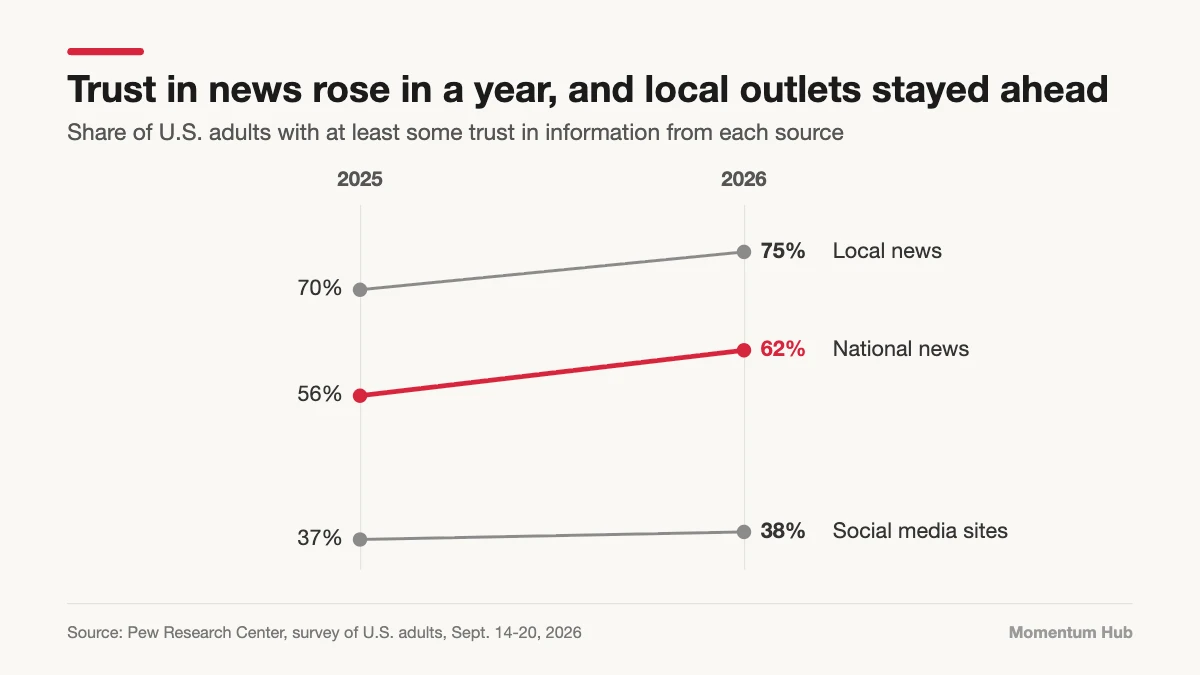
- 62% of U.S. adults now have at least some trust in national news organizations, up from 56% a year ago.
- Local news remains more trusted, at 75%, and the gap holds in both parties.
- Trust rose among Republicans and Democrats, and among young and older adults.
- Social media did not share in the rebound. Trust there is 38%, almost unchanged.
62%
Share of U.S. adults with at least some trust in information from national news organizations, up from 56% in 2025, according to Pew Research Center.
1. National News: 62%, Up Six Points
The headline figure is a six-point rise in one year. That is a real movement in a measure that usually changes slowly. It also needs context. A decade ago, in 2016, the same Pew question found 76% trusting national news organizations. The rebound recovers less than a third of what was lost.
The survey was conducted September 14 to 20, 2026, among more than 5,000 U.S. adults.
2. Local News: 75%, Still Clearly Ahead
Three-quarters of Americans have at least some trust in information from local news organizations, up from 70% last year. That 13-point lead over national news is one of the most stable findings in media research.
It is also a painful irony. Local outlets are the most trusted part of the news system and among the most financially fragile, as we explored in what is happening to local news traffic.
3. The Partisan Gap Narrowed Slightly, but Remains Wide
Trust rose in both parties. Among Republicans and Republican-leaning independents, 50% now trust national news, up six points, and 69% trust local news. Among Democrats and Democratic leaners, the figures are 73% for national news and 81% for local news, as summarized by Inside Radio.
Two things stand out. The 23-point party gap on national news is still large. And among Republicans, local news is trusted by 19 points more than national news, which makes local outlets the most credible channel for reaching that audience.
4. Young Adults Moved the Most on Local News
Among adults aged 18 to 29, trust in local news rose from 65% to 72%. Among those 65 and older, it rose from 76% to 81%. On national news, the two groups are closer than many assume: 60% of the youngest adults and 70% of the oldest express at least some trust.
The idea that young people have simply given up on news organizations does not fit these numbers. Their habits are different, a point we covered in how Gen Z consumes media, but distrust is not the whole story.
5. Social Media: 38%, Flat
Trust in information from social media sites is 38%, compared with 37% a year earlier. In other words, the rebound belongs to news organizations specifically. People did not become more trusting of everything they see.
That matters for strategy. A message that appears only on social platforms starts from a lower base of trust than the same message reported by a news outlet.
6. More Trust Does Not Mean Less Suspicion of Power
A second Pew analysis, published November 6, adds a caution. It found that 69% of Americans say social media companies have too much power and influence in politics, and more than half say the same about news organizations.
So the public can trust the information a little more while still being wary of the institution. Both things are true at once.
Why Might Trust in News Be Rising?
Pew’s analysis reports the change, not the cause, so any explanation is informed guesswork. Possible factors include a calmer news cycle than an election year, growing unease about unverified and AI-generated content elsewhere, and the continued shift toward individual journalists and creators whom people follow by choice. It is worth watching whether next year’s survey confirms the trend before building a strategy on it.
What Communicators Should Do With This
- Lead with local outlets when credibility matters, especially for audiences that distrust national media.
- Do not over-read a six-point gain. One year does not make a trend.
- Pair social posts with coverage from news organizations where you can, since the two carry different levels of trust.
- Segment by age and party. The averages hide large differences.
- Track trust among your own audience with a simple recurring question.
- Earn it directly: show sources, correct errors visibly, and explain how you know what you claim.
Quick Questions, Answered
Is trust in news back to normal? No. It is higher than last year and still well below the levels of a decade ago.
Do people trust AI more than news organizations? That is a different question. Our look at AI as a gateway to news found people using AI tools more while remaining uneasy about AI-made journalism.
Does trust mean people pay for news? Not necessarily. Trust and willingness to pay are related but separate, and many trusted outlets still struggle financially.
Final Thoughts: A Small Rise Worth Protecting
A year of rising trust in news is good news, and fragile. It was earned slowly and can be lost quickly. For communicators, the practical message is to treat credibility as the scarce resource it is, and to respect the outlets, especially local ones, that still hold it. For more coverage, visit our Media Trends section.