
- What an Agent Skill Actually Is
- From One Company's Feature to a Shared Format
- NVIDIA's SkillEvaluator: Quality Gates for Skills
- Google's Stitch Skills: Design Goes Agent-Native
- Skills Over MCP: Two Standards Start Talking
- Why This Matters If You Don't Write Code
- Try It Yourself in Five Minutes
- What to Check Before You Install a Skill
- Final Thoughts: Agent Skills Are Becoming Infrastructure
A year ago, teaching an AI agent a new trick meant pasting in a long prompt and hoping it stuck. Today you hand it a folder. That folder is called an Agent Skill, and agent skills have quietly stopped being a neat idea from one company and started looking like shared infrastructure for the whole software world.
Three projects tell the story: NVIDIA’s SkillEvaluator, which is trending on GitHub this week, Google’s design skills for Stitch, and a Model Context Protocol release that lets servers hand skills straight to agents. If you care about where AI skills are heading, this is worth ten minutes.
Let’s walk through what changed and what it means for you.
Key takeaways
- An Agent Skill is a folder of instructions that any compatible agent can load on demand.
- The format started at Anthropic and is now an open standard used across Claude Code, Codex, Gemini CLI, Cursor, and more.
- NVIDIA’s SkillEvaluator adds quality gates, so teams can test a skill before trusting it.
- Google’s Stitch Skills show the format going domain-specific, starting with design.
- Skills over MCP lets a connected service hand your agent its own instructions.
What an Agent Skill Actually Is
At its core, a skill is a folder with one required file, SKILL.md. That file carries a name, a description, and plain-language instructions for a specific task. The folder can also hold scripts, reference documents, and templates. The Agent Skills format was originally developed by Anthropic and then released as an open standard.
Here is what a minimal skill looks like:
---
name: report-formatter
description: Formats weekly status reports in our house style. Use when someone asks for a status report.
---

# Report Formatter

1. Open with a three-line summary.
2. Follow the layout in assets/template.md.
3. Flag any missing numbers instead of guessing.
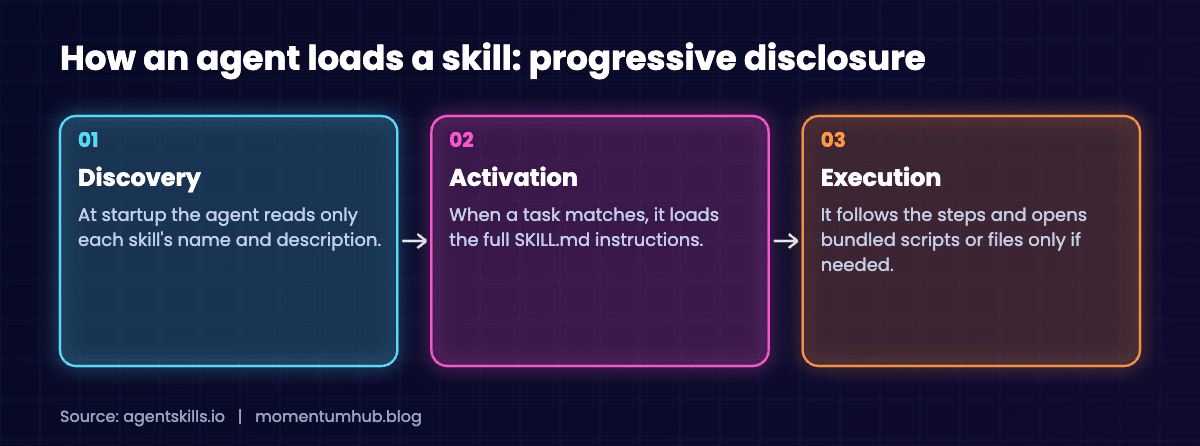
The clever part is how skills load. An agent reads only each skill’s name and description at startup. When a task matches, it pulls in the full instructions, and it opens the bundled files only if it needs them. The specification calls this progressive disclosure, and it is why an agent can keep dozens of skills on hand without crowding its context window.
From One Company’s Feature to a Shared Format
Anthropic’s public skills repository has passed 187,000 stars on GitHub, with examples that range from creative and design work to document handling and enterprise workflows.
What matters more is who else showed up. Google’s Stitch skills list Codex, Antigravity, Gemini CLI, Claude Code, Cursor, and OpenCode as compatible agents. One folder, many tools. That portability is what turns a feature into a format.
NVIDIA’s SkillEvaluator: Quality Gates for Skills
Once anyone can publish a skill, the obvious question is whether a given skill is any good. SkillEvaluator, an Apache-2.0 project from NVIDIA that has already passed 2,500 stars, tackles that in three tiers. Tier 1 validates that a skill is safe, well-formed, and compatible. Tier 2 uses embeddings to catch guidance that repeats or overlaps. Tier 3 runs an agent in a sandbox with and without the skill to see whether it actually helps.
Teams can wire those checks into CI so a weak skill never ships, the same thinking behind leak-free data pipelines. One honest caveat: NVIDIA labels the project experimental and community-supported, so treat it as a promising early tool, not a finished standard.
Google’s Stitch Skills: Design Goes Agent-Native
Skills are also getting specific. Stitch Skills from Google Labs, now past 8,700 stars, is a library built for Stitch, Google’s design platform. Its skills fall into three groups: design (generate a design, manage a design system, turn code into a design), build (React components, React Native, shadcn/ui), and utilities.
These skills need the Stitch MCP server running, which hints at the bigger pattern. The skill supplies the know-how and the server supplies the access. If you follow design programs and technologies, this is the next chapter: your design tool now ships instructions for your coding agent.
Skills Over MCP: Two Standards Start Talking
For a while, people framed skills and MCP as rivals. They answer different questions. MCP connects an agent to outside tools and data. Skills teach the agent how to do a job well.
Now the two are meeting. Version 2.4.0 of the MCP TypeScript SDK, released on October 23, added Skills over MCP. A server can publish a folder of skills, and a client can list, read, and verify them. In plain terms, the service you connect to can also hand your agent the manual for using it. Part of the API is still marked experimental, so expect changes.
Why This Matters If You Don’t Write Code
Here is the part I find most exciting. A skill is mostly plain writing. If you can explain how your team reviews a contract, formats a report, or checks a dataset, you can capture that as a skill, and any compatible agent can follow it.
That puts subject experts, not only engineers, in the author’s seat. It is the same democratizing move that low-code tools brought to data work: the people who know the process get to encode it.
Try It Yourself in Five Minutes
You do not need a big project to see how this works. Each of these commands comes straight from the project pages linked above:
- Browse Anthropic’s examples in Claude Code: run
/plugin marketplace add anthropics/skills, then install a plugin from the menu. - Add Google’s design skills: run
npx skills add google-labs-code/stitch-skills. They need the Stitch MCP server set up first. - Grade a skill you wrote: install with
pip install skillevaluator, then runskillevaluator validate ./my-skill --tiers 1for a quick check that needs no API key.
Start by reading one SKILL.md file from top to bottom. It takes two minutes, and it removes most of the mystery.
What to Check Before You Install a Skill
A little caution goes a long way. Skills can bundle executable scripts, so read what you install, especially from authors you don’t know. Anthropic notes that its own example skills are for demonstration and education. And popularity is not a quality signal, which is exactly why evaluation tools are arriving now.
A practical rule: start with skills from sources you trust, test them on low-stakes work, and keep the ones that measurably help.
Final Thoughts: Agent Skills Are Becoming Infrastructure
Folders of instructions sound humble. But a shared format, quality gates, domain-specific libraries, and a delivery channel through MCP are the same ingredients that turned packages and plugins into ecosystems.
Agents are getting easier to teach, and the teaching is getting easier to share. As AI takes on more of our decision-making, the instructions we hand it matter more than ever. So here is the real question: what expertise would you package first?