

- 1. What Computational Communication Actually Means
- 2. Where the Field Came From
- 3. The Four Families of Methods
- 4. Text as Data Is the Workhorse
- 5. What the Field Has Actually Found
- 6. AI Is Now the Subject, Not Just the Tool
- 7. The Honest Limits
- How to Use Computational Communication in Your Own Work
- Key Terms in Computational Communication
- Quick Questions, Answered
- Final Thoughts: A Field Built on Checking
Computational communication is the study of how people talk, share, and persuade, done with data, code, and AI at a scale no team of human readers could manage. Instead of hand-coding 300 news stories, a researcher can analyze three million posts, map who shares what with whom, and test ideas in online experiments with thousands of people. If you read our earlier look at AI and big data in communication, think of this guide as the bigger map.
The field is young but organized. It has a dedicated journal, launched in 2019 with a roadmap for computational communication research, and it grew out of the wider computational social science movement that a group of scholars first described in Science in 2009. Below are the seven things worth knowing before you read anything else in our Computational Communication section.
Key takeaways
- Computational communication combines communication theory with large-scale data, automated text analysis, network analysis, and online experiments.
- The methods are powerful, but only as good as their validation against careful human judgment.
- Some of the best-known findings are humbling: exposure to misinformation is more concentrated, and algorithms less all-powerful, than headlines suggest.
- AI is now both a research tool and a research subject, and that is where the field is moving fastest.
1. What Computational Communication Actually Means
A useful definition comes from Wouter van Atteveldt and Tai-Quan Peng, who described the field in 2018 through four features. The data sets are large and complex. They are usually digital traces, meaning records people leave behind as they post, click, search, and share. They need algorithms to analyze. And, most important, the goal is still to test and build communication theory.
That last point is what separates the field from general data science. A dashboard that counts mentions is analytics. A study that asks why some messages travel further than others, and then measures it across millions of cases, is computational communication.
2. Where the Field Came From
Communication researchers have counted things in texts for a century. What changed in the 2000s was the raw material. Email, blogs, search logs, and social platforms began to record human communication automatically, and the 2009 Science paper argued that this could transform social research.
Training followed. The Summer Institute in Computational Social Science, known as SICSS, started in 2017 and now runs partner sites around the world, with its teaching materials free online. The opening lecture from the 2018 institute is still one of the clearest introductions you can watch.
3. The Four Families of Methods
Almost every study in the field uses one or more of these.
- Text as data. Turning words into numbers so that themes, tone, and frames can be measured across huge collections.
- Network analysis. Mapping who follows, cites, replies to, or shares with whom, then studying the shape of those connections.
- Online experiments. Randomly assigning thousands of people to different messages, feeds, or chatbots to see what actually causes a change.
- Simulation and AI models. Building artificial agents or using language models to explore how communication might unfold.
Networks are the piece newcomers find least intuitive, so this short primer from the Stockholm Resilience Centre is worth ten minutes.
4. Text as Data Is the Workhorse
Most communication is language, so most computational communication work starts with text. The toolkit has grown in layers. First came dictionaries that count words from fixed lists. Then supervised classifiers that learn from human-labeled examples. Then topic models that discover themes without labels. Now large language models can follow a written codebook directly.
The speed of that last shift is striking. A widely cited 2023 study in PNAS found that ChatGPT beat crowd workers on several annotation tasks by about 25 percentage points on average, at a cost of less than $0.003 per label. Later work has added cautions, and the consistent advice is to check machine labels against careful human coding every time.
5. What the Field Has Actually Found
The headline results often cut against popular fears.
On misinformation, a 2024 review in Nature concluded that the average person sees little false or inflammatory content, and that exposure is concentrated among a small group who actively seek it out. On echo chambers, a Nature study of Facebook found that the median user got about half of their feed from like-minded sources, yet cutting that content by a third for three months produced no measurable change in polarization.
Some interventions do work. A 2025 PNAS study estimated that once a Community Note was attached to a post on X, reposts fell by 46.1% and likes by 44.1%. The catch is timing, since much of a post’s spread happens before any note appears.
6. AI Is Now the Subject, Not Just the Tool
The newest strand of computational communication studies AI as a communicator. Researchers are asking how persuasive chatbots are, whether AI companions help or harm lonely people, and whether AI-written text can be reliably detected.
The early answers matter for everyone who communicates for a living. One large experiment with 76,977 participants and 19 language models found that training and prompting choices raised AI persuasiveness by up to 51% and 27%, and that the more persuasive setups were also less accurate. We have covered the practical side of this shift in how AI is becoming the gateway to news and in how algorithms shape what we make sense of.
7. The Honest Limits
Three limits come up again and again.
- Data access. Platforms decide what researchers can see. Free access to Twitter data ended in 2023, and Meta closed its CrowdTangle tool in August 2024.
- Validity. A sentiment score or topic label is a measurement, and measurements can be wrong in patterned ways. Good studies show their validation.
- Reproducibility and ethics. Closed AI models change without notice, and studying people online raises real questions about consent and privacy.
None of these are reasons to distrust the field. They are reasons to read its findings the way its best researchers do, with attention to how each number was produced.
How to Use Computational Communication in Your Own Work
You do not need a research lab to borrow the habits.
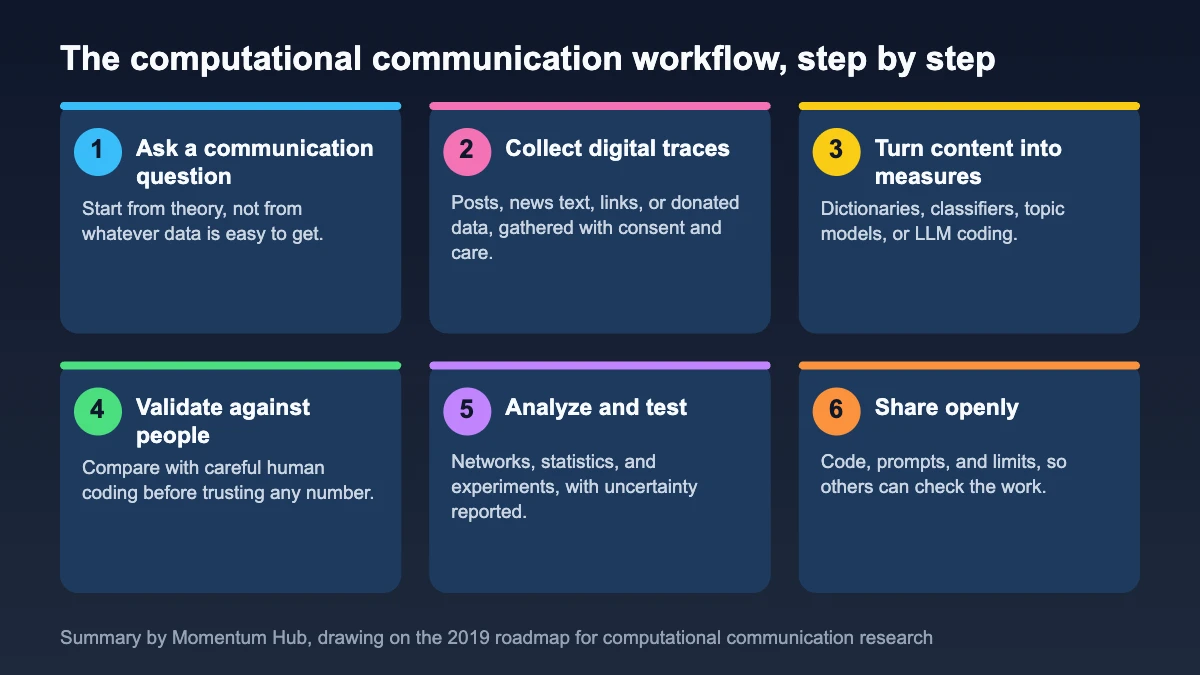
- Start with a question about people, then pick the data, not the other way around.
- When a tool gives you a score, hand-check a sample of at least 100 items before you rely on it.
- Treat one study as one data point. Look for results that hold across platforms and methods.
- Keep a record of your prompts, settings, and dates when you use AI to analyze content.
- Ask who is missing from your data. Platform users are never the whole public.
Key Terms in Computational Communication
A little vocabulary goes a long way when you read computational communication research. These six terms appear in almost every study.
- Digital trace data. Records created as a by-product of using digital services, such as posts, likes, shares, and search queries.
- Corpus. The full collection of texts selected for a study. What is left out matters as much as what is included.
- Codebook. The written rules that define each category, used by human coders and, increasingly, given to AI models as instructions.
- Intercoder reliability. How consistently different people apply the same codebook to the same material.
- Validation. Checking that a computational measure agrees with careful human judgment before drawing conclusions from it.
- Preregistration. Publishing the analysis plan before seeing results, which makes cherry-picking harder.
If a computational communication study uses these ideas openly, that is usually a good sign about the rest of the work.
Quick Questions, Answered
Is computational communication just data science with a new name? No. It uses many of the same tools, but its questions come from communication theory: who says what, to whom, through which channel, and with what effect.
Do I need to code to follow the field? Not to read it well. To do the work, basic Python or R helps a great deal, and free materials from SICSS are a good starting point.
Is it only about social media? No. Researchers also study news archives, TV transcripts, podcasts, search results, and conversations with AI systems.
Final Thoughts: A Field Built on Checking
The promise of computational communication is scale, but its real strength is the habit of checking. The strongest studies pair big data with careful human judgment and say plainly what they cannot show. That habit travels well. Whether you manage a brand, edit a newsroom, or study communication yourself, it is worth more than any single tool. For a more reflective take on why this matters, see our piece on the human side of computational communication.


