The Hugging Face trending list is the closest thing open-source AI has to a weekly chart. Two open models on it right now make a useful pair: Qwen3.8-27B, a model small enough to run on serious local hardware, and DeepSeek-V4.1-Flash, a giant built for scale.
They sit at opposite ends of the size spectrum. Here is what each offers, what the makers claim, and how to read those claims with the same care we bring to AI decision-making.
Key takeaways
- Qwen3.8-27B is an Apache-2.0 model that handles text, images, and video, with a 262,144-token context window.
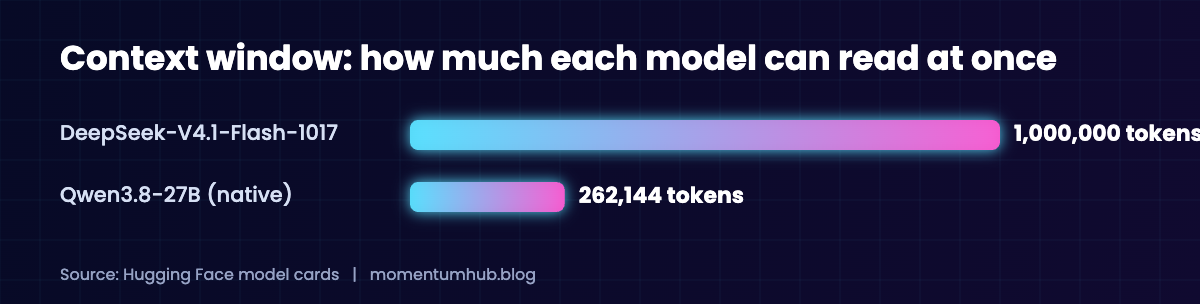
- DeepSeek-V4.1-Flash-1017 is an MIT-licensed model with 763 billion parameters and a 1 million token context window.
- Both model cards report strong coding and agentic benchmark results. These are the authors’ own numbers.
- Open licenses mean you can run, study, and adapt them, if you have the hardware.
Qwen3.8-27B: Big Capability, Manageable Size
Qwen3.8-27B is listed as an image-text-to-text model with about 27 billion parameters, released under the Apache-2.0 license. It supports a native context of 262,144 tokens and includes a thinking mode you can switch on or off.
Its popularity is striking: about 6.76 million downloads in the past month and more than 20,000 likes. The card says quantized versions exist for tools like llama.cpp, Ollama, and LM Studio, which is why hobbyists and small teams are paying attention.
DeepSeek-V4.1-Flash: Scale First
DeepSeek-V4.1-Flash-1017 is a different animal. The model card lists 763 billion parameters, an MIT license, and a context window of 1 million tokens. It is described as a minor update that improves reasoning, coding, agentic tasks, and visual benchmarks while finishing tasks faster.
This is not a laptop model. It is aimed at organizations with serious GPU infrastructure that want an open option for heavy workloads.
How to Read the Benchmarks
Both cards publish benchmark tables. Qwen reports 61.7 on SWE-bench Pro and 84.3 on OSWorld-Verified, the best scores in its own comparison table. DeepSeek reports gains over its previous version across several tests, while its own table shows a leading proprietary model scoring higher on most of them.
Two cautions apply. These are numbers reported by the model makers. And benchmarks measure narrow tasks under specific conditions. The honest test is your own workload.
Why Open Weights Matter
Permissive licenses like Apache-2.0 and MIT let you run a model on your own machines, inspect how it behaves, fine-tune it, and keep sensitive data in-house. For researchers and smaller companies, that independence is the point. It is the model-level version of the democratization we have seen in data tools.
Which One Is for You?
- Experimenting locally or on one strong GPU server: start with a quantized Qwen3.8-27B.
- Building agents that read screens or images: both accept images. Qwen’s card also lists video.
- Processing very long documents at scale: DeepSeek’s 1 million token window is the draw, if you have the infrastructure.
- Just curious: try a hosted demo before downloading tens of gigabytes.
A Note on Cost
Free to download does not mean free to run. Large models need expensive GPUs, electricity, and people who know how to operate them. For many teams, a hosted service is cheaper until usage becomes heavy or data rules require keeping everything in-house.
Run the numbers both ways before you commit. The right answer depends on your volume, your privacy needs, and your team’s skills.
Quick Questions, Answered
Are these models free to use? Both are released under permissive open-source licenses: Apache-2.0 for Qwen3.8-27B and MIT for DeepSeek-V4.1-Flash-1017. Running them still costs hardware and electricity.
Can I run Qwen3.8-27B on a laptop? Not at full precision. Quantized versions lower the requirements, but you still need a capable machine.
Are the benchmark scores independently verified? The numbers cited here come from the model cards. Look for independent evaluations before making decisions.
Final Thoughts: Two Sizes, One Trend
A compact model millions of people can download and a massive one for industrial use are trending side by side. Open models are no longer one category. They are a full range.
The skill that matters is matching the model to the job, and testing claims yourself. That is a big part of the AI skills worth building now.