


Black Friday is almost here, and inboxes are already filling with Black Friday discounts and countdown timers. Then a report landed that every marketer should read before scheduling another “limited-time offer.”
The policy group Groundwork Collaborative examined Amazon’s own Black Friday and Cyber Monday deal pages and concluded that many of the advertised deals did not save shoppers anything. Whatever you make of the group’s advocacy, the pricing lesson is universal, and it connects to everything we have said about earning attention honestly in search and beyond.
Key takeaways
- The report looked at more than 350 products from Amazon’s 2024 and 2025 deal pages.
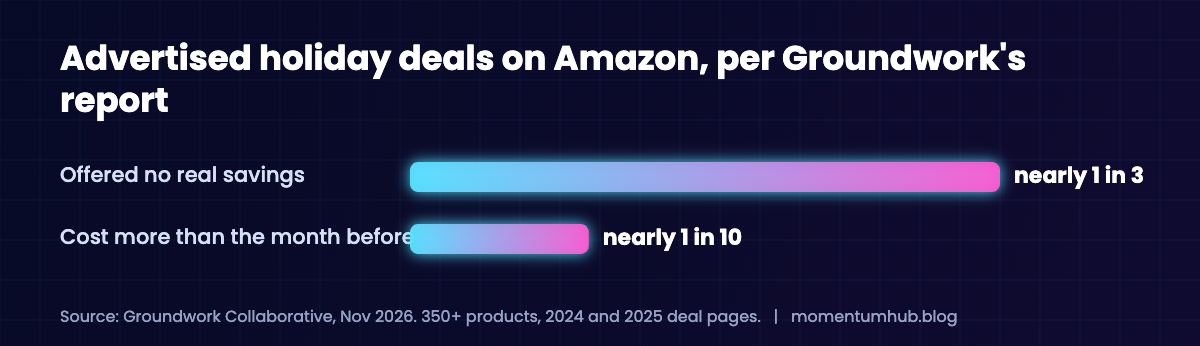
- Nearly 1 in 3 advertised deals offered no real savings compared with the prior month’s price, according to the report.
- Nearly 1 in 10 were more expensive than the month before.
- Reference prices only persuade when customers believe them.
What the Report Found
Researchers compared each sale-event price with what the product cost in the month before the sale. By their count, nearly one in three “deals” sold for the same price or less in the prior month. Nearly one in ten cost more during the sale, with a median increase of 19% among those.
The report cites specific examples, including boots priced well above what they had cost a few weeks earlier. The announcement does not include a statement from Amazon. It notes that the deal pages studied have since been removed, though archived versions remain.
Why Discounts Work on Our Brains
Discounts work through anchoring. The crossed-out price sets a reference point, and everything after feels like a gain. It is one of the most reliable effects in pricing psychology.
But anchoring borrows against trust. The moment a customer checks a price tracker and finds the “was” price was never real, the anchor flips. Now the brand is the thing being discounted.
The Trust Math
The same announcement notes that a record 203 million Americans shopped between Thanksgiving and Cyber Monday in 2025. With that many people comparing prices, and with browser extensions and AI shopping assistants doing the comparing for them, inflated reference prices are easier to catch than ever.
A fake deal might lift one day of sales. A screenshot of it can follow your brand for years.
The Regulatory Direction
The report urges regulators to require retailers to show the lowest price from the previous 30 days whenever they advertise a sale. The European Union already has a rule along those lines. Whether or not it spreads, building your promotions as if it applied is a safe bet.
An Honest Promotions Checklist
- Use a real reference price: one you actually charged for a meaningful period.
- Keep records of price history for every promoted product.
- Say what the offer is in plain words: amount off, dates, and limits.
- Skip fake urgency. If the timer resets, customers notice.
- Offer value beyond price, such as bundles, extended returns, or early access.
What to Do Instead of Deeper Discounts
The strongest brands compete on clarity. Tell people exactly what they get and why it is worth it. Use AI in your marketing design to make offers more relevant, not to obscure prices. And if you want reach without racing to the bottom, look at where your customers actually search, including the alternative search engines most marketers ignore.
How Shoppers Will Check Your Prices
Assume every offer will be checked. Price-history tools are a click away, comparison is built into many browsers, and shoppers share screenshots freely. That is not a threat if your pricing is honest. It is an advantage.
Consider showing your own price history on product pages. Transparency turns a point of suspicion into a reason to buy.
Quick Questions, Answered
Who produced the report? Groundwork Collaborative, a policy organization. It was published on November 16, 2026.
What counts as “no real savings” in the report? The product sold for the same price or less in the month before the sale event.
Is this only an Amazon issue? The report studied Amazon’s deal pages only. The lesson about reference prices applies to any retailer.
Final Thoughts: The Cheapest Thing to Lose Is Trust
Promotions are not the problem. Pretend promotions are. In a season when everyone is shouting “sale,” the brand that tells the truth stands out.
Before you publish your next offer, ask one question: would this still look like a deal if the customer saw our price history?


