


Ask a question online in 2026 and there is a good chance an AI system answers before any website does. That shift is no longer a forecast. It shows up clearly in new survey data on AI and news, along with a stubborn fact: people still do not want machines writing their news.
The Reuters Institute’s Generative AI and News Report 2026 surveyed audiences in nine countries, and one of its authors summarized the findings for Nieman Lab. The picture is nuanced, and it matters for anyone who communicates for a living. It also builds on what we covered in how AI is redefining the rules of communication.
Key takeaways
- About half of people in the countries tracked over time now use generative AI every week.
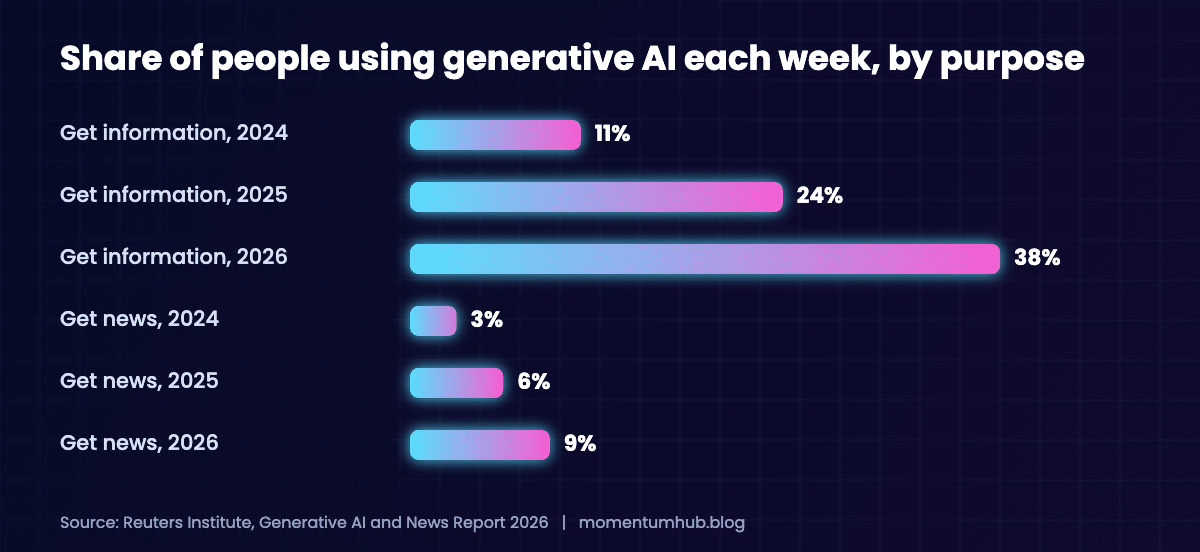
- Using AI to get information jumped to 38% weekly, up from 24% in 2025 and 11% in 2024.
- Only 9% use it for news each week, though that share has tripled since 2024.
- Just 12% are comfortable with news made entirely by AI. Human oversight raises that to only 19%.
From Standalone Tool to Information Infrastructure
The report’s subtitle says it all: AI has moved from a tool you choose to open to a layer built into everything. Weekly use of generative AI reached 51% across the six countries with earlier data, and 49% in the United States.
Usage is uneven, though. Weekly use is more common among professionals than among entry-level or service workers, and most people rely on free models, which are usually less advanced. So “everyone uses AI” hides real gaps in who uses what.
Exposure Without Choosing
You do not have to open a chatbot to meet AI. In the past week, 57% of respondents saw or used AI-generated search answers. About 24% noticed a label saying content was made with AI, and 20% saw an AI-written bullet-point summary of a news story.
This is incidental exposure, and it changes the rules. Like the feeds we discussed in algorithmic sensemaking, the system now makes the first move.
News Is Still a Small Slice
Here is the surprise. While 38% used AI to get information in the past week, for things like researching a topic, getting advice, and answering factual questions, only 9% used it for news. That is up from 6% in 2025 and 3% in 2024, so the trend is real but the base is small.
For communicators, the takeaway is that AI is becoming a research assistant first and a news source second.
Why People Use It: Convenience First
Asked why they use AI for information, people pointed to convenience (64%) and interactivity (56%). Only 21% said it gave them more reliable information than other sources.
Yet trust among users is high. Around three in four people who use AI for facts, advice, or news say they trust the answers. That gap between convenience-driven use and high trust deserves attention, especially given what we know about misinformation risks.
The Comfort Gap
Using AI to find information is one thing. Letting it write the news is another. Only 12% of respondents were comfortable with news produced entirely by AI. With some human oversight, comfort rose to just 19%, and it has barely moved since 2024. People were even less comfortable with AI writing commentary or opinion.
In other words, audiences draw a line between AI as a helper and AI as an author.
Agents Are Next, Slowly
What about AI agents that act on your behalf? Two thirds of respondents (67%) had not used one in the past week. About 14% had used an agent for a real task, and 13% had tried one as an experiment. It is early, but worth watching, because agents will make even more choices before a human sees anything.
What Communicators Should Do Now
Four practical moves stand out.
- Label clearly. A quarter of people already notice AI labels. Make yours plain and specific.
- Keep humans visible. Bylines, sources, and editors’ notes signal accountability.
- Write for answer engines. Clear structure and direct answers help both readers and AI systems represent you accurately.
- Earn the click. Offer depth, voice, and original reporting that a summary cannot replace.
If your work touches computational communication, these numbers are a baseline worth saving.
Quick Questions, Answered
How many people use AI to get news? About 9% each week in the countries tracked over time, up from 6% in 2025 and 3% in 2024.
Do people trust AI answers? Among those who use AI for information, roughly three in four say they trust it. Many people overall hold no clear view either way.
Are audiences comfortable with AI-written news? Mostly not. Only 12% are comfortable with news made entirely by AI, and 19% when there is some human oversight.
Final Thoughts: A Gateway, Not an Author
AI is becoming the front door to information. But walking through a door is different from trusting whoever built it to tell you the story.
For now, audiences want AI to help them find and understand, and humans to stand behind the news itself. The communicators who respect that distinction will keep their audience’s trust.


