
We talk a lot about what AI can do. A better question is what working with AI actually looks like once the novelty wears off. Do they hand over the thinking, or keep it?
Microsoft’s 2026 Work Trend Index offers one of the larger looks so far: a survey of 20,000 knowledge workers who use AI at work across 10 markets, plus anonymized usage data. The findings say a lot about human-AI communication, a theme we have followed since AI began redefining the rules of communication.
Key takeaways
- 86% of AI users treat AI output as a starting point and stay responsible for the thinking.
- Nearly half of analyzed Copilot chats supported cognitive work, more than any other category.
- The most valued human skills are quality control of AI output and critical thinking.
- Only 26% say their leadership is clearly aligned on AI.
A Conversation, Not a Vending Machine
The headline number is reassuring. 86% of AI users say they treat AI output as a starting point and remain responsible for the thinking. Two thirds (66%) say AI lets them spend more time on high-value work, and 58% say they now produce work they could not have a year ago.
That is a picture of collaboration. People are not pressing a button and walking away. They are going back and forth. One caveat: this is research from a company that sells AI tools, and it surveyed people who already use AI.
What People Ask AI to Do
Microsoft analyzed 105,000 Copilot chat samples from one week in February 2026. About 49% supported cognitive work, 19% involved working with people, 17% were about producing work, and 15% were about finding information.
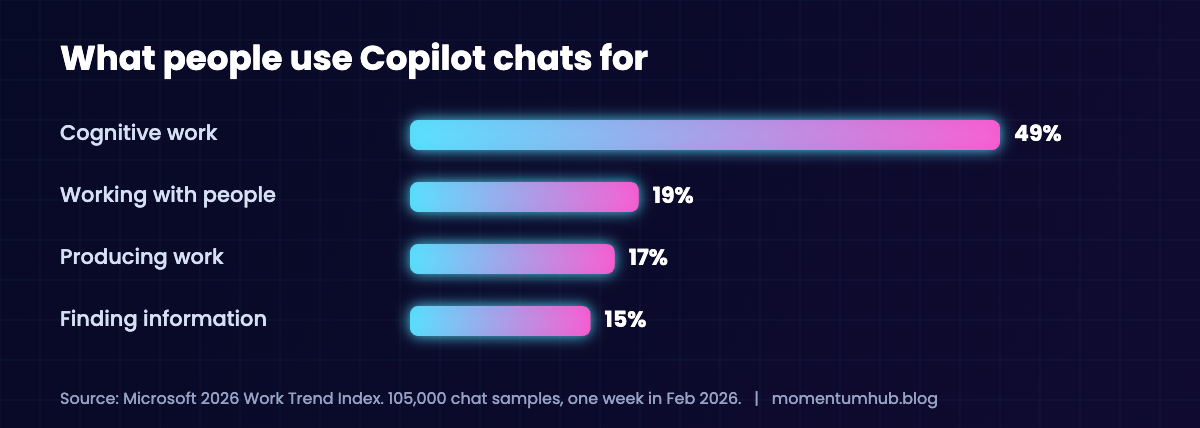
Notice what is on top. The most common use is thinking support, not search. That changes what “good prompting” means. It is less about magic keywords and more about explaining your problem clearly, which is a communication skill.
The Human Skills That Rise to the Top
Asked which human skills matter most in an AI-heavy job, respondents chose quality control of AI output (50%) and critical thinking (46%). In other words, the valuable person is the one who can tell when the answer is wrong.
This echoes what we wrote about AI and decision-making: the tool proposes, the human decides.
Protecting Your Own Thinking
The report identifies a group it calls Frontier Professionals, about 16% of those surveyed, who use agents for multi-step work and regularly redesign how they work. Interestingly, they are also more protective of their skills. 43% keep some work deliberately AI-free, compared with 30% of others, and 53% decide on purpose what AI should do versus what humans should do.
The heaviest users are the most intentional ones. That is worth copying.
The Alignment Gap
Not everything is rosy. Only 26% of AI users say leadership is clearly and consistently aligned on AI. Meanwhile 65% fear falling behind if they do not adapt quickly, and 45% say it feels safer to focus on current goals than to redesign their work.
Mixed messages from the top plus pressure from below is a communication problem before it is a technology problem.
Three Habits for Better Human-AI Communication
- Brief it like a colleague. State the goal, the audience, and what good looks like.
- Review like an editor. Check facts, numbers, and tone before anything leaves your hands.
- Keep an AI-free zone. Choose one kind of work you do unaided to keep your own skills sharp.
What This Means for Communicators
If you write, teach, or manage for a living, this data carries a practical message. Your audience is already using AI to think through what you send them. Clear structure, explicit reasoning, and well-labeled sources make your work easier for both people and their AI tools to use well.
It also raises the bar for you. When a first draft is one prompt away, the value you add is judgment: knowing what to ask, what to keep, and what to throw out.
Quick Questions, Answered
Who was surveyed? 20,000 knowledge workers who use AI at work, across 10 markets, surveyed in early 2026.
Do people treat AI output as final? Mostly no. 86% say they treat it as a starting point.
What is a Frontier Professional? The report’s term for people who use agents for multi-step work and routinely redesign their workflows. They made up about 16% of AI users surveyed.
Final Thoughts: Stay in the Conversation
The most encouraging signal in this data is that people are staying in the loop. They are using AI to think with, not to think for them.
Keep it that way. Ask better questions, check the answers, and protect the skills that make you worth listening to. Our piece on computational communication explores where this is heading.