- The Manager Effect, in Numbers
- Why Psychological Safety Matters More With AI
- The Perception Gap Between Leaders and Teams
- It Is the Organization, Not Just the Individual
- What the Best Teams Do Differently
- Five Things to Say This Week
- A Simple Team Ritual to Try
- Quick Questions, Answered
- Final Thoughts: Culture Is a Conversation
Your team’s results with AI may depend less on the tool than on what you, the manager, say and do about it. That is the striking message in recent workplace research, and it puts communication, and psychological safety in particular, at the center of AI adoption.
The numbers come from Microsoft’s 2026 Work Trend Index, which includes a separate study of 1,800 workers on manager behavior. Here is what it found, and how to apply it using skills we have covered in transformational leadership.
Key takeaways
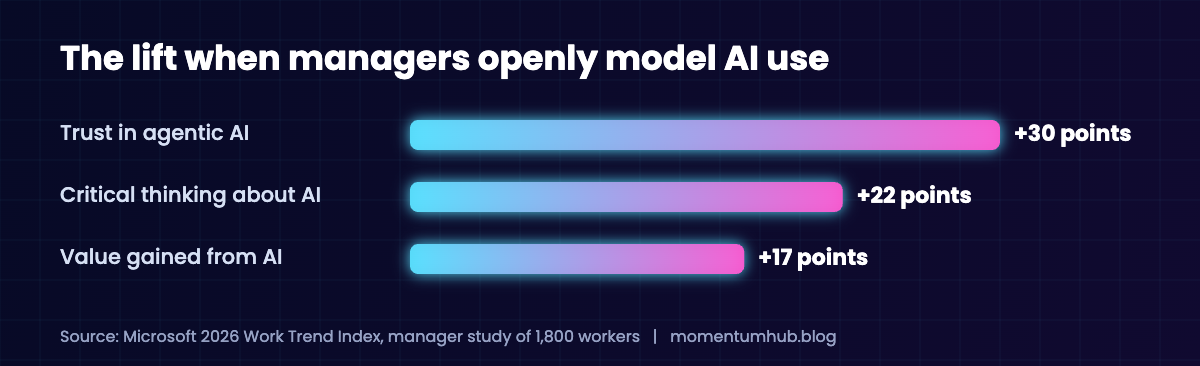
- When managers openly model AI use, trust in agentic AI rises by 30 points.
- Psychological safety around experimentation is linked to up to 20 points higher AI readiness and value.
- Leaders feel safer suggesting new ways of working than employees do: 81% versus 67%.
- Organizational factors account for about two thirds of measured AI impact.
The Manager Effect, in Numbers
In the manager study, teams whose managers modeled AI use showed a 17-point lift in the value they got from AI, a 22-point lift in critical thinking about AI, and a 30-point lift in trust in agentic AI.
Showing your work matters. When a manager says “here is how I used AI on this, and here is what I had to fix,” it gives everyone permission to do the same.
Why Psychological Safety Matters More With AI
Psychological safety is the shared belief that you can speak up, ask questions, or admit mistakes without being punished. With AI, mistakes are part of learning. The research links safety around experimentation with up to 20 points higher readiness and value, and people in those environments were 1.4 times more likely to be frequent users of agentic AI.
The Perception Gap Between Leaders and Teams
Leaders and employees see the same workplace differently. 81% of leaders feel safe suggesting new AI ways of working, compared with 67% of employees. 78% of leaders say managers make room for experimentation. Only 59% of employees agree.
And when experiments fail? Just 13% of AI users say they are rewarded for AI-driven reinvention even when results fall short. If only successes are celebrated, people stop trying risky things.
It Is the Organization, Not Just the Individual
The report estimates that organizational factors such as culture, manager support, and talent practices account for 67% of measured AI impact, compared with 32% for individual mindset and behavior. The authors note this is an association, not proof of cause.
Still, it is a useful corrective. Telling individuals to “upskill” is not enough if the environment punishes experiments.
What the Best Teams Do Differently
Teams in the report’s most advanced group share habits that are all about talking:
- They brainstorm how to redesign processes for AI (63% versus 32% elsewhere).
- They share AI tips and mistakes openly (61% versus 36%).
- They discuss quality standards for AI output (54% versus 29%).
Five Things to Say This Week
- “Here is where I used AI on this, and here is what I changed.”
- “What did you try that did not work? I want to hear it.”
- “What is our quality bar before AI-assisted work goes out?”
- “Which part of this process should stay human?”
- “Let’s write down what worked so the next team can reuse it.”
These lines combine active listening with clear standards, and they pair well with our guide to mastering feedback.
A Simple Team Ritual to Try
Borrow a habit from teams that learn fast: a ten-minute “AI show and tell” at the end of a weekly meeting. One person shares something that worked, another shares something that failed, and the group agrees on one thing to standardize.
It costs almost nothing, and it does three jobs at once. It normalizes experimenting, it spreads useful techniques, and it builds a shared quality bar without a policy document.
Quick Questions, Answered
What is psychological safety? The shared belief that it is safe to speak up, ask questions, and admit mistakes at work.
Does manager behavior really change AI results? In this research, teams whose managers modeled AI use reported clearly higher value, critical thinking, and trust. It is survey data, so treat it as a strong signal, not proof.
Where should a manager start? Share one honest example of your own AI use, including what went wrong.
Final Thoughts: Culture Is a Conversation
AI adoption looks like a technology project. Underneath, it is thousands of small conversations about what is allowed, what is expected, and what happens when something fails.
Managers set the tone for those conversations. Start one today.