
- 1. GPT-6.2 Is Two Models With Two Jobs
- 2. Who Can Use GPT-6.2 Today
- 3. Prices Fell, Especially Per Task
- 4. The Coding Claims Come From the Vendors
- 5. Independent Tests Are More Mixed
- 6. Hallucinations Have Not Gone Away
- 7. Two Safety Flags Worth Knowing
- What to Do With GPT-6.2 This Week
- Quick Questions, Answered
- Final Thoughts: Cheaper Matters More Than Smarter
GPT-6.2 arrived on November 17, 2026, and it comes as a pair. GPT-6.2 Astra is OpenAI’s new flagship for hard, long projects. GPT-6.2 Sol is the cheaper model for everyday and agent-style work. The launch topped tech news for a day, but the useful question is simpler: what actually changes for people who write, analyze, and build with these tools?
The short answer is price and coding, with real caveats on accuracy. This guide pulls together OpenAI’s announcement, GitHub’s rollout notes, and the first independent tests. If you are still finding your footing with these tools, start with how people actually work with AI.
Key takeaways
- GPT-6.2 comes in two versions: Astra for the hardest work and Sol for daily tasks at a quarter of the price.
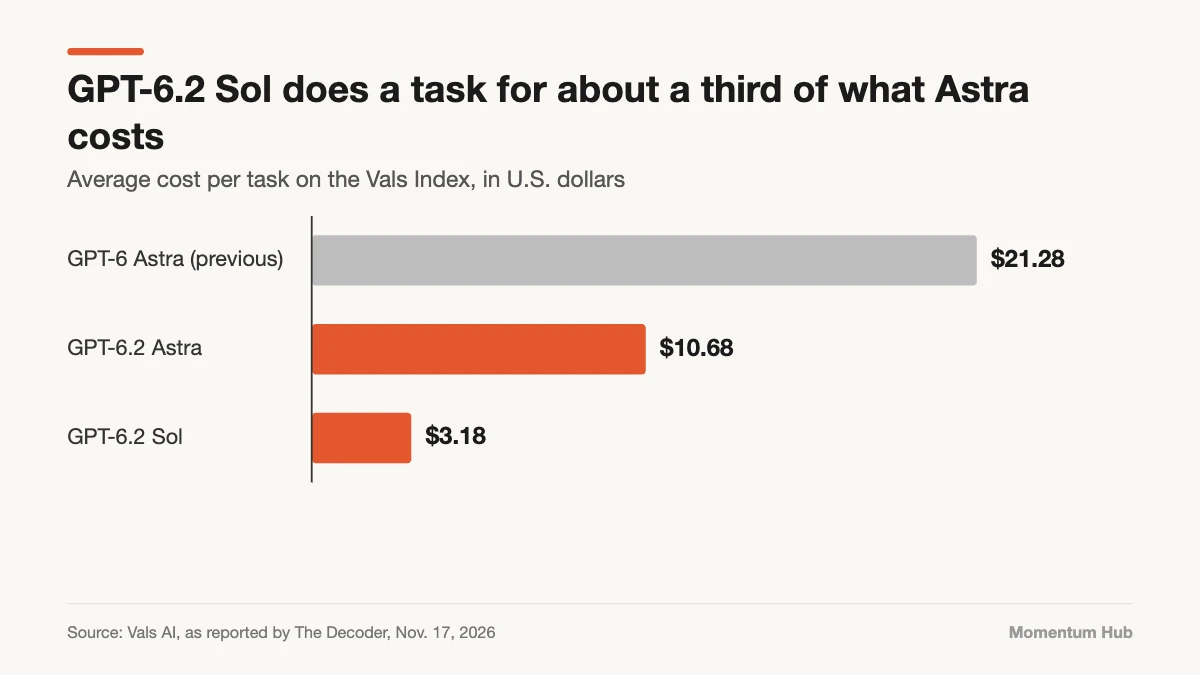
- Prices dropped. Independent testers measured Sol at roughly a third of Astra’s cost per task.
- Coding gains are OpenAI’s and GitHub’s own claims. Outside benchmarks call coding progress flat.
- Accuracy still needs human checking, and both models carry new safety flags.
$3.18
Average cost per task for GPT-6.2 Sol on the Vals Index, against $10.68 for Astra and $21.28 for the older GPT-6 Astra, as reported by The Decoder.
1. GPT-6.2 Is Two Models With Two Jobs
OpenAI describes Astra as the flagship for hard projects and Sol as the efficient model for everyday and agentic work. In practice, that means Astra for long research, complex analysis, and difficult code, and Sol for drafting, summarizing, and routine automation.
The split matters because most work is routine. If the cheaper model handles 80% of your tasks well, the expensive one becomes a specialist you call in, not a default.
2. Who Can Use GPT-6.2 Today
Both models are available in ChatGPT Work and Codex for Plus, Pro, Enterprise, and Edu users, and in the API as gpt-6.2-astra and gpt-6.2-sol. OpenAI says they were not added to regular Chat at launch, and availability depends on plan and rollout progress.
GitHub added both models to Copilot the same day for Pro+, Max, Business, and Enterprise plans, also as a gradual rollout. If you do not see them yet, that is expected.
3. Prices Fell, Especially Per Task
API prices are $8 per million input tokens and $40 per million output tokens for Astra, and $2 and $10 for Sol. The Decoder reports that Astra is 20% cheaper than its predecessor, while Sol keeps the same price as GPT-6.1 Sol.
Token prices only tell part of the story. What you pay depends on how many tokens a model uses to finish a job. On that measure, the testing firm Vals AI found Sol at $3.18 per task and Astra at $10.68, compared with $21.28 for the previous GPT-6 Astra.
4. The Coding Claims Come From the Vendors
OpenAI says that on its FrontierCode 2.0 benchmark, Sol nearly matches Astra at about one-fifth the cost. GitHub’s changelog adds that, in early testing, Sol “caught nearly twice as many real issues in code review as GPT-6.1 Sol.”
Those are encouraging, and they are also company claims. Treat them as a reason to test, not as settled fact.
5. Independent Tests Are More Mixed
Outside evaluators give a cooler picture. According to The Decoder’s roundup, the Artificial Analysis Intelligence Index puts Claude Fable 5.2 first at 65, with Astra second at 62 and Sol at 57. The same firm describes coding progress as flat, and Sol actually scored 3 points lower than GPT-6.1 Sol on its coding measure.
Epoch AI found Astra tied with Fable 5.2 on its capabilities index but behind on real-world research tasks. Vals AI rated legal performance as weak. The fair summary: a strong price cut, and a modest step in ability.
6. Hallucinations Have Not Gone Away
On Artificial Analysis’s hardest factual test, Astra gave wrong answers 59% of the time at maximum effort and Sol 55%. The firm notes these questions are unusually difficult, so everyday error rates will be lower. Still, it is a reminder that fluent is not the same as correct.
Testers also noted that the new models more often failed to flag obstacles, such as a missing file or an unavailable tool. For anyone delegating multi-step work, that is the behavior to watch.
7. Two Safety Flags Worth Knowing
Both models reached the “Critical” cybersecurity threshold in OpenAI’s own risk framework, so they ship with tighter safeguards that the company admits will also limit some legitimate security research. OpenAI also says Astra is the first model it has released publicly that reaches its “High” threshold for AI self-improvement.
For most users this changes nothing day to day. It does explain why some security-related requests may now be refused.
What to Do With GPT-6.2 This Week
- Make Sol your default for drafting and summarizing, and compare the results with what you use now.
- Save Astra for work where a better answer is worth several times the price.
- Rerun your five most important prompts. New models change behavior in small ways.
- Measure cost per finished task, not cost per token.
- Keep a human fact-check on anything that leaves the building.
- If you rely on agents, add a step that confirms each task was actually completed.
Open models remain a serious alternative for cost and privacy, as we covered in our guide to open models. And if you are building repeatable workflows, agent skills matter more than which model sits underneath.
Quick Questions, Answered
Is GPT-6.2 the best model available? It depends on the task. Independent indexes place Astra close to the top but not first, and it leads on cost for its level.
Should I pay for Astra? Only if your hardest work clearly benefits. For most writing and analysis, Sol is the sensible starting point.
Can I trust the benchmarks? Trust the pattern, not the single number. Vendor and independent results disagree in places, so test on your own work.
Final Thoughts: Cheaper Matters More Than Smarter
The headline feature of GPT-6.2 is not a leap in intelligence. It is that capable AI keeps getting cheaper to run, which changes what is worth automating. The right response is practical: try the cheaper model first, check the results, and spend more only where it pays. You can find more coverage like this in our AI section.