
- 1. What Algorithm Responsiveness Means
- 2. How the Study Worked
- 3. Many Cues Make a Post Feel Personal
- 4. Only Personalization Predicted Algorithm Responsiveness
- 5. Feeling Understood Went With Feeling Connected
- 6. Why the Method Matters
- Limits to Keep in Mind
- The Bigger Picture: Perception Is Half the Story
- Quick Questions, Answered
- Final Thoughts: The Feed You Feel
Algorithm responsiveness is the feeling that your feed understands you. Most of us have had it: a post appears that fits your mood or interests so well that the app seems to be listening. A new open-access study in Social Media + Society asks where that feeling comes from and what it does to us.
The paper, by Samuel Hardman Taylor and David M. Markowitz, appeared online on October 25, 2026. It is worth reading for its findings and for its method, which pairs a diary study with automated analysis of real posts. That mix sits at the heart of computational communication.
Key takeaways
- Perceived algorithm responsiveness, or PAR, is how much you feel a feed understands and responds to you.
- The study combined a 7-day, twice-daily diary with data on 10,337 tweets people actually saw.
- Several message features shaped whether a tweet felt personalized, but only that sense of personalization predicted PAR.
- Higher PAR went with feeling more connected to other people on the platform.
10,337
Tweets analyzed alongside a week of twice-daily diary surveys in the study of perceived algorithm responsiveness (Taylor and Markowitz, 2026).
1. What Algorithm Responsiveness Means
The idea borrows from research on relationships. We feel close to people who seem to understand us, value us, and respond to what we need. Perceived algorithm responsiveness applies that idea to a feed.
It is not about what the code does. It is about what you believe the system is doing for you. Two people can see similar feeds and feel very differently about them.
2. How the Study Worked
For a week, participants answered a short survey twice a day about what they had just seen on Twitter, now X. The researchers linked those answers to digital traces of the tweets in the algorithmic feed.
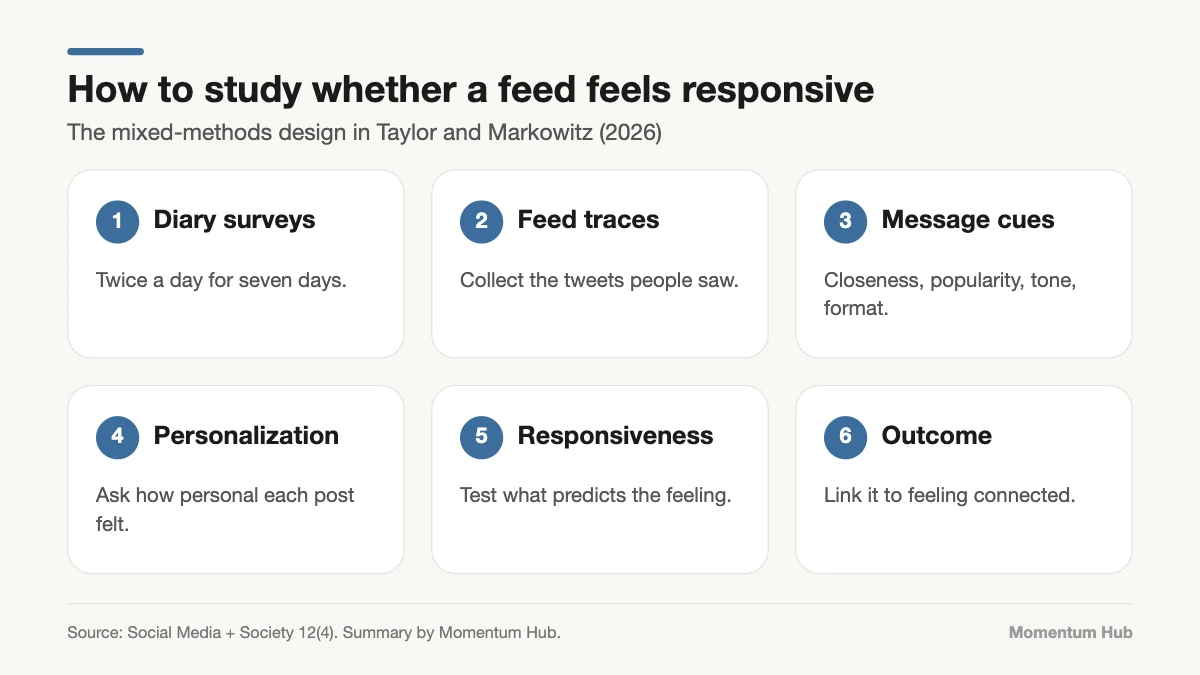
They then described each tweet with four cues: how close the participant felt to the poster, how popular the tweet was, its emotional tone, and its format. This is a clear case of treating text as data while keeping people’s own perceptions in the loop.
3. Many Cues Make a Post Feel Personal
All four cues were associated with whether a tweet felt personalized. A post from someone you feel close to reads differently from a viral post by a stranger, even when both land in the same feed.
In other words, personalization is not one thing. It is a judgment people make from several signals at once.
4. Only Personalization Predicted Algorithm Responsiveness
Here is the central result. Closeness, popularity, tone, and format shaped the sense of personalization, but perceived personalization was the only message characteristic associated with PAR itself.
Put simply, people decide a feed gets them when individual posts feel chosen for them. Popular or upbeat content does not earn that feeling alone.
5. Feeling Understood Went With Feeling Connected
PAR also predicted an outcome: feeling more connected to others on the platform. Two message-level factors pointed the same way, closeness to the poster and message personalization.
That helps explain why feeds can feel socially rewarding even when we mostly scroll. It also links to our piece on AI companions, where the sense of being understood by a system is the whole product.
6. Why the Method Matters
Surveys alone tell you what people think they saw. Platform data alone tells you what was shown, not how it felt. Joining the two answers questions neither can answer alone.
If you want to try a small version of this design:
- Pick one platform and one feeling to track, such as how relevant the feed felt.
- Ask the same two or three questions at set times each day for a week.
- Save or log the posts seen in each session, with consent.
- Code simple features of each post, by hand or with a method like topic modeling.
- Compare sessions within the same person before comparing across people.
Limits to Keep in Mind
- The data come from Twitter, now X, and feeds have changed since the study.
- The abstract reports the number of tweets, not the number of participants, so check the full paper before citing a sample size.
- The results are associations. A diary study cannot prove that personalization causes connection.
- Trace data like this is harder to get now, as we explain in social media data access.
The Bigger Picture: Perception Is Half the Story
Most public debate about feeds focuses on what algorithms do to us. This study adds the other half: what we believe they are doing, and how that belief shapes our experience.
For designers, the lesson is that a feed can be accurate and still feel indifferent. For users, algorithm responsiveness is a perception worth examining, not a fact about the software.
Quick Questions, Answered
What is perceived algorithm responsiveness? It is the sense that a feed understands you and responds to your needs and interests.
Did the study measure the algorithm itself? No. It measured the posts people saw and how people perceived them.
Is high algorithm responsiveness good for you? The study links it to feeling connected. It does not test long-term effects on wellbeing.
Final Thoughts: The Feed You Feel
Algorithm responsiveness is a reminder that the experience of a platform lives partly in our heads. The posts matter, and so does the story we tell ourselves about why we are seeing them. Next time a feed seems to read your mind, ask which cue did the work.