- Where the Idea of Echo Chambers Came From
- 1. Like-Minded Content Is Common, but Far From Total
- 2. Reducing Like-Minded Content Did Not Reduce Polarization
- 3. Turning Off the Algorithm Changed Behavior, Not Beliefs
- 4. Choice Often Matters More Than Ranking
- 5. The Sharpest Divide Is Asymmetric
- Why These Studies Are Still Debated
- What Echo Chambers Research Means for Communicators
- Key Terms in the Echo Chambers Debate
- Quick Questions, Answered
- Final Thoughts: A Less Tidy, More Useful Picture
Echo chambers are one of the most familiar ideas about life online: we are each sealed inside a feed that tells us what we already believe, and that is why politics feels so divided. It is a powerful story. It is also one that computational communication researchers have now tested with some of the largest experiments ever run on social media, and the results are more complicated than the story.
The short version is that echo chambers exist, but they are leakier than feared, and changing what feeds show people has had much less effect on their views than almost anyone predicted. This guide, part of our Computational Communication section, walks through five findings and the debates around them.
Key takeaways
- On Facebook, the median US adult got about half of their content from like-minded sources, not all of it.
- Cutting like-minded content by a third for three months did not measurably change polarization.
- Replacing the ranking algorithm with a chronological feed changed what people saw and how long they stayed, but not their attitudes.
- These studies have real limits, including their dependence on Meta’s cooperation.
Where the Idea of Echo Chambers Came From
Two books shaped the debate. Legal scholar Cass Sunstein warned in 2001 that the internet would let people sort themselves into like-minded groups. A decade later, Eli Pariser popularized the “filter bubble,” the idea that personalization algorithms do the sorting for us, invisibly.
The two terms are often used interchangeably, but they describe different things. An echo chamber is about who you choose to connect with. A filter bubble is about what an algorithm chooses to show you. Separating choice from ranking turns out to be the heart of the research, as media scholar Axel Bruns argued in his 2019 book asking whether filter bubbles are real at all.
1. Like-Minded Content Is Common, but Far From Total
The best data comes from a collaboration between academic researchers and Meta around the 2020 US election. In a study published in Nature, Brendan Nyhan and colleagues measured what US adults actually saw on Facebook.
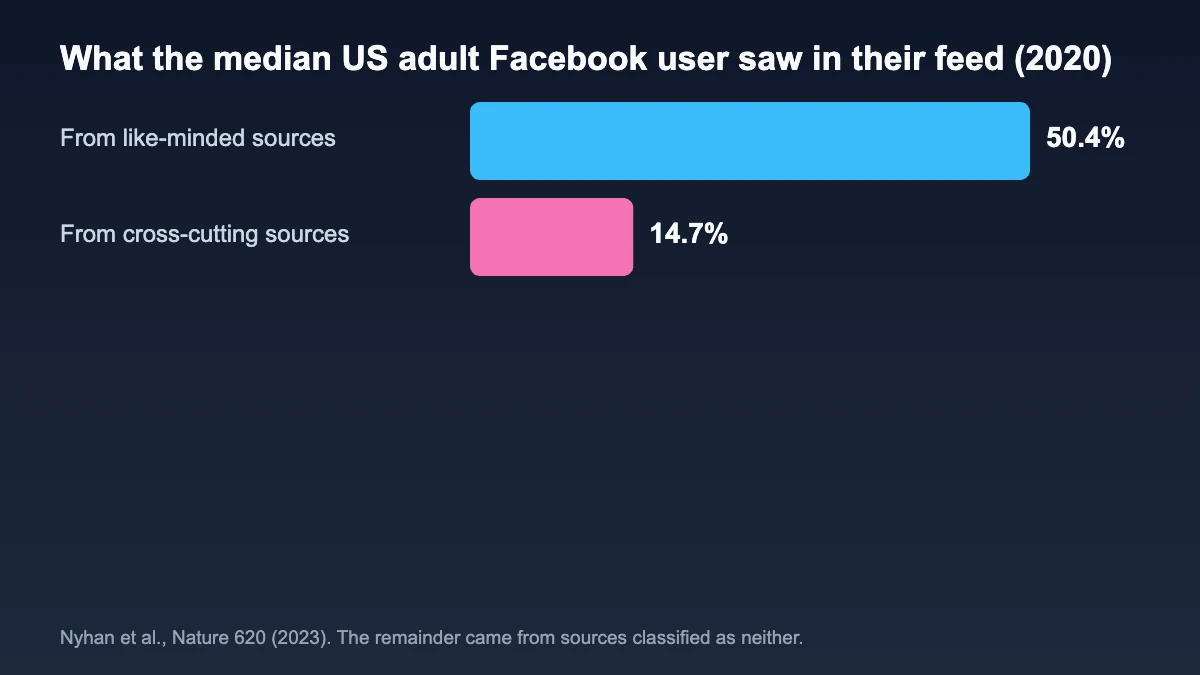
The median user received 50.4% of their content from like-minded sources and 14.7% from sources on the other side. The rest came from friends, pages, and groups that were neither. That is a clear tilt, and it is nothing like a sealed chamber.
In this talk, Nyhan discusses what the evidence shows about selective exposure online.
2. Reducing Like-Minded Content Did Not Reduce Polarization
The same team then ran an experiment. For 23,377 consenting users, they reduced exposure to content from like-minded sources by about a third, from late September to late December 2020.
People in the experiment saw more content from other viewpoints and less uncivil language. But the intervention had, in the authors’ words, “no measurable effects on eight preregistered attitudinal measures,” including how warmly people felt toward the other party. Three months of a noticeably more balanced feed did not move the needle.
3. Turning Off the Algorithm Changed Behavior, Not Beliefs
A companion study in Science tested the filter bubble idea directly. Some Facebook and Instagram users were switched from the usual ranked feed to a simple chronological one for three months.
The switch mattered for behavior. People on the chronological feed spent substantially less time on the platforms and engaged less. What they saw also changed, including more political content and, on Facebook, more content from untrustworthy sources. Yet their levels of polarization, political knowledge, and other key attitudes did not shift significantly. The algorithm strongly shapes experience. Over three months, it did not appear to shape opinion.
4. Choice Often Matters More Than Ranking
This echoes an earlier result. In 2015, Facebook researchers reported in Science that, among about 10 million US users, people’s own choices about what to click limited their exposure to opposing views more than the feed’s ranking did.
That study was criticized at the time because its authors worked for Facebook. But the broad point has held up across independent work: who we follow and what we choose to open explain a lot of the tilt in our information diets. Algorithms amplify preferences. They do not create them from nothing.
5. The Sharpest Divide Is Asymmetric
None of this means the information environment is healthy. A third 2020 study, also in Science, examined news consumption among 208 million US Facebook users. It found high ideological segregation in political news, and an important asymmetry: a substantial part of the news ecosystem was consumed almost entirely by conservative audiences, and most of the stories rated false by Meta’s third-party fact-checkers sat in that part.
So the picture is not “everyone is in a bubble.” It is closer to “most people have mixed diets, while one segment of the audience lives in a far more separate space.”
Why These Studies Are Still Debated
Good research invites criticism, and these studies have received plenty.
- They depended on Meta. The project’s independent observer described the arrangement as “independence by permission.”
- They cover three months around one election in one country. Slow effects over years would not show up.
- Critics have argued that temporary changes Meta made to its feed around the election may limit how far the chronological feed result generalizes.
- They tested changes for individuals, not for everyone at once. Changing a whole platform could work differently.
A fair reading is that the studies rule out the simplest version of the echo chambers story. They do not prove that feeds are harmless.
What Echo Chambers Research Means for Communicators
- Do not assume your audience never sees the other side. Many do, and they may simply not be persuaded by it.
- Reaching across divides takes more than exposure. Trust in the messenger matters more than the presence of the message.
- Expect format and platform design to shape attention and time spent, even when they do not change opinions.
- Watch the highly engaged minority. That is where separation is strongest and where rumors are most likely to take hold.
- Be wary of blaming “the algorithm” for communication problems that are really about relevance or credibility.
We explored how people now make sense of algorithmically curated information in algorithmic sensemaking, and how younger audiences build their own media diets in creator-led media and Gen Z.
Key Terms in the Echo Chambers Debate
Arguments about echo chambers often go in circles because people use the same words differently. These definitions help.
- Echo chamber. A social environment where people mostly hear views similar to their own, largely through their own choices of who to follow.
- Filter bubble. The narrowing of what a person sees that results from algorithmic personalization.
- Selective exposure. The tendency to choose information that fits existing beliefs.
- Cross-cutting content. Material from sources on the other side of a political divide.
- Affective polarization. Growing dislike and distrust of the other side, as distinct from disagreement on policy.
- Chronological feed. A feed that shows posts in time order instead of ranking them by predicted interest.
When someone claims that echo chambers are getting worse, it is worth asking which of these they mean. The evidence differs for each.
Quick Questions, Answered
So are echo chambers a myth? No. Like-minded content is the largest share of many people’s feeds, and some audiences are highly separated. What the evidence challenges is the claim that most people are sealed in.
Do algorithms cause polarization? The best experiments so far did not find that changing the feed for three months changed polarization. Longer-term and society-wide effects remain open questions.
Would a chronological feed fix things? It would change what people see and reduce time spent. On current evidence, it would not make people less divided.
Final Thoughts: A Less Tidy, More Useful Picture
The research on echo chambers replaces a tidy villain with a messier truth. Our feeds lean toward what we already like, largely because of choices we make, and adjusting them is not a quick route to a less divided public. That is less satisfying than blaming an algorithm, and more useful. It points attention toward trust, relevance, and the small groups where separation is real. As AI systems become a new layer between people and information, a shift we covered in AI as the new gateway to news, these questions will need asking all over again.