
- Rule 1: Treat Generative Engine Optimization as SEO
- Rule 2: Publish What Others Cannot
- Rule 3: Keep the Technical Basics Clean
- Rule 4: Skip the Special Files, at Least for Google
- Rule 5: Do Not Chop Up or Rewrite for Machines
- Rule 6: Be Honest About Structured Data
- Rule 7: Measure, and Distrust Magic Metrics
- Where Google's View Is Incomplete
- A Practical Checklist
- Quick Questions, Answered
- Final Thoughts: Be the Source
Generative engine optimization, or GEO, is the newest three-letter promise in marketing. Alongside AEO (answer engine optimization) and a few other acronyms, it describes the effort to make your content appear in AI-generated answers. Agencies sell it, tools measure it, and many teams are unsure whether it is a new discipline or a new label.
Google has now put its position in writing. Its official guide to generative AI features in Search, last updated in July 2026, is unusually direct. Here are seven rules drawn from it, with a few places where the picture is more complicated than Google suggests.
Key takeaways
- Google’s guide says that optimizing for generative AI search is still SEO.
- It recommends original, first-hand content and sound technical basics.
- It says special AI files, tiny content chunks, and rewrites aimed at machines are unnecessary for Google.
- Other AI services have their own rules, so measure across more than one.
Still SEO
Google’s guide states that “optimizing for generative AI search is optimizing for the search experience.” Source: Google Search Central.
Rule 1: Treat Generative Engine Optimization as SEO
The guide’s central claim is that the work is the same. A page that is clear, useful, and technically accessible is the kind of page AI features draw on. According to Wikipedia’s summary of the topic, Google had said this at conferences before, and 2026 was the first time it appeared in official documentation.
That does not make the acronyms meaningless. It means they describe a goal, being cited in AI answers, not a separate set of techniques.
Rule 2: Publish What Others Cannot
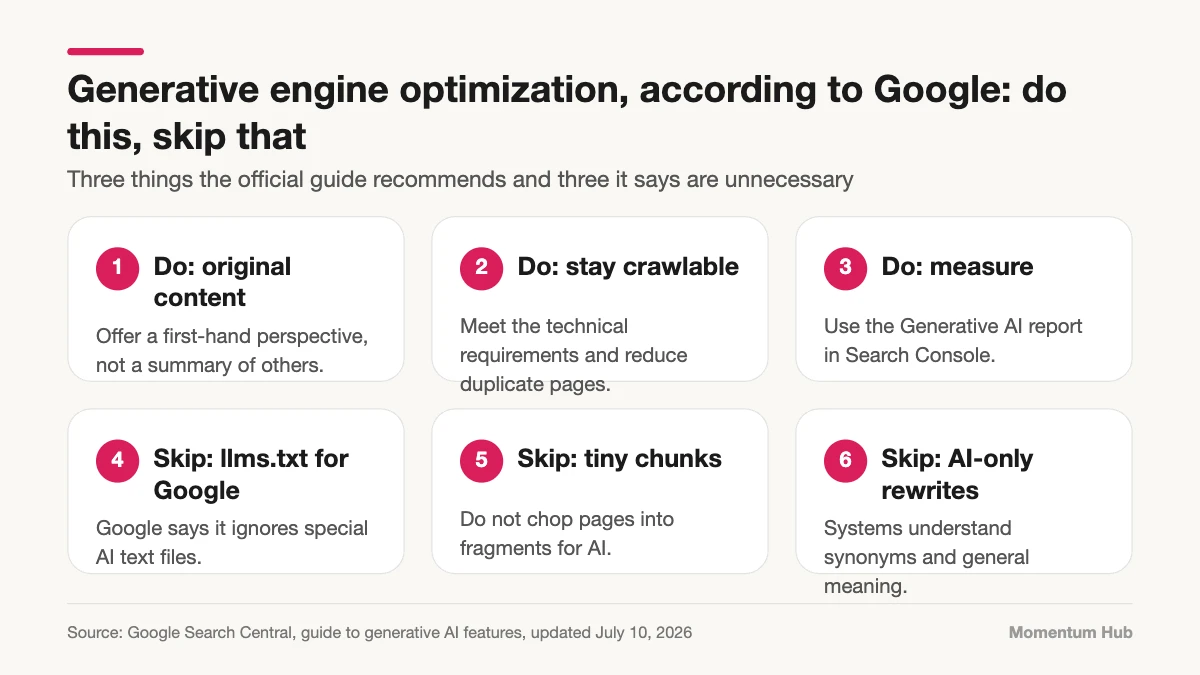
Google recommends what it calls non-commodity content: material with a first-hand perspective, not a summary of what other pages already say. This is the most important rule and the hardest to fake.
If an AI system can produce your article from general knowledge, it has no reason to cite you. Original data, real experience, named experts, and specific examples are what make a source worth quoting.
Rule 3: Keep the Technical Basics Clean
The guide tells site owners to meet the standard technical requirements for Search, keep content crawlable, follow good practice for JavaScript-heavy pages, and reduce duplicate content. It suggests semantic HTML where practical, mainly for readability and accessibility.
Nothing here is new. It is a reminder that AI features sit on top of the same index as ordinary results. If Google cannot read a page, no AI summary will mention it.
Rule 4: Skip the Special Files, at Least for Google
One of the clearest statements concerns files such as llms.txt, which some sites publish to guide AI systems. Google says it ignores them for Search, along with special markup created for AI. You can keep them for other services if you wish.
This saves effort. It also removes a common upsell from the GEO sales pitch.
Rule 5: Do Not Chop Up or Rewrite for Machines
The guide advises against breaking content into tiny chunks for AI, and against rewriting pages just for AI systems. Its reasoning is that these systems understand synonyms and general meaning, and that page length should suit your audience.
Write for the reader. A well-organized article with clear headings is already easy for a machine to follow.
Rule 6: Be Honest About Structured Data
Structured data, the labels that help search engines understand a page, is still worth using for the rich results it enables. But the guide says it is not required for generative AI search, and that no special AI schema exists. It also warns against chasing inauthentic mentions across the web, and against mass-producing pages for variations of a query.
Rule 7: Measure, and Distrust Magic Metrics
Google points site owners to the Generative AI performance report in Search Console. It also cautions against third-party tools that claim access to its internal ranking or AI metrics.
Measurement is where genuine new work lies. Check which pages are cited, for which questions, and how that changes over time.
Where Google’s View Is Incomplete
The guide speaks for Google Search. It does not describe how other AI assistants choose sources, and those services matter more each month. A few honest caveats:
- Other AI products may weigh sources differently, and some may use files that Google ignores.
- Being cited is not the same as being visited. An answer that satisfies the user may send no traffic at all.
- Communicators are already adapting. In a PR Newswire survey of 1,016 professionals, 57% said they write descriptive headlines so AI search tools can find and reference their news.
- Google has an interest in telling you not to do anything unusual. That does not make it wrong, but it is worth remembering.
A Practical Checklist
- Audit your ten most important pages for clear, quotable facts.
- Add something original to each: a figure, an example, or an expert view.
- Fix crawl and duplicate-content problems before anything else.
- Review the Generative AI report monthly.
- Test your key topics in several AI assistants and note which sources they cite.
- Be skeptical of any agency that promises AI rankings through secret techniques.
The basics in our guide to SEO strategies remain the foundation, and distribution still matters, as we covered in social media marketing.
Quick Questions, Answered
Is generative engine optimization a scam? No. The goal is real. But much of what is sold under the name is ordinary SEO, and some of it is unnecessary.
Do I need an llms.txt file? Not for Google. It may be useful for other services, so decide based on where your audience searches.
Will AI answers reduce my traffic? For some queries, yes. That is why original content and direct relationships with your audience matter more.
Final Thoughts: Be the Source
The simplest summary of generative engine optimization is to be the page worth citing. That means knowing something, saying it clearly, and making it easy to find. The acronyms will keep changing. That advice will not. For how AI is reshaping the path to audiences, see AI as the gateway to news, and browse our Marketing section.