
- 1. Layoffs Are Elevated, but AI Is Rarely the Stated Cause
- 2. Non-Users Are Overrepresented Among the Laid Off
- 3. The Pattern Is Strongest in Tech
- 4. AI Use Goes With Better Jobs, Though Not Necessarily Because of It
- 5. Frequent Users Worry More, Not Less
- 6. Good Management Reduces the Fear
- What the Data Cannot Tell You
- A Practical Growth Plan
- Quick Questions, Answered
- Final Thoughts: Familiar Beats Fearful
AI and jobs is the career question of the moment, and most answers come as predictions. Gallup has something better: survey data on who has actually been laid off, why, and how they used AI before it happened. The findings do not support the idea that AI is taking jobs wholesale. They do suggest that people who avoid AI entirely are in a weaker position.
That is a careful distinction, and this post tries to keep it. Here are six findings from recent Gallup research, what they can and cannot tell you, and a practical plan for your own career.
Key takeaways
- Only 1% of laid-off workers name AI or automation as the main reason they lost their job.
- Non-users of AI make up 62% of laid-off workers, compared with 50% of people still employed.
- In tech, infrequent AI users were three times as likely to have been laid off.
- These are associations, not proof that using AI protects you. Role, industry, and seniority matter too.
1%
Share of laid-off workers who cite AI or automation as the primary reason for losing their job, according to Gallup.
1. Layoffs Are Elevated, but AI Is Rarely the Stated Cause
In a Gallup workforce survey of more than 23,000 employed adults, 21% said their employer was letting people go, well above the 8% recorded in 2022. At the same time, 34% said their employer was hiring.
When laid-off workers were asked why, only 1% named AI or automation as the primary reason. Restructuring or downsizing was cited by 15%, and budget cuts and economic conditions by 11% each. Whatever role AI plays in corporate decisions, the people affected mostly do not see it as the direct cause.
2. Non-Users Are Overrepresented Among the Laid Off
The second finding is the one that should make people think. Among laid-off workers, 62% said they had used AI in their role once a year or less. Among those still employed, the figure was 50%. Frequent users, meaning daily or a few times a week, made up 22% of laid-off workers and 28% of employed ones.
A 12-point gap is meaningful. It does not show that learning AI would have saved those jobs. It shows that the two things travel together.
3. The Pattern Is Strongest in Tech
Gallup reports that tech workers who used AI less than monthly were “three times as likely to have been laid off” as those who used it at least monthly. Outside tech, the gap is much smaller.
That fits the wider picture of a sector in transition, which we described in the tech job market in late 2026. Where AI tools are already part of daily work, not using them is more visible.
4. AI Use Goes With Better Jobs, Though Not Necessarily Because of It
A separate study, the American Job Quality Study, found that 52% of employees who use AI daily or weekly hold what it defines as a quality job. Among infrequent users the figure is 46%, and among those who never use AI, 32%.
Gallup is careful here, and so should we be. The groups most likely to have good jobs, including college graduates and managers, are also the groups most likely to use AI. The link may reflect who gets access to these tools as much as what the tools do.
5. Frequent Users Worry More, Not Less
You might expect people who use AI every day to feel safest. The opposite is true. In Gallup’s analysis, 6.3% of frequent users said their job was very likely to be eliminated within five years, about twice the share among infrequent users. Across all workers, about 19% said elimination was somewhat or very likely.
Familiarity brings a clearer view of what the technology can do. It also means the fear is highest among those best placed to adapt.
6. Good Management Reduces the Fear
The same analysis found that workers who feel respected, and who believe their organization cares about their wellbeing, are noticeably less likely to fear being replaced. The effect is largest among frequent AI users. We covered this in depth in how managers talk about AI.
For your own career, that makes the quality of your manager and employer part of your AI strategy.
What the Data Cannot Tell You
- These are surveys. They show patterns, not causes.
- Laid-off workers may not know the real reasons behind a company’s decision.
- AI use is tied to job type. Desk workers use it far more than on-site workers.
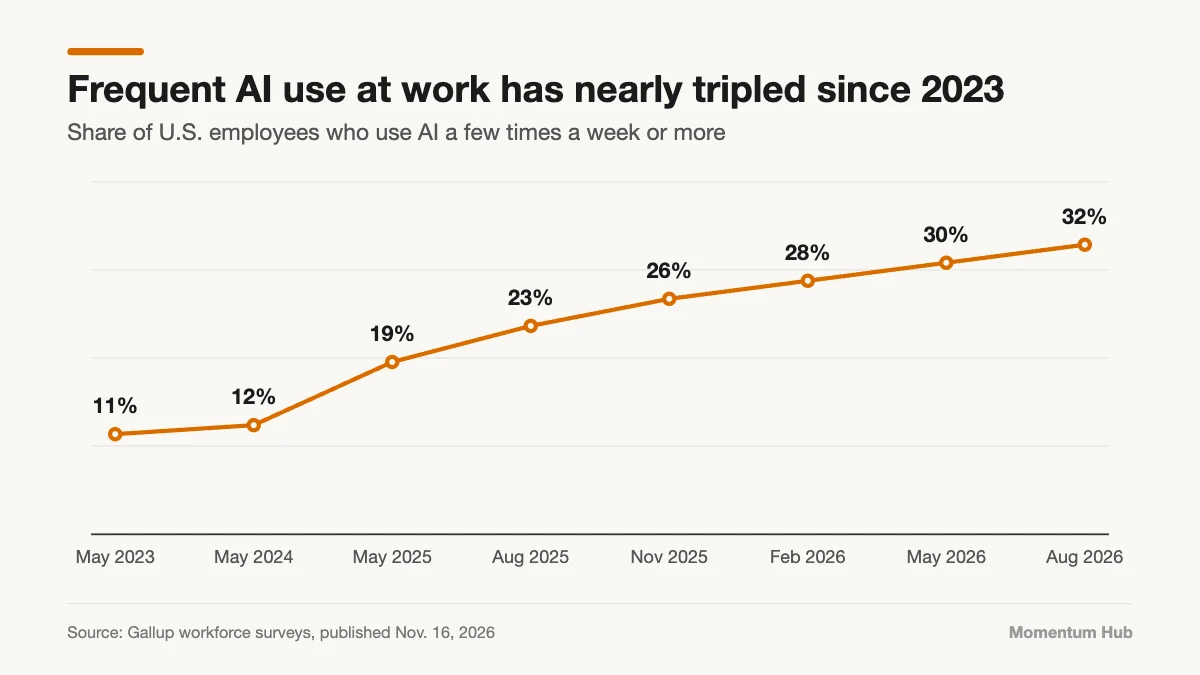
- The picture is changing quickly. Frequent use has risen from 11% of employees in 2023 to 32% now.
Write “associated with,” not “caused by,” whenever you repeat these figures.
A Practical Growth Plan
- Use AI on real tasks every week, not just in a training session.
- Keep a short record of results: time saved, quality improved, problems solved.
- Learn to check its work. Judgment is the skill employers cannot automate.
- Ask for training, and for clarity about what is allowed.
- Build skills that combine with AI, such as communication, analysis, and domain knowledge. Our guide to AI skills for your career is a starting point.
- Watch your sector. If you are considering a move, our piece on healthcare jobs for career changers shows where demand is steady.
- Choose managers as carefully as you choose roles.
Quick Questions, Answered
Is AI causing layoffs? Very few laid-off workers say so directly. Companies may still be reorganizing around it in ways workers do not see.
Will using AI protect my job? There is no guarantee. Regular users are less represented among the laid off, but other factors could explain that.
I am not in tech. Does this apply to me? The pattern is weaker outside tech today. Use is spreading, so the gap may grow.
Final Thoughts: Familiar Beats Fearful
The most useful reading of the AI and jobs data is modest. AI is not the main reason people are losing work right now, and using it is not a shield. But being comfortable with the tools is becoming part of being employable, as spreadsheets and email once became. Start small, keep going, and stay curious. For more, visit our Career section.