
For most of the web’s history, the default was simple: bots could crawl your site unless you said otherwise. That default is flipping, as more publishers block AI bots and other crawlers unless they are invited. Dow Jones, the publisher of The Wall Street Journal, told Nieman Lab that since May it disallows all bots by default on its consumer news sites, including the Journal, Barron’s and MarketWatch, and lets in only an approved list.
It is the latest sign that publishers want to block AI bots unless there is a deal in place. If you work in media, SEO or generative engine optimization, this shift affects how your content is found and used. Here is what changed, why, and what you can do.
Key takeaways
- The Journal’s allow list has more than 60 bots, including search crawlers and three OpenAI scrapers covered by a licensing deal.
- A Known Agents analysis found about 2% of 1,000 leading English-language publisher sites now disallow all bots by default.
- Publishers block AI bots for leverage in licensing talks, to add friction for scrapers, and to cut server load.
- Robots.txt is voluntary, so some publishers are adding server-side blocks.
34%
Share of pageviews that came from bots across more than 5,000 randomly selected websites over 90 days, according to an index from Known Agents, a bot analytics company, reported by Nieman Lab.
What Dow Jones Changed
The change happened in each site’s robots.txt file, the page that tells bots which parts of a site they may visit. Instead of naming the bots it wants to keep out, a blocklist, Dow Jones now names the bots it lets in, an allow list. Everything else is disallowed.
Nolly Evans, Dow Jones’ chief development officer, told Nieman Lab the change tells third parties they “must negotiate and partner directly with us for content access.” He also pointed to fast-growing bot traffic while human referrals to news sites shrink. OpenAI’s scrapers are on the list because News Corp, Dow Jones’ parent company, has a licensing deal with OpenAI worth more than $250 million.
Why Publishers Block AI Bots by Default
Bot traffic now rivals human traffic
Known Agents keeps an index of more than 5,000 randomly selected websites. Over the past 90 days, about 34% of their pageviews came from bots, and about 29% of those bots were AI-related, such as AI agents, chatbots and training scrapers.
Leverage for licensing
Blocking by default turns access into something AI companies have to ask for. News Corp CEO Robert Thomson told CNBC that the company wants AI firms to pay for its journalism, and that it will sue those that will not.
A growing club
About 2% of leading English-language publisher sites now disallow all bots by default, according to Known Agents, including Reuters, Bloomberg Law, Publishers Weekly and The Register. Several News Corp papers in Australia and the U.K. do the same, and The Atlantic, Reuters and Time use allow lists too.
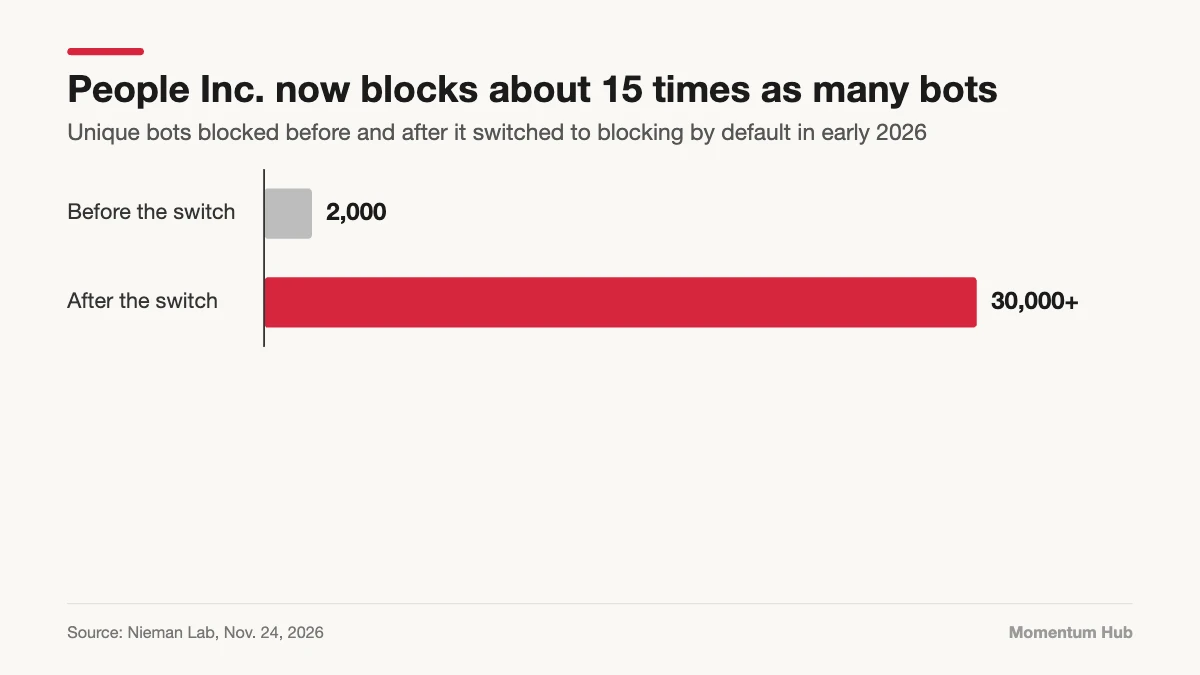
People Inc. has gone further than robots.txt. When it switched to hard-blocking bots by default early this year, the number of unique bots it blocked jumped from 2,000 to more than 30,000. This Search Engine Journal segment explains the difference between blocking in robots.txt and blocking at the server.
The Limits of Robots.txt
Robots.txt is guidance, not a lock, which limits how well it can block AI bots. Bots can ignore it, and Nieman Lab notes that some AI companies, including Perplexity, have used stealth crawlers to get around it.
Slate’s experience shows both sides. Its small product team uses a free Known Agents tool to update Slate’s robots.txt weekly as new bots appear. Since September, Slate has seen several bots ignore the file and keep crawling, so it is exploring server-side paywall approaches. Slate has no licensing deals with major AI companies.
Even so, Known Agents CEO Gavin King calls robots.txt the easiest first line of defense, and says some clients cut traffic from known AI bots by more than 90% just by using a more complete list.
What This Means for You
If you run a publication or content site
If you want to block AI bots on your own site, start small and measure.
- Check your robots.txt and see which AI bots it names. Most publishers restrict only a fraction of known AI bots.
- Decide which bots you actually want: search crawlers, AI search bots that send referrals, or nothing beyond search.
- Watch your server logs for bots that ignore your rules, and consider server or CDN blocks for repeat offenders.
- Measure what AI search sends you before you shut it out. Our guide to tracking AI search traffic shows how.
A minimal allow-list robots.txt looks like this:
User-agent: Googlebot
Allow: /

User-agent: *
Disallow: /
Test any change carefully. A rule this strict blocks every bot you have not named, including ones that might send you readers.
If you rely on AI tools for news
Expect AI answers to lean more on publishers with licensing deals and less on those that block. It is worth checking where an AI answer’s sources come from, a habit we covered in our look at AI as the front door to information. This Paywall Podcast episode asks whether pay-per-crawl models can make up for lost traffic.
Quick Questions, Answered
Does blocking AI bots hurt search rankings? Not if your allow list keeps search engine crawlers. The Journal’s list includes them.
Can I block AI bots without leaving Google Search? Only partly. Google’s main search crawler also supports some of its AI features, so blocking it has a cost. Check Google’s current crawler documentation before you decide.
Will robots.txt stop all AI scraping? No. It is voluntary. Server-side blocks and licensing deals are stronger tools.
Final Thoughts: Access Is Becoming a Negotiation
The Journal’s move shows where the open web is heading. Instead of assuming bots are welcome, more publishers will decide which ones to let in and on what terms. That may push AI companies toward paying for news, which matters for how journalism gets funded. It may also make AI answers less complete. Either way, if you publish online, now is a good time to decide whether to block AI bots on your own site, and which ones.