
- Canada's Bet: Make Public Funding Permanent
- Where the Money Actually Goes
- Indonesia's Bet: Make Platforms Pay
- The Platform Pushback
- Two News Funding Models, Side by Side
- What This Means for Publishers and Creators
- A Third Path: Readers Paying Directly
- Quick Questions, Answered
- Final Thoughts: Follow the Money, Then Build Your Own
Good journalism costs money, and the old models of news funding keep breaking. So in late 2026, two countries are trying two very different fixes. Canada is committing public money. Indonesia wants platforms to pay.
Both stories come from recent Nieman Lab reporting on Canada’s budget and Indonesia’s copyright bill. If you follow how creator-led media and traditional outlets compete for attention, these experiments matter, because the money decides who survives.
Key takeaways
- Canada’s proposed budget would make its Local Journalism Initiative permanent and extend a 35% newsroom salary tax credit through 2028.
- Indonesia’s bill would require platforms to pay publishers for previews and snippets, including in AI search products.
- Google, Meta, and TikTok testified against the Indonesian bill.
- Each model has tradeoffs: public money can favor big chains, and platform mandates can trigger news blocks.
Canada’s Bet: Make Public Funding Permanent
Canada’s proposed 2026 budget would make the Local Journalism Initiative permanent, with C$134 million over four years and C$41 million a year after that. The program, launched in 2019, supports about 470 reporting positions in roughly 1,000 communities.
The budget also extends a 35% labor tax credit on newsroom salaries through 2028. It had been scheduled to drop to 25% at the end of 2026. For the first time, radio and television newsrooms would qualify. The budget still has to pass Parliament.
Where the Money Actually Goes
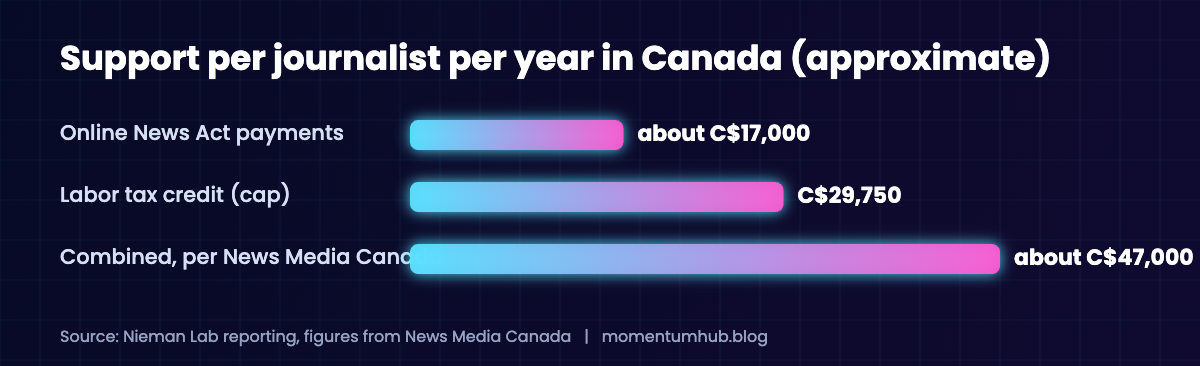
Support for the plan is strong among publishers. The head of News Media Canada called the tax credit the leading driver of newsroom headcount, and said that combined with platform payments, support comes to about C$47,000 per journalist per year.
But there are fair criticisms. The largest share of tax credit dollars goes to the largest employers. And a rule requiring at least two arm’s-length journalists shuts out some tiny family-run papers, often the ones serving communities with the fewest alternatives.
Indonesia’s Bet: Make Platforms Pay
Indonesia is taking the other road. A proposed copyright bill would require digital platforms to pay news publishers for aggregating and previewing their content, with no distinction between a snippet and a full republication. Payments would flow through a state-run management organization, and platforms that refuse could lose local business permits.
The bill reaches into AI too. Previews inside AI search products would count, and platforms would owe compensation when journalism is used to train AI models. If it passes, Indonesia would be the first Southeast Asian country to write AI into its copyright law.
The Platform Pushback
Google, Meta, and TikTok all testified against the bill. Their argument is that it would limit access to news and that publishers could lose traffic, advertising, and subscribers.
There is precedent for that warning. After Canada’s 2023 Online News Act required payment for sharing or linking to news, Meta blocked news on Facebook and Instagram in the country. Google took a different path, and its payments now bring in about C$100 million a year.
Two News Funding Models, Side by Side
- Public funding is predictable and keeps reporters employed, but it depends on political will and can tilt toward large chains.
- Platform payments tie money to the companies that benefit from news, but they depend on platforms choosing to stay.
- Both leave open the hardest question: how to reach communities with no newsroom at all.
What This Means for Publishers and Creators
Neither model is a rescue. Even in Canada, where both exist, recruiting reporters in remote communities remains hard. The lesson for small publishers is the one we drew in our look at user-generated content: direct relationships with an audience are the asset nobody can legislate away.
Policy money can buy time. Use it to build newsletters, memberships, and community ties, the same durable habits behind the podcast boom.
A Third Path: Readers Paying Directly
Public money and platform money both come with strings. That is why many outlets are leaning harder on a third source: the people they serve. Memberships, donations, events, and newsletters with paid tiers do not depend on a budget vote or a platform’s goodwill. They do depend on being worth paying for.
In practice, most healthy newsrooms will blend all three. The mix matters less than the principle: no single funder should be able to switch your journalism off.
Quick Questions, Answered
Is Canada’s plan final? Not yet. It is part of the proposed 2026 budget and must pass Parliament.
Does Indonesia’s bill cover AI? Yes. It would apply to previews in AI search products and to using journalism for AI training.
Did platform payments work in Canada? Partly. Google pays about C$100 million a year, while Meta chose to block news instead.
Final Thoughts: Follow the Money, Then Build Your Own
Who pays for news is being rewritten country by country. Some will lean on taxpayers, some on platforms, most on a mix.
Whatever your government decides, the publishers in the strongest position will be the ones whose readers would notice if they disappeared.