
- Why Internal Communications Metrics Matter Now
- 1. Reading Behavior
- 2. Link Activity
- 3. Differences by Audience
- 4. Message Length and Sender
- 5. Repeated Questions
- 6. Feedback and Sentiment
- 7. Business Outcomes
- A Starter Dashboard You Can Build This Month
- The Bigger Picture: Data Should Inform the Story
- Quick Questions, Answered
- Final Thoughts: Measure Understanding
Internal communications metrics used to mean open rates and little else. That is no longer enough. US employee engagement has fallen to its lowest level since 2011, and the share of workers who clearly know what is expected of them is sliding with it.
On November 17, 2026, PR Daily published a piece arguing that internal communicators now need data literacy alongside storytelling. Paired with Gallup’s latest engagement figures, it makes a strong case for measuring whether messages are understood, not just sent.
Key takeaways
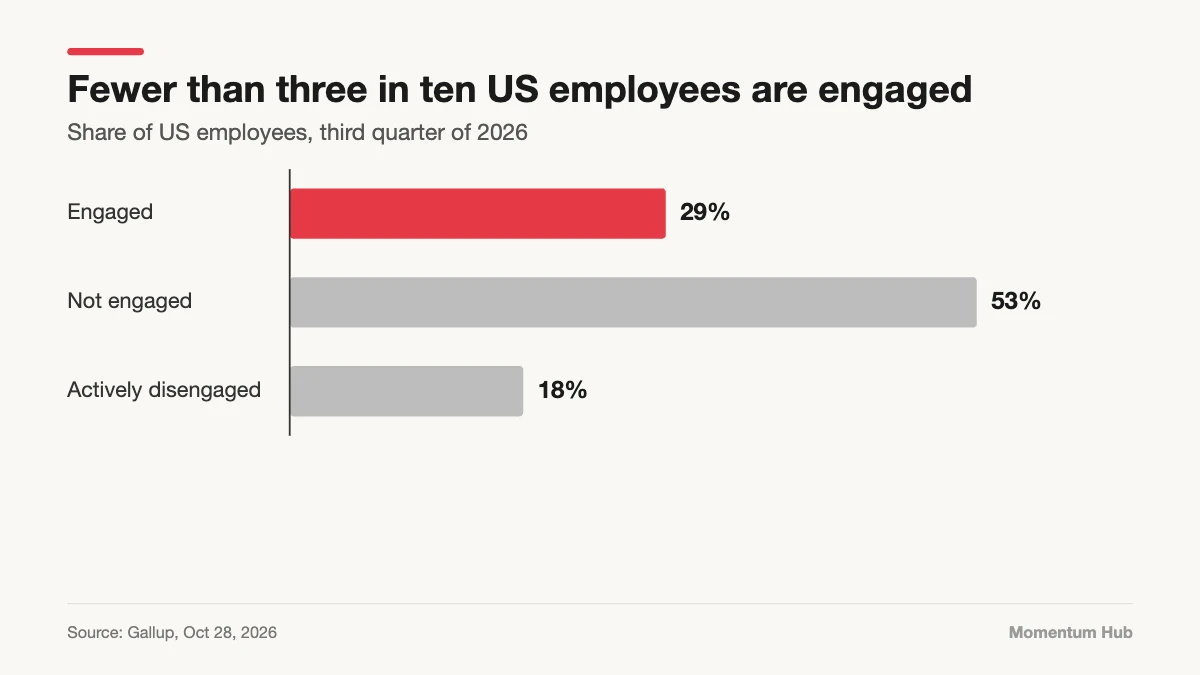
- Only 29% of US employees were engaged in the third quarter of 2026, down from 31% the quarter before.
- Just 46% strongly agree they know what is expected of them at work, down from 49% earlier in the year.
- An open rate tells you a message arrived. It does not tell you it was understood.
- The most useful internal communications metrics compare audiences, channels, and message length.
46%
Share of US employees who strongly agree they know what is expected of them at work, 15 points below the 2015 high of 61%, according to Gallup.
Why Internal Communications Metrics Matter Now
Gallup surveyed 21,648 US adults in August 2026. Engagement dropped to 29%, with 53% not engaged and 18% actively disengaged. Clarity fell too. So did the share who strongly agree that someone at work cares about them as a person, from 40% to 37%.
Clarity is a communication outcome. When fewer than half of employees are sure what is expected, something between leadership and the front line is not landing. Good measurement shows where.
1. Reading Behavior
Start with what people do. Track opens, but also time spent and how far people read. The PR Daily piece uses a newsletter with a 72% open rate as an example. That number sounds healthy and still says nothing about whether the content was understood.
2. Link Activity
Clicks show intent. If a benefits update gets opened by most staff and almost no one clicks through to enroll, the message may be clear and the action is not.
3. Differences by Audience
Averages hide problems. Break results out by team, location, and role. Gallup found engagement fell fastest among fully remote workers, from 37% to 32% in one quarter. A message that works at headquarters may be missing remote and shift-based staff.
4. Message Length and Sender
Compare similar messages of different lengths and from different senders. Many teams find that a short note from a direct manager outperforms a long one from the executive floor. Test it. Do not assume it.
5. Repeated Questions
Count the questions that come back after an announcement. If the same three questions fill the help desk and team chats, the message left a gap. This is one of the cheapest internal communications metrics to collect and one of the most honest.
6. Feedback and Sentiment
Add a one-question pulse to major messages: was this clear, and do you know what to do next? Read the comments, not only the score. Our guide to mastering feedback covers how to ask in a way that gets real answers.
7. Business Outcomes
Tie communication to something the organization already tracks: enrollment completed, training finished, safety steps followed, policy adopted. PR Daily’s writer argues for measuring outcomes over output, and cites a survey of 3,457 employees in which satisfaction with internal communication was linked to higher engagement.
A Starter Dashboard You Can Build This Month
Keep the first version small. Five rows are enough:
- Read rate and average read time, split by audience segment.
- Click-through on the single most important link in each message.
- Number of repeated questions in the week after each major announcement.
- One clarity pulse question, asked the same way every time.
- One business outcome per campaign, agreed with the owner before you send.
Then benchmark. Compare each message with your own past campaigns before comparing with anyone else’s numbers.
The Bigger Picture: Data Should Inform the Story
None of this replaces craft. As the PR Daily article puts it, “A metric is not a conclusion.” Numbers tell you where to look. People still decide what to say and how.
The Gallup data adds one more pointer. Its analysts recommend clarifying expectations for AI use by role and equipping managers to support it. That fits what we reported in AI is cutting writing time, not meetings and in managers, AI, and psychological safety. Much of the clarity gap is about change that has not been explained. The human side of that work is covered in the five human skills for an AI workplace.
Quick Questions, Answered
What are internal communications metrics? They are measures of whether employees received, understood, and acted on a message, beyond simple open rates.
Which metric should I start with? Repeated questions after announcements. It is free to count and points straight at unclear messages.
How often should I report? Monthly is enough for most teams, with a short review after each major announcement.
Final Thoughts: Measure Understanding
Internal communications metrics are worth the effort for one reason: they show whether people understood. With clarity at 46%, that is the gap to close. Pick two signals, track them for a month, and let what you learn shape the next message.