
- 1. Hydrogen Is the New Default in Google AI Mode
- 2. It Also Touches AI Overviews
- 3. A Core Update Is Running at the Same Time
- 4. A Reporting Bug Distorted the Data
- 5. The Model Label Disappeared, and Carbon Spread
- 6. AI Mode Is Connecting to Apps
- How to Read November's Data
- What to Do About Visibility
- Quick Questions, Answered
- Final Thoughts: Patience Is a Strategy
Google AI Mode got a new engine this month. On November 12, 2026, Google’s head of Search product announced that Gemini 4 Hydrogen is now the default model behind AI Mode, calling it the biggest model upgrade to Search yet. For anyone whose traffic depends on Google, that sentence alone is worth a closer look.
The timing makes it harder. The change landed two days into a core ranking update and in the middle of a reporting bug. If your numbers look strange this month, three different things could be responsible. This guide untangles them and sets out six changes to understand.
Key takeaways
- Gemini 4 Hydrogen became the default model in Google AI Mode on November 12 and also handles the hardest AI Overviews queries.
- A core update began on November 10 and can take up to two weeks to roll out.
- A logging error lowered reported impressions in Search Console’s Generative AI report for November 9 to 11.
- Do not draw conclusions from this month’s data until the dust settles.
3 overlapping changes
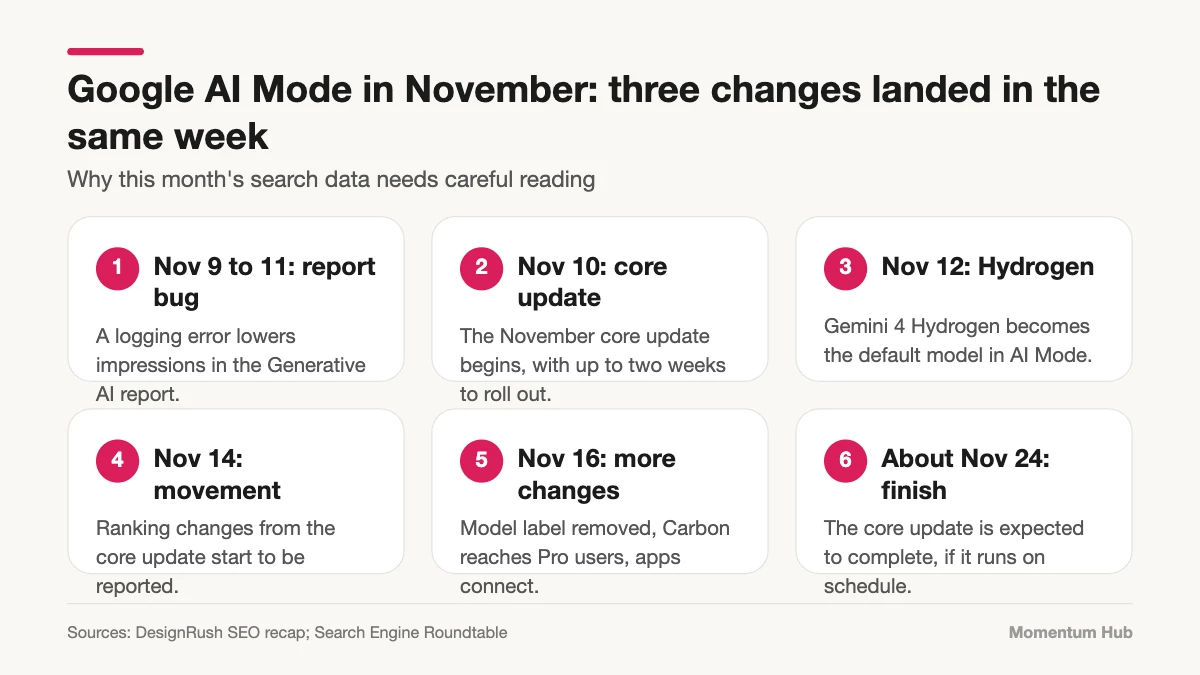
A new AI model, a core ranking update, and a reporting bug all landed between November 9 and 12, according to a DesignRush recap.
1. Hydrogen Is the New Default in Google AI Mode
The announcement came from Robby Stein, Google’s vice president of product for Search, who wrote that “the biggest model upgrade to Search yet has landed.” Hydrogen now powers AI Mode by default.
AI Mode is the conversational side of Google Search, where a user can ask a long question and follow up. A stronger model there means answers that handle more complex requests, and potentially different choices about which sources to cite.
2. It Also Touches AI Overviews
Hydrogen is not limited to AI Mode. Google says it also handles the hardest questions in AI Overviews, the summaries that appear above ordinary results. So the upgrade reaches people who never open AI Mode at all.
For publishers and brands, this is the part with the widest effect. AI Overviews sit on top of the classic results page that most searchers still use.
3. A Core Update Is Running at the Same Time
Google’s November 2026 core update began rolling out on November 10. Google says such updates can take up to two weeks. Search Engine Roundtable reports that ranking movement began to show around November 14, and that reaction has been quieter than usual, possibly because tracking tools are struggling to keep up with the changes.
A core update changes how Google ranks pages in general. It is separate from the AI model change, but both affect what users see.
4. A Reporting Bug Distorted the Data
To complicate things further, a logging error lowered the impressions shown in Search Console’s Generative AI report for November 9 to 11. According to the DesignRush recap, Google’s data anomalies page says the error affected logging only. The dip in the report reflects missing data, not a real loss of visibility.
If you saw a sharp drop in that report early in the month, do not act on it.
5. The Model Label Disappeared, and Carbon Spread
Two smaller changes followed. Google removed the label that showed which Gemini model AI Mode was using, and a second model, Gemini 4 Carbon, became available to Pro subscribers after being limited to the top tier. Both were confirmed by a Google representative, Search Engine Roundtable reports.
Removing the label means users, and marketers, can no longer easily see which model produced an answer. It is a reminder that this is a system Google tunes continuously.
6. AI Mode Is Connecting to Apps
Stein also announced that AI Mode can now connect to more apps, naming Adobe, Calm, and Peloton. Google is also testing temporary threads that do not draw on past context.
The direction is clear. AI Mode is becoming a place where people do things, not just a place where they read answers. Brands should expect more journeys to start and finish inside Google’s interface.
How to Read November’s Data
- Add notes in your analytics for November 9 to 11 (report bug), November 10 (core update), and November 12 (Hydrogen).
- Do not credit or blame content changes you made this month. Too many variables moved at once.
- Wait until the core update finishes before comparing rankings.
- From December, track how often your pages are cited in AI answers, on a weekly basis.
- Compare several weeks, not single days.
What to Do About Visibility
Google’s own advice has not changed with the new model. Its guide to AI features says optimizing for generative AI search is still SEO, and recommends unique, useful content with a first-hand perspective.
- Keep key facts on your important pages clear, current, and easy to quote.
- Make sure pages are crawlable and technically sound.
- Publish original information that others do not have.
- Use the Generative AI report in Search Console, once the data is stable again.
- Do not rebuild your site around rumors about what a new model prefers.
The fundamentals in our guide to SEO strategies still apply, and it is wise to spread risk across channels, including the alternative search engines that are gaining ground.
Quick Questions, Answered
Did Hydrogen cause my traffic change? It is impossible to say from this month’s data alone, because a core update and a reporting bug overlapped with it.
Can I optimize specifically for Hydrogen? There is no evidence of a special technique. Google’s guidance is to focus on helpful, original content.
Should I check AI Mode myself? Yes. Search your main topics in AI Mode monthly and note which sources it cites.
Final Thoughts: Patience Is a Strategy
The Google AI Mode upgrade matters, but this is a month for observation, not reaction. Note the dates, wait for the core update to finish, and judge results over weeks. The sites that do best through changes like this are usually the ones that keep publishing useful things. For more, visit our Marketing section.