
Most open models get better by getting bigger. Inkling 2 Mini, released by Thinking Machines Lab on Nov. 20, tries something else: it runs the middle of the model three times for every token. The goal is more reasoning without more stored weights, in a model small enough to run on a 32GB laptop.
The weights are on Hugging Face under the Apache 2.0 license. If you read our look at Qwen3.8-27B and DeepSeek-V4, Inkling 2 Mini is the new model to compare against. Here is what looping is, what the scores do and do not show, and how to try it.
Key takeaways
- Inkling 2 Mini is a mixture-of-experts model with 26.4 billion parameters, 3.4 billion of them active.
- Its middle 12 layers run three times per token, which the company says improves reasoning without adding weights.
- Maker-reported scores put it ahead of Qwen3.8-27B on most agent benchmarks, but not all of them.
- The checkpoint is about 20GB and runs on a Mac with 32GB of memory or a GPU with 32GB of VRAM.
5.4B
Weight activations per token, from 3.4 billion active parameters run through the loops, according to Thinking Machines. The model has 26.4 billion parameters in total.
What Looping Means in Inkling 2 Mini
A standard transformer passes each token through its layers once. Inkling 2 Mini has 24 layers in four blocks of six. The first block runs once, the two middle blocks run three times with shared weights, and the last block runs once. That gives 48 layer applications per token from 24 stored layers.
The company’s reasoning is that the middle layers do the most abstract work, while the first and last layers translate between words and internal representations. In its experiments, looping the middle layers beat looping the last layers on 27 of 28 evaluations. On top of that, it is a mixture-of-experts model: each token is routed to 8 of 128 experts in every layer.
There is a trade-off the company states plainly. Looping helps reasoning, but it does not let the weights store more facts. Knowledge still depends mostly on total size, so extra loops do not improve fact recall. Mehul Mohan’s video explains what running a model like this on your own machine looks like.
How Inkling 2 Mini Scores
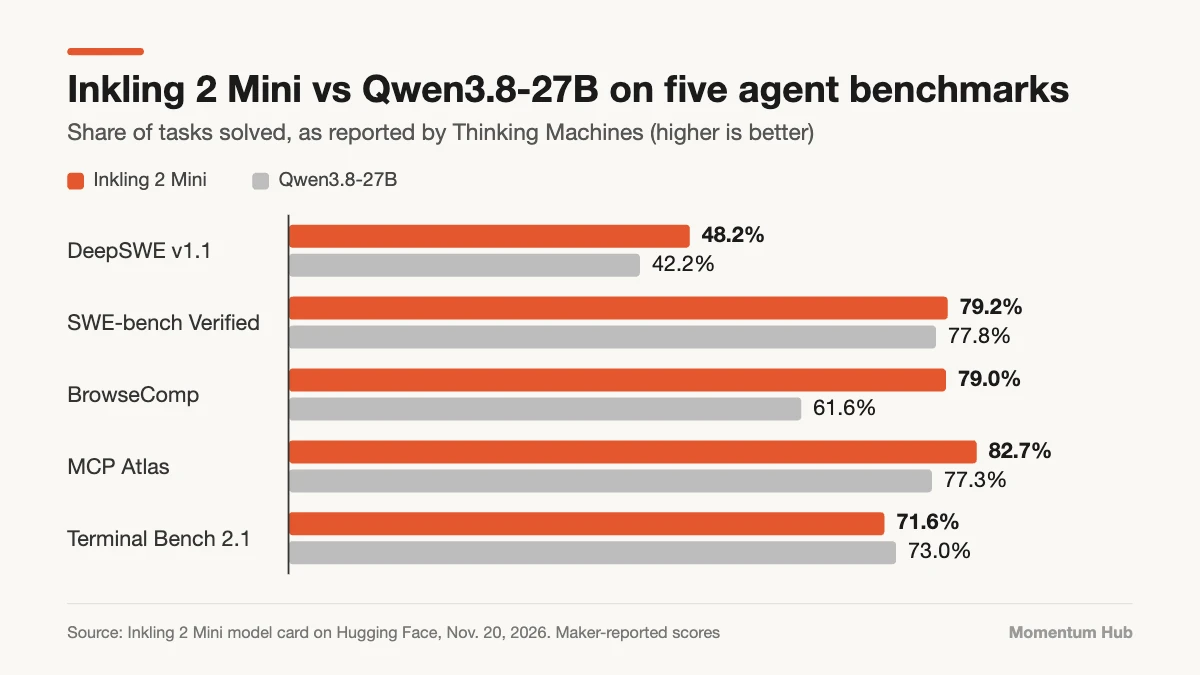
Every number here comes from Thinking Machines, so treat them as maker claims until independent testers catch up. On the coding benchmark DeepSWE v1.1, Inkling 2 Mini resolved 48.2% of tasks, ahead of Qwen3.8-27B at 42.2%. It also leads on BrowseComp, a web research test, and MCP Atlas, a tool-use test.
Where it trails
It is not a clean sweep. Qwen3.8-27B scores higher on Terminal Bench 2.1 and on several knowledge-work tests in the model card. The company also says Inkling 2 Mini is not the strongest small model for multi-turn chat or for instructions with many constraints, and that it trails larger models on hard reasoning tests.
Energy use
The launch post also cites an intelligence-per-joule measurement on an NVIDIA DGX Spark: 0.703 for Inkling 2 Mini against 0.430 for Qwen3.6-35B-A3B. The setups were not identical, so read it as a rough signal, not a ranking.
Why Researchers Care: Reasoning You Can Still Read
Looping lets a model think longer without writing every step down. That raises a safety question: if more reasoning happens inside the loops, can people still monitor it by reading the model’s chain of thought?
Thinking Machines released a research variant with a variable number of loops to study this. On a measure of how long a task it could handle without writing out its reasoning, it rose from 16 seconds at one pass to 37 seconds at three. Its written reasoning got shorter as loops were added but, the company reports, stayed legible, and it did not score higher on tests of agentic sabotage. If you work on AI agent verification, that result is worth following as others test it.
How to Run Inkling 2 Mini
The checkpoint is about 20GB in mixed NVFP4 and MXFP8 precision. The model card lists an NVIDIA DGX Spark, an Apple silicon Mac with 32GB or more of memory, or another GPU with at least 32GB of VRAM. It works with vLLM, SGLang, Ollama, llama.cpp and other common runtimes. A minimal vLLM start looks like this:
pip install vllm
vllm serve "thinkingmachines/Inkling-2-Mini"
Before you rely on it, read the limits the company lists: it can get stuck in reasoning loops, it sometimes takes destructive actions as an agent, its quality is lower outside English, and its factual recall is limited.
- Give it tool access only on a copy of your project.
- Compare it with your current model on five real tasks of your own.
- Watch for long reasoning that never reaches an answer.
- If you connect it to tools, package your instructions as Agent Skills so you can reuse them across models.
AI Coding Daily put it through 140 coding prompts in this hands-on test.
Quick Questions, Answered
Can I use Inkling 2 Mini commercially? The weights use the Apache 2.0 license, which allows commercial use. Check the company’s acceptable use policy as well.
Will it run on a 16GB laptop? Not the official checkpoint, which needs 32GB or more. Community quantized versions can go lower, usually at some cost to quality.
Is looping a new idea? No. The design builds on earlier research into looped transformers. What is new is a capable open-weights model built around it.
Final Thoughts: Smarter Use of the Same Weights
Inkling 2 Mini is interesting less for any single score than for the design choice behind it. Reusing layers is a cheap way to add reasoning to a small model, and the early monitoring results are encouraging. Until independent benchmarks arrive, treat the numbers as the company’s case, and test it on your own work before you switch. For context on the closed models it competes with, see our look at GPT-6.2 Astra and Sol.