- 1. One in Three Over a Year, Nearly One in Two at the Peak
- 2. Most AI-Written Press Releases Are a Blend
- 3. Releases Are Getting Longer
- 4. Use Varies Widely by Industry
- 5. A Few Issuers Skew the Totals
- 6. Communicators Say the Same Thing
- How Much Should We Trust the Numbers?
- Why This Matters for Credibility
- A Simple Standard for Teams
- Quick Questions, Answered
- Final Thoughts: The Signature Still Matters
AI-written press releases are now ordinary. An analysis of one major newswire found that in June 2026, almost half of the English-language releases it carried contained text generated by AI. Two years earlier the figure was under one in ten. Corporate communication has changed its tools faster than almost any other kind of professional writing.
The analysis comes from Pangram Labs, which sells AI-detection software and used its own classifier, so the numbers deserve some caution. But they are detailed, and they match what communicators report about their own habits. Here are six numbers, and what they mean for trust.
Key takeaways
- Over twelve months, 34% of 178,672 press releases on a major newswire contained AI-generated text.
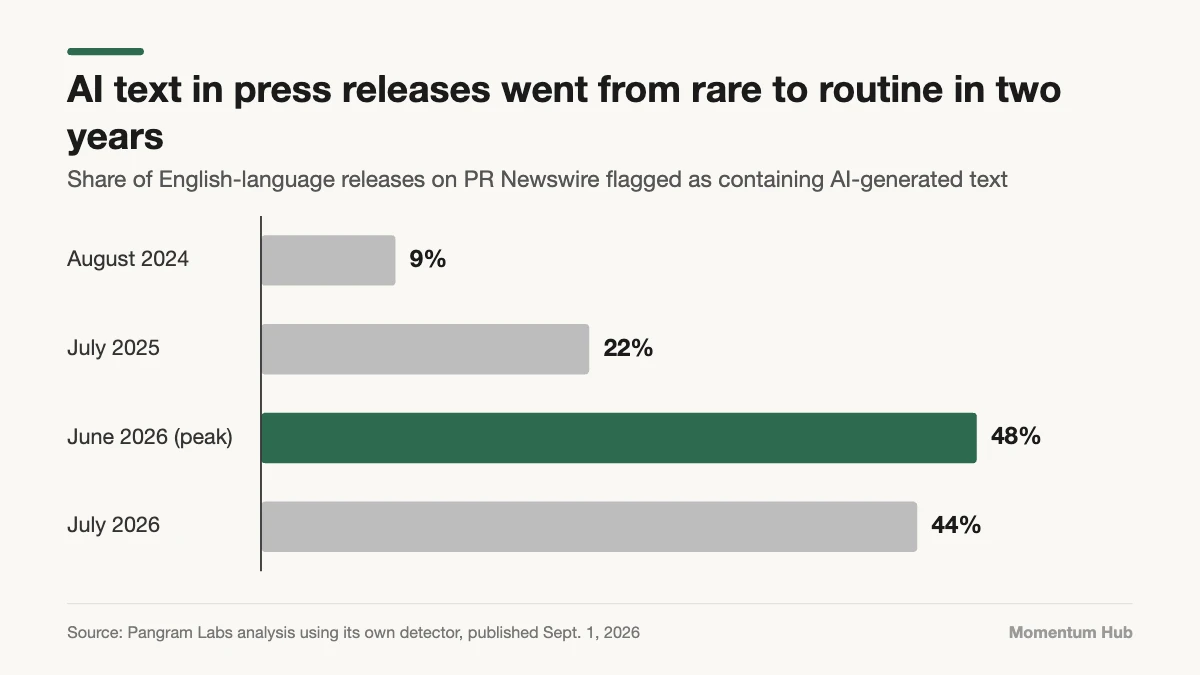
- The monthly share climbed from 22% in August 2025 to a peak of 48% in June 2026.
- Most flagged releases are a mix of human and AI writing. A quarter were fully AI-generated.
- AI-assisted releases run longer, and use varies sharply by industry.
48%
Share of press releases on one major newswire that contained AI-generated text in June 2026, up from 22% in August 2025, according to Pangram Labs.
1. One in Three Over a Year, Nearly One in Two at the Peak
Pangram examined 178,672 English-language releases of more than 100 words, published on PR Newswire between mid-August 2025 and the end of July 2026. It flagged 34% as containing AI-generated text.
The trend is the story. The monthly share rose from 22% at the start of the period to 48% in June 2026, before easing to 44% in July. Using an older data set, the company puts the figure for August 2024 at just 9%.
2. Most AI-Written Press Releases Are a Blend
Of the 61,523 releases flagged, 25% were classed as fully AI-generated and 75% as mixed. In the typical flagged release, about half the text was attributed to AI.
That fits how people actually work. A communicator drafts with a tool, then edits, adds quotes, and inserts the facts. The result is neither purely human nor purely machine.
3. Releases Are Getting Longer
The median length of a release rose about 15% over the year, from 488 to 562 words. In July 2026, human-only releases had a median of 521 words, while releases containing AI text averaged about 601.
Longer is not better. Journalists skim. If a tool makes it effortless to add paragraphs, the discipline of cutting them matters more.
4. Use Varies Widely by Industry
Advertising led by a wide margin, with 64% of releases containing AI text and 41% fully AI-generated. Financial technology came in at 44%. Banking and financial services were lower, at 25%. Finance, energy, and biotechnology each had fewer than 5% of releases classed as fully AI-generated.
The pattern is sensible. Heavily regulated sectors, where every claim is reviewed by lawyers, are moving more carefully.
5. A Few Issuers Skew the Totals
The analysis found a single issuer responsible for 2,265 releases, of which 2,198 were classed as fully AI-generated. It also found that two lower-cost wire services had close to double the AI share of the main newswire.
This matters for interpretation. “Half of press releases” does not mean half of all companies. A small number of high-volume senders account for a large slice of fully automated content.
6. Communicators Say the Same Thing
The findings line up with what professionals report. In PR Newswire’s own 2026 survey of 1,016 communicators, published November 17, 70% said they use generative AI to help create releases, up from 57% a year earlier.
How Much Should We Trust the Numbers?
Three cautions are worth stating plainly.
- Pangram is a vendor measuring a problem its product addresses.
- Every figure depends on one detector. The company reports a false positive rate of one in 21,625 on releases written before ChatGPT existed, but detectors are imperfect, as we explained in detecting AI-generated content.
- The study covers English-language releases on specific wires, not all corporate communication.
The direction is very likely right. The precise percentages are estimates.
Why This Matters for Credibility
A press release is a company speaking on the record. Its value rests on accuracy and accountability, not on prose style. AI drafting does not threaten that by itself. Three side effects can.
- Sameness. Releases drafted by the same tools start to sound alike, and readers tune out.
- Padding. Extra length buries the news.
- Unchecked claims. A fluent draft can contain a wrong number or an invented detail that nobody verified.
Audiences are already wary. Research on AI-generated news shows that people accept AI assistance far more readily than AI authorship with no visible human behind it.
A Simple Standard for Teams
- Treat AI output as a first draft, never as a finished release.
- Have a named person verify every fact, figure, and quote before distribution.
- Cut the draft. If AI made it longer, edit it back to what a journalist needs.
- Use real quotes from real people, approved by them.
- Keep a short internal note of how AI was used, in case you are asked.
- Agree a house position on disclosure, and apply it consistently.
Quick Questions, Answered
Is it wrong to use AI for a press release? No. The question is whether a person has checked it and stands behind it.
Can journalists tell? Sometimes, by tone and length. More often they notice a lack of specific facts, which is the real problem.
Will newswires start labeling AI releases? That is not standard practice today. It may change as detection and watermarking improve.
Final Thoughts: The Signature Still Matters
The spread of AI-written press releases is not a scandal. It is a tool being adopted quickly. What it does is raise the value of the things a tool cannot supply: a verified fact, an accountable name, and a reason for the reader to care. For more on how AI is reshaping professional messages, visit our AI and Communication section.