AI agents are getting good at producing answers. The hard part is knowing which answers are right. On Nov. 23, 2026, Google DeepMind and Google Quantum AI showed one way through: teams of Gemini 4 agents searched for better quantum algorithms, and every idea had to pass Lean, a formal theorem prover, before it counted. The DeepMind blog post and the paper, Discovering formally verified quantum programs with AI, report cheaper quantum algorithms for fusion energy, chemistry and drug design.
You do not need to know quantum physics to take something from this. The method, agents plus a machine that checks their work, is the same idea behind AI agent verification in software. Here is what the team found, what it open-sourced and what the results do not mean yet.
Key takeaways
- Teams of Gemini 4 agents improved well-known quantum algorithms, with gains from 2.5× to 290× on the problems tested.
- Every result was proved in Lean, because circuits this large cannot be tested on today’s computers.
- DeepMind open-sourced its Lean library, problem specifications and verified solutions on GitHub.
- The results are Google’s own, the paper is a preprint, and running these quantum algorithms at full scale would need bigger machines than exist.
11.8×
Cut in computing cost for a quantum circuit used in inertial confinement fusion research, found by Gemini 4 agent teams and proved in Lean, per Google DeepMind.
How the Agent Teams Worked
Separate teams, shared proofs
For each problem, independent agent teams looked for algorithmic improvements. An idea entered a shared notebook only after Lean verified it. Every four hours, agents from each team met at a virtual conference to trade, debate and compare ideas. As better ideas piled up, the computing cost of the algorithms fell.
Why proofs instead of tests
You cannot run a large quantum circuit on a classical computer, and today’s quantum processors are too small. So correctness has to be proved mathematically. As DeepMind puts it, “Our agent teams proved each result using Lean, a formal theorem prover.” To make that possible, the team built a new Lean library for quantum programs.
Terence Tao, one of the best-known mathematicians working with Lean and AI, explains how the combination works in this Lex Clips video.
What the Agents Found in Quantum Algorithms
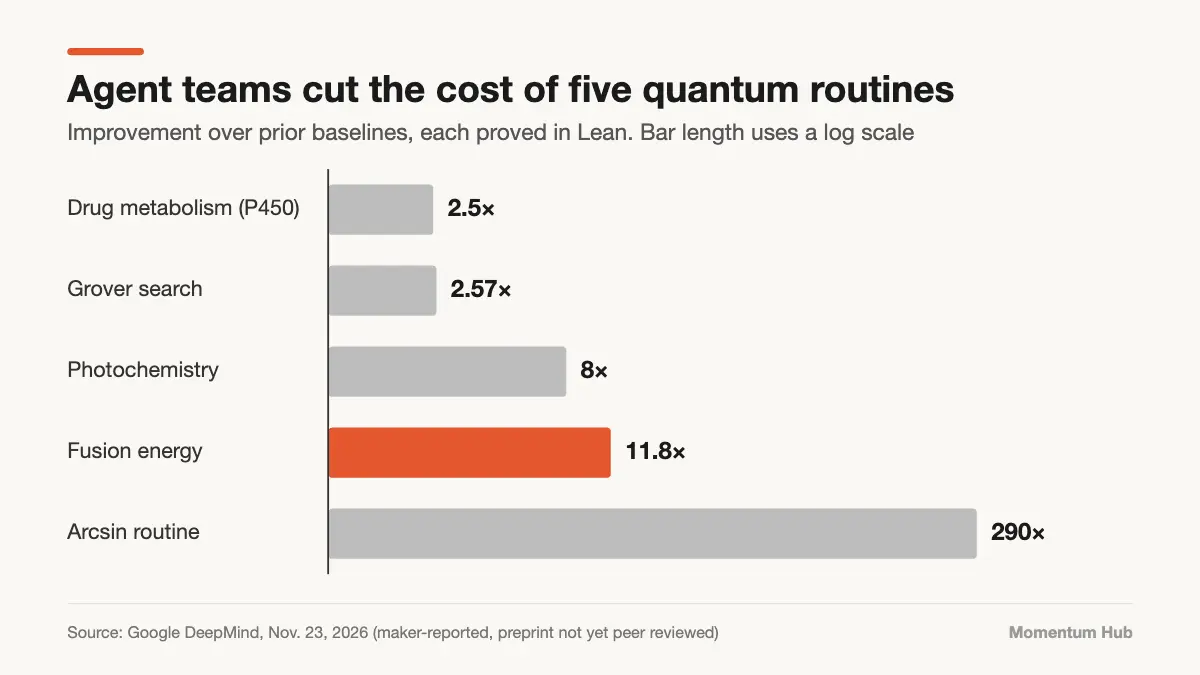
- Fusion energy. For a circuit that helps calculate a property of inertial confinement fusion, the agents cut computing cost by 11.8× and lowered memory from 5,650 to 4,338 error-corrected qubits.
- Photochemistry. For a common light-sensitive molecule, simulation became 8× cheaper.
- Drug metabolism. For Cytochrome P450, an enzyme that breaks down most human medicines, the agents found a 2.5× improvement and cut memory from 481 to 333 qubits.
- Core building blocks. A 2.57× speedup for a specific implementation of Grover’s search algorithm, and a 290× speedup for arcsin, a routine many quantum algorithms use to load numbers.
The paper’s abstract rounds some of these figures, giving 12× for fusion, for example. Both versions come from the same team.
What This Does Not Mean Yet
DeepMind is careful here, and you should be too. Running these quantum algorithms in real scientific simulations would still need more resources than the first error-corrected quantum computers are likely to provide. The results are machine-checked, which is strong evidence they are correct, but the paper is a preprint and the improvements are measured against baselines the team chose. Because the Lean library, specifications and verified solutions are public, others can check the proofs for themselves.
If you are curious about Lean itself, this introduction from the Ank Yog channel is a gentle start.
The Lesson for Anyone Building Agents
The reusable idea is not the quantum result. It is the pattern: let agents explore freely, but let nothing through until a checker approves it.
- Find your verifier. Tests, type checkers, schema validators and proofs all work. Pick the strongest one your domain allows.
- Gate the shared memory. DeepMind only let verified ideas into the notebook. Do the same with any knowledge base your agents share.
- Run teams in parallel, then compare. Independent teams with regular exchanges explore more ground than one long chain of work.
- Keep humans on direction. The researchers chose the problems and supervised progress. The agents did the search.
The open-source release is at github.com/google-deepmind/formal-quantum-computation. For more on the models behind this kind of work, see our explainer on GPT-6.2 Astra and Sol and our look at open models on Hugging Face.
Quick Questions, Answered
What did DeepMind’s agents find? Cheaper quantum algorithms for fusion, photochemistry and drug metabolism research, plus faster versions of two building blocks, Grover’s search and arcsin.
Why use Lean? Because these quantum algorithms cannot be tested on today’s hardware. Lean checks each proof mechanically, so a wrong idea cannot slip through.
Can I use the results? The Lean library, problem specifications and verified solutions are open source on GitHub. Running the algorithms at full scale needs future quantum computers.
Final Thoughts: Agents Plus Proofs
This is a glimpse of how research with AI agents may work: many parallel explorers, one strict gatekeeper, and humans choosing the questions. For quantum algorithms, the gatekeeper was Lean. In your work, it might be a test suite. Either way, the lesson is the same: agents are most useful when their output can be checked, so build the checking in first. For a broader view of where AI models are heading, our Inkling 2 Mini explainer is a good next read.