When something shocking happens, rumors move faster than facts. Within hours, people fill the gaps with theories, and fact-checkers often have little to work with. A new study in the Proceedings of the National Academy of Sciences asks whether an AI chatbot can help during that window. Researchers tested DebunkBot, a chatbot instructed to counter misinformation, in the days after two real crises.
The short answer, according to Cornell’s summary of the study, is yes, with limits: about 15% of people were talked out of their conspiracy belief. That adds something new to what we know from misinformation research: a test of debunking while events are still unfolding.
Key takeaways
- Researchers ran experiments days after the July 2024 attempt on Donald Trump’s life and after the September 2025 assassination of Charlie Kirk.
- A short chat with DebunkBot reduced conspiracy beliefs almost as much as it does for long-established theories.
- The chat was about five to seven times more effective than a fact sheet.
- The big catch: it only helps people who choose to talk to it.
15%
Share of people talked out of a conspiracy belief right after a crisis, according to Cornell’s summary of the PNAS study.
What DebunkBot Is
DebunkBot comes from researchers at Cornell, MIT and Carnegie Mellon, including Thomas Costello, David Rand and Gordon Pennycook. In a widely covered 2024 study, they showed that conversations with the bot reduced belief in established conspiracy theories, the kind about UFOs or chemtrails, where plenty of debunking material exists.
The bot gathers the evidence against a specific claim and presents it in a way tailored to the person’s own reasons for believing it. That works well when there is a lot of evidence to draw on. The open question was what happens when there is almost none, because the event just happened.
This CBS Mornings segment, recorded around the earlier study, shows how a conversation with the bot works.
How the New DebunkBot Study Worked
The team recruited people in the week after the July 13, 2024 attempt on Trump’s life and asked them to describe any conspiracy beliefs they held about it. Some blamed shadowy government insiders, while others suspected the event was staged. The researchers repeated the experiment after Charlie Kirk’s assassination in September 2025, with 472 and 1,042 U.S. adults taking part across the two experiments.
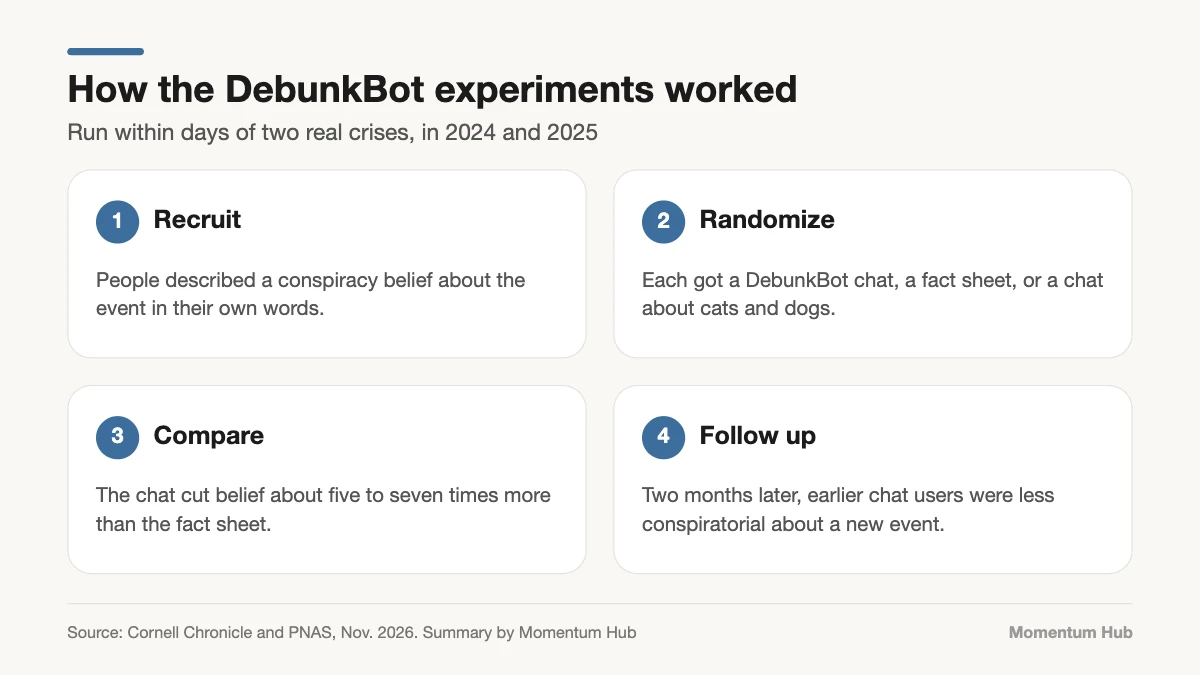
People were randomly assigned to one of three groups: a short conversation with DebunkBot about their specific belief, a fact sheet about the event, or a control chat with the bot about whether cats or dogs are better.
What the bot did differently
Besides laying out the evidence that existed, DebunkBot told people how little was known so far and encouraged them to look for information from trusted sources. That matters. In breaking news, honest uncertainty may persuade better than false confidence.
What the Results Show
After both crises, DebunkBot reduced conspiracy beliefs almost as effectively as it does for well-established theories, and about five to seven times more than the fact sheet. Thomas Costello, the study’s first author, described the goal as a way to “turn down the temperature in real time.”
There was also a follow-up. Two months after the first attempt on Trump, authorities arrested a gunman near his golf course. When researchers asked the original participants about this new event, those who had talked with DebunkBot were less likely than the control groups to hold conspiracy beliefs about it. That points to a lasting, inoculation-like effect, though the authors treat this part of the evidence as suggestive, so it needs replication.
The Record’s short explainer covers how the chatbot approach works.
The Catch: People Have to Show Up
The researchers are clear about the main limit. A person must first agree to talk with DebunkBot for it to work, and people deep in a conspiracy theory may be the least likely to open a chat with a fact-checking bot. As Costello put it, in our paraphrase, pulling people out is no longer the hardest part; getting them to engage is.
That leaves a practical question for platforms, newsrooms and researchers: where would a tool like this live? Some options worth testing:
- Inside search or social platforms, offered when people look up a breaking event, since feeds already shape what people see.
- Run by newsrooms alongside live coverage, with clear labels and sources.
- Used by community moderators who can invite someone into a conversation.
Each option raises questions about trust, consent and who controls the bot’s instructions. A tool that can persuade people away from false beliefs could, in other hands, persuade them toward false ones.
Why It Matters for Computational Communication
For researchers in computational communication, this study is a model of fast, field-relevant experimentation: real events, random assignment and a follow-up when a related event happened. It also connects to research on echo chambers, where simply changing what people see in their feeds has done little to shift attitudes. Tailored, evidence-based conversation seems to be what makes the difference.
Quick Questions, Answered
Did DebunkBot work as well as it does for old conspiracy theories? Almost. The researchers say it was nearly as effective, even with little information available.
Is 15% a big effect? For beliefs that are often seen as immune to facts, it is meaningful, especially from one short conversation.
Should AI fact-check breaking news on its own? Not on this evidence. The bot worked partly because it admitted uncertainty and pointed people to trusted sources, which keeps human reporting at the center.
Final Thoughts: Honest Uncertainty Can Persuade
The most useful lesson here may not be about AI at all. In the first hours of a crisis, admitting what we do not know and pointing to trustworthy sources can calm a rumor better than a list of facts. DebunkBot shows a well-instructed chatbot can do that at scale. The harder work is making sure the people who need it actually use it, and that whoever runs it deserves their trust.