Reuters journalists represented by The NewsGuild of New York voted to authorize a strike on November 16, 2026, the union said the next day. Nearly 96% of the unit took part, and 94% of those voted yes. Among the union’s demands is something new for a newsroom contract fight: a share of the AI licensing revenue that its members’ reporting helps earn.
That money is real. On its November 3 earnings call, Thomson Reuters said AI licensing brought Reuters about $19 million in the third quarter. Here’s what the numbers show, what each side has said, and why AI licensing is turning into a newsroom labor issue, one step beyond the question of who pays for news.
Key takeaways
- Reuters’ organic revenue grew 12% in the third quarter, helped by about $19 million of one-off licensing deals with AI companies; without them, growth was 7%.
- The Reuters Guild, which represents nearly 300 workers, authorized a strike after more than a year of bargaining. No strike has been called.
- The union says management rejected its AI proposals, including a cut of AI licensing revenue from members’ work.
- Thomson Reuters expects Reuters growth to be roughly flat in the fourth quarter, partly because these deals come and go.
$19M
Transactional generative AI content licensing revenue at Reuters in the third quarter of 2026, as chief financial officer Gary Bischoping said on the November 3 earnings call.
What the Reuters Guild Voted On
The vote
The Reuters Guild represents nearly 300 media workers, and its members have worked under an expired contract since December 2025. The union says it has filed five unfair labor practice charges since bargaining began. A strike authorization gives the bargaining committee the power to call a walkout; it doesn’t start one. Unit chair Scott DiSavino summed up the members’ view: “there is no Reuters without us.”
The AI demands
According to the union, management rejected three AI proposals: adequate human oversight of AI-generated content, reasonable pay for people whose jobs AI may eliminate, and a cut of profits from licensing revenue derived from members’ work. The Guild also objects to proposed raises it says trail inflation, a merit pay system it calls unfair, and managers doing union jobs. These are the union’s descriptions. When we checked on November 28, Reuters hadn’t published a response to the vote.
Where the AI Licensing Money Comes From
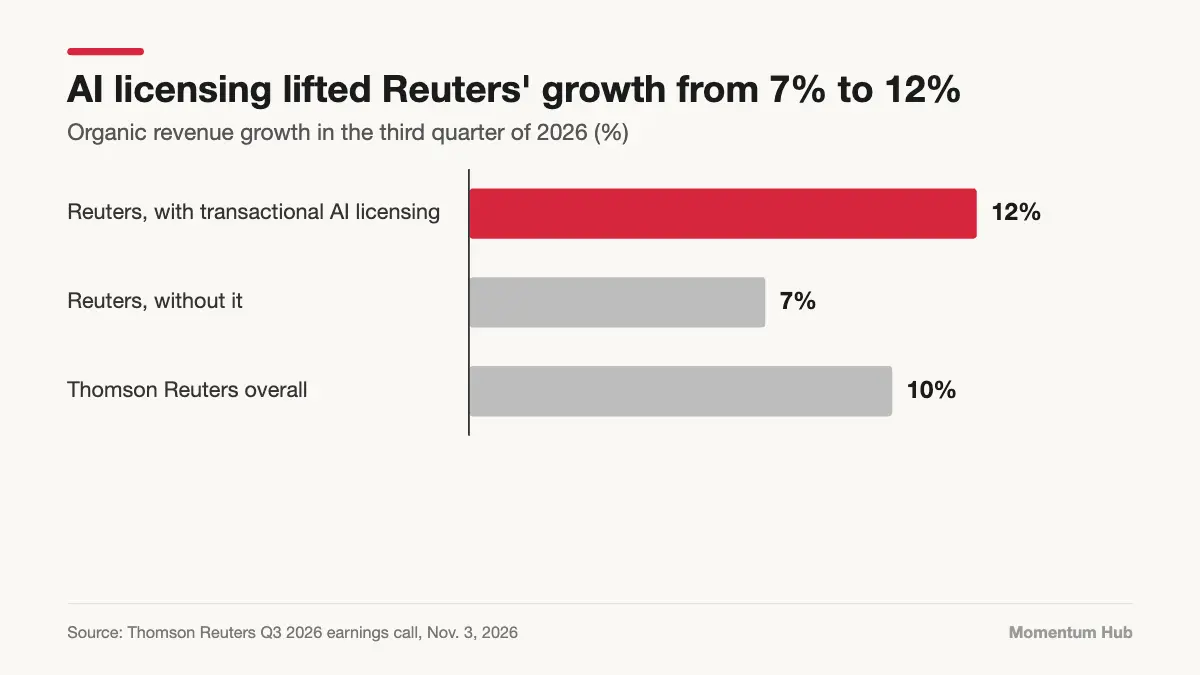
On the November 3 call, Bischoping said Reuters’ organic revenue grew 12% in the quarter, boosted by about $19 million of transactional generative AI content licensing. Leaving out that kind of revenue in the third quarters of both 2026 and 2025, Reuters grew 7%. Thomson Reuters’ results release describes that revenue as largely transactional, meaning deal by deal rather than recurring subscriptions.
Why one-off deals matter
One-off deals make AI licensing lumpy. Bischoping said the company expects Reuters growth to be flattish in the fourth quarter, partly because it laps $5 million of transactional licensing revenue from a year earlier. Revenue that swings by quarter is harder to plan around, for a company and for anyone bargaining over a share of it.
The Tow Center’s panel on AI content deals, with speakers from Scientific American and NewsGuild-CWA, asks whether these agreements help newsrooms or hurt them:
Why AI Licensing Is Becoming a Labor Question
Who made what’s being sold
AI licensing deals sell access to news reporting, archives or both, and the Reuters Guild argues that the journalists who produced that work should share in the proceeds. It’s one of the clearest tests yet of whether AI money reaches newsrooms, or only the companies that own them.
Wire services may gain the most
Publishers have split between licensing their content to AI companies and blocking or suing them, as our post on why The Wall Street Journal blocks AI bots by default shows. In a November 25 piece from the Reuters Institute, media consultant David Buttle suggested that if a few companies dominate consumer AI agents, a small number of news agencies might supply most licensed news, and Gina Chua pointed to specialized wire services such as AP and Reuters as one viable path. As AI becomes the front door to information, that would put wire journalists close to the money.
The National Press Foundation’s session looks at how courts and contracts are shaping these deals:
What to Watch Next
- Whether a strike is called. The authorization lets the bargaining committee call one; it doesn’t set a date.
- The fourth-quarter numbers. Thomson Reuters expects flat Reuters growth, so watch how much licensing revenue comes in.
- Contract language on AI. Any agreement could become a model for writing oversight and revenue sharing into newsroom contracts.
- The company’s side. Reuters hasn’t spoken publicly about the union’s AI proposals yet.
- How readers react. People already say they don’t want AI writing the news, which raises the stakes for oversight rules.
Quick Questions, Answered
Are Reuters journalists on strike? No. They voted to authorize a strike, which allows the bargaining committee to call one.
How much does Reuters earn from AI licensing? About $19 million in the third quarter of 2026, according to the company’s earnings call.
What does the union want from AI licensing? A cut of licensing revenue derived from members’ work, plus human oversight of AI-generated content and pay for jobs AI may eliminate.
Final Thoughts: AI Licensing Money Now Has More Stakeholders
For years, the licensing debate ran between publishers and tech companies. The Reuters vote brings the people who write the news to that table. However the talks end, the question of who shares in AI licensing money is unlikely to stay inside one newsroom.