
Your agent can write a feature in minutes, and then the pull request sits for a day waiting on review, fixes and an approval. Claude Ship, which Anthropic announced on November 23, 2026, goes after that wait: its agents review a pull request, fix what fails and approve the changes your team’s policy allows.
It builds on the idea behind the Claude Code team’s verification lessons: agent work should be checked before it ships. Here is how Claude Ship works, what it costs, and how to turn it on without quietly removing human review.
Watch the 2-minute version
Key takeaways
- Claude Ship bundles three agents: Code Review, which is generally available, plus PR Steward and Claude Approvals, both in beta.
- PR Steward fixes failing checks, merge conflicts and review comments, but it’s designed never to approve or merge.
- Claude Approvals follows a policy file you write, and Anthropic recommends starting it in observe mode.
- It needs a Team or Enterprise plan and GitHub, it’s billed on tokens, and it isn’t available with Zero Data Retention.
40%+
Drop in the share of reverted pull requests on the Claude Code team from June to September, while merged pull requests more than doubled. Anthropic’s own figure, from its Claude Ship announcement.
What Claude Ship Does
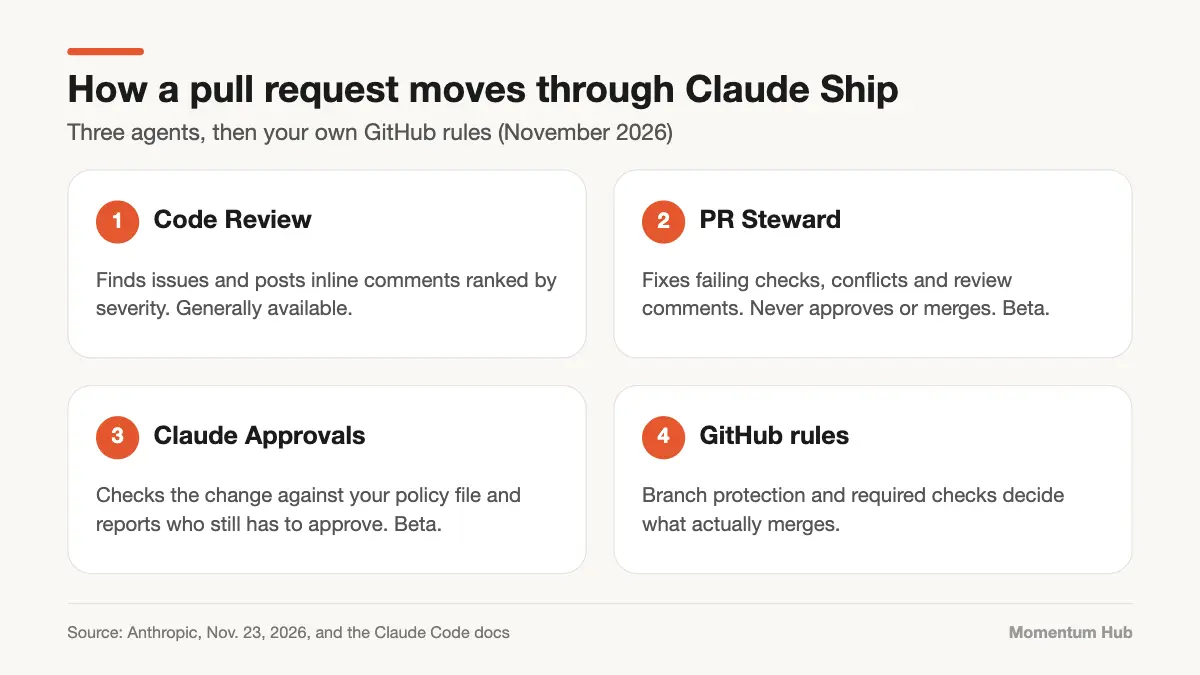
Claude Ship takes a pull request through three stages. You switch each agent on separately, and your existing GitHub rules still decide what merges.
Code Review finds the problems
Code Review reads the change alongside the surrounding code and posts findings as inline comments ranked by severity, according to the Claude Ship docs. Anthropic says it verifies findings adversarially before posting them, and admins choose a Quick, Standard or Deep review level for each repository.
PR Steward keeps the pull request green
PR Steward works on failing CI checks, merge conflicts and review comments from people or bots, then pushes fixes. After every push it comments with what it changed and how to undo it. You can steer it with an @claude comment or send it away with @claude stop. It is designed not to approve or merge anything.
Claude Approvals applies your policy
Claude Approvals reads .claude/approvals.yml from your default branch and reports who still has to approve a change. Anthropic compares it to a smarter CODEOWNERS file: a rule can let Claude approve routine changes and require people for sensitive ones. The check only blocks a merge where you make it a required check in GitHub.
How to Start With Claude Ship Safely
Anthropic’s setup guide is cautious, and it’s worth following in order:
- Pick one repository and turn on Code Review first.
- Add PR Steward in Manual mode, so it only starts when someone comments
@claude steward. Set a spend limit, because it has none until you add one. - Add an approval policy in observe mode. The check then reports what your policy would decide without blocking anything.
- Compare its decisions with your reviewers’ for a few weeks before you make it a required check.
Developers can also try it on their own work with the new /ship command in Claude Code, which pushes the change, opens the pull request, reviews it and works on the feedback:
/ship                # in Claude Code: push, open the PR, review and fix
@claude steward      # PR comment: start PR Steward in Manual mode
@claude stop         # PR comment: ask PR Steward to step back
Rob Shocks of Switch Dimension walks through what turning it on looks like in practice:
The Catch: Who Still Reviews the Code?
The policy file is where the new tool gets powerful, and where it can go wrong. InfoQ’s write-up points out three details worth knowing:
- The author can fill a seat. A rule that asks for one human seat can mean nobody else looks, and zero seats can let a bot-authored pull request merge with no person involved.
- Claude’s approval counts. Its approving review can satisfy a GitHub rule that requires one approval.
- Auto-merge removes the pause. Anthropic’s docs warn that with auto-merge or a merge queue, and a policy that doesn’t require a person, a change can merge without anyone acting.
Costs need watching too. Usage is billed on tokens, separately from your plan’s included usage, and a policy that calls Claude’s review triggers a billed Code Review even in observe mode. Anthropic’s starter policy is a good model: it asks for two people on paths under .claude/ and doesn’t let Claude approve those.
For a wider view of what this means for developers, Helena Liu’s breakdown is a useful listen:
Claude Ship also fits a bigger trend. Replit Missions uses a separate AI judge, and Copilot Evals tests agent behavior before you rely on it. Because PR Steward reads review comments and CI output, keep prompt injection in mind for any repository that takes outside contributions.
Quick Questions, Answered
Who can use Claude Ship? Organizations on Claude Team and Enterprise plans with repositories on GitHub. It isn’t available with Zero Data Retention, the HIPAA configuration or customer-managed encryption keys.
Will Claude merge my code on its own? PR Steward never approves or merges. Claude Approvals can approve when your policy allows it, and your GitHub branch rules decide what merges.
What does Claude Ship cost? It’s billed on tokens. Admins can set spend limits for Code Review and PR Steward, and eligible Enterprise organizations can claim at least $10,000 in credits by January 15, 2027.
Final Thoughts: Claude Ship Moves the Bottleneck
Claude Ship doesn’t remove the need for judgment. It moves that judgment into a policy file. If you try it, start with one repository, keep observe mode on until its decisions match your reviewers’, and keep a person on every path you can’t afford to get wrong.