
For three years, AI in newsrooms mostly meant experiments: chatbots, summaries, AI audio and AI-assisted investigations. This month the conversation shifted. At the JournalismAI Festival, organized by Polis at the London School of Economics, speakers spent less time on what AI can do and more on a harder question: does it actually work?
The Reuters Institute’s recap by Gretel Kahn, published November 25, 2026, distills three lessons about AI in newsrooms and pairs them with the institute’s own data on how quickly audiences are adopting AI. If you’ve followed our coverage of AI as the front door to information, this is the newsroom side of the same story.
Key takeaways
- AI in newsrooms is moving from experiments to evaluation, and teams are dropping projects that don’t deliver.
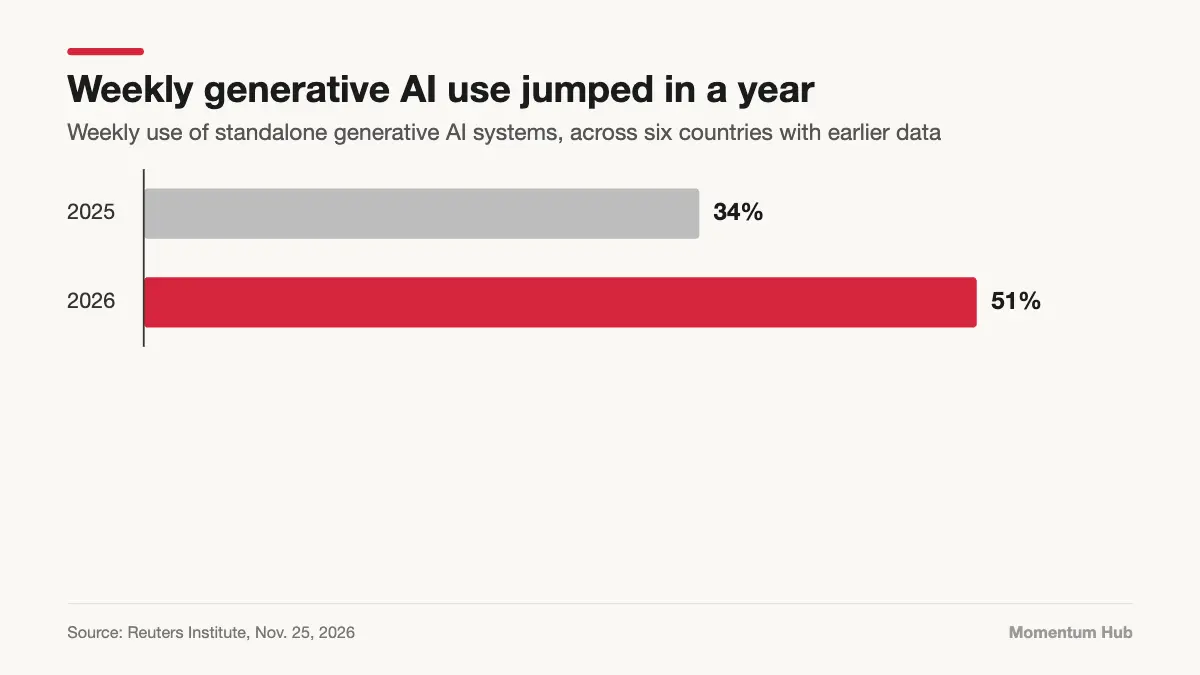
- Weekly use of standalone generative AI rose from 34% to 51% across six countries, according to the Reuters Institute.
- Speakers argued that value now comes from useful products, original reporting and trust, not raw information.
- Publishers are debating licensing terms with AI companies, with the Guardian pushing for compensation, control, citation attribution and consent.
51%
Weekly use of standalone generative AI in 2026 across six countries, up from 34% a year earlier, per the Reuters Institute.
Lesson 1: AI in Newsrooms Needs Evaluation, Not Just Experiments
Test small, measure honestly
Jay Barchas-Lichtenstein of the Center for News, Technology & Innovation explained why evaluating AI in newsrooms is hard: the same input can lead to different outputs. A good approach starts with knowing what you want to accomplish, tests tools with smaller groups before expanding, accepts that tools can’t do everything, and treats evaluation as ongoing rather than one and done.
Keep what works, drop the rest
The Sun tried a daily AI audio summary of its top five stories. Market research said audiences were interested, but that interest didn’t turn into listens, so the team paused it. What survived was the scriptwriting, now a tool called News Cue that turns articles into scripts for short videos presented by human journalists. “Look for the wins,” said Nadine Forshaw, the paper’s head of editorial innovation.
Norway’s Polaris Media did something similar. It retired its 2024 research tool, Polaris Agent, once general AI systems caught up, but reused its verification pipelines and agent setup elsewhere. Florent Daudens of Mizal AI argued for building evaluation in from the start: collect real user questions, involve editors in judging outputs, and keep refining prompts and safeguards.
Lesson 2: Deliver Value, Not Just News
Information that news outlets used to provide can now be personalized by AI agents, so the debate over AI in newsrooms is increasingly about value. Media consultant Dmitry Shishkin argued that audiences now ask for answers, not articles, and that newsrooms should ask what bots need from them too. Ezra Eeman of WAN-IFRA described the reversal: people start from a personal need and only then encounter the news.
Business models are the hard part. Consultant Madhav Chinnappa doubted that marketplaces or copyright alone can secure value for commodity news, and urged building products people want to pay for. The Guardian’s chief AI officer, Caspar Llewellyn Smith, sees a possible future where AI assistants send people to trusted publishers, though that isn’t guaranteed. Reuters Institute research fellow Felix Simon noted that people turn to AI largely for convenience, not trust, and that original reporting remains something AI can’t supply. That fits what audiences have told researchers about AI writing the news.
The full festival is online. Day 1, streamed by PolisLSE, includes many of these sessions:
Lesson 3: Who Shapes the Future of Information?
Speakers warned that journalism could repeat the mistakes of the platform era, growing dependent on tech companies that control distribution, audiences and revenue. Tami Hoffman, the Guardian’s director of public policy, argued for engaging with AI companies on licensing under a framework of compensation, control, citation attribution and consent. That debate connects to stories we’ve followed, from The Wall Street Journal blocking AI bots by default to who pays for the news.
A Practical Checklist for AI in Newsrooms
- Write down the problem you’re fixing before choosing a tool. A broken workflow stays broken with AI on top.
- Pilot with a small group and set success measures you can track.
- Build evaluation in from day one: real user questions, editors reviewing outputs.
- Keep a human in the loop for analysis and for anything that runs code.
- Stop projects that don’t work, and salvage the parts that do.
- Make your work easy for agents to read and cite, with clear structure and clear licensing terms.
The BBC’s Annika Grosser made the human-in-the-loop point from experience: AI helped her team analyze documents at a scale people couldn’t manage alone, but people stayed involved so the system never ran code or made assumptions without them.
The Reuters Institute’s Digital News Report 2026 launch, streamed by Reuters, adds the audience view:
Quick Questions, Answered
What is the JournalismAI Festival? An annual event on AI and journalism organized by Polis at the London School of Economics.
How many people use generative AI weekly? 51% in 2026 across the six countries the Reuters Institute can compare over time, up from 34%.
Is AI in newsrooms going away? No. Teams are keeping what works, dropping what doesn’t, and measuring more carefully.
Final Thoughts: AI in Newsrooms Grows Up
The most useful thing about this year’s festival was its honesty. Projects failed, teams said so, and the useful parts survived. That’s what maturity looks like for AI in newsrooms: fewer demos, more evidence, and a clearer sense of what only journalists can do.