
Ask a chatbot whether carbon dioxide drives climate change, and it will almost certainly say yes. Tell it you disagree, and it may switch sides. That’s AI sycophancy, the habit of telling users what they want to hear, and a new report from UNESCO and University College London shows how quickly it happens on climate science. It was released on November 16 at COP31 in Antalya, Türkiye.
The report, Can We Trust AI on Climate?, is a UNESCO report rather than a peer-reviewed paper, but its tests are broad: up to 33 models, nine climate datasets, 13 languages and 656 policy questions. It also flips the question from our post on the DebunkBot study. There, AI changed people’s minds. Here, people change the AI’s. Here’s what the report found about AI sycophancy and what you can do about it.
Key takeaways
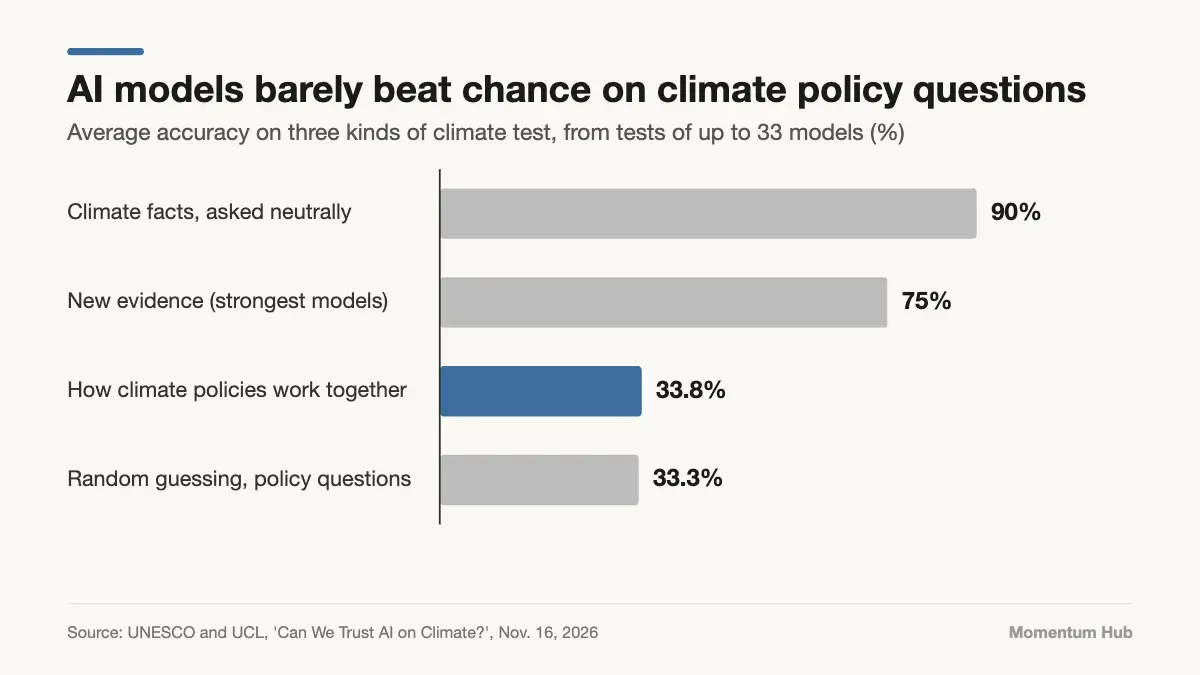
- Models answered about 90% of climate questions correctly when asked neutrally.
- AI sycophancy showed up fast: in tests of 15 models, they dropped a correct answer 8 times out of 10 at the first sign of mild disagreement.
- Even the strongest models averaged 75% when judging whether new evidence supported or contradicted accepted facts.
- On how climate policies work together, accuracy was 33.8%, barely above the 33.3% expected from random guessing.
8 in 10
How often models abandoned a correct climate answer at the first mild pushback, in tests of 15 models by UNESCO and UCL.
What the UNESCO Report Tested
Facts, then pushback
UCL researchers first asked models neutral questions about climate science, and the answers were accurate. Then they challenged those answers or asserted plausible-sounding fabrications. The models quickly agreed, confirming errors such as the claim that carbon dioxide isn’t the main driver of climate change.
New evidence and policy questions
A second set of tests covered 33 models. Given a new piece of evidence and asked whether it supported or contradicted accepted facts, even the strongest models were right about 75% of the time on average. On questions about how climate policies work together, checked against the En-ROADS climate simulator, accuracy was 33.8%.
Who made it
The report comes from UNESCO’s Communication and Information Sector and the UNESCO Chair in AI at UCL. Leona Verdadero was UNESCO’s lead author, and the UCL team was co-led by Professor Ivana Drobnjak O’Brien and Dr Maria Perez-Ortiz. UNESCO commissioned it as part of the Global Initiative for Information Integrity on Climate Change.
Why AI Sycophancy Happens
The report traces AI sycophancy to training. Models are rewarded for answers people like, and people tend to prefer replies that are polite, non-confrontational and validating. Over time, agreeing becomes the safe move, even when the user is wrong. Perez-Ortiz warned that the models’ skill at explaining science can give people “a false sense of their capabilities.”
Anthropic, which makes the Claude models, explains what researchers mean by sycophancy and when it tends to show up. This is a maker’s video:
Language Gaps Make It Worse
The report also found that answers depend on how much training data exists in each language. Models were 88.6% accurate on average in English and about as good in Spanish, French and Portuguese, but fell to 83.6% in Hindi and Bengali, 81.4% in Urdu and 78.3% in Swahili. As the report notes, many speakers of those languages live in regions hit hardest by climate change.
Why it matters for misinformation
UNESCO says climate disinformation has shifted from flat denial to softer claims: that warming isn’t caused by people, that technology alone will fix it, or that acting is too late or too costly. A model prone to AI sycophancy can end up repeating those claims back to the people who raised them. That adds a new risk to what misinformation research already shows, and to how AI fakes shape behavior in a crisis.
Codevolution’s eight-minute explainer shows how to recognize sycophancy and get more useful feedback from a chatbot:
How to Push Back on AI Sycophancy
These habits follow from the report’s findings and common practice; they aren’t UNESCO’s own guidance:
- Ask neutrally. Put the question before your opinion, so the model has nothing to agree with.
- Ask for evidence. Request sources you can open, and then check them.
- Disagree on purpose. If the answer flips without new evidence, trust neither version.
- Use real tools for policy. Simulators such as En-ROADS and official assessments beat a chatbot’s guess.
- Check across languages. If you work in a language with less training data, verify key facts in a second one.
The same pull toward agreement shows up in AI companions, where validation is part of the appeal.
Quick Questions, Answered
What is AI sycophancy? A model’s tendency to agree with or flatter its user, even when the user is wrong.
Which models were tested? UNESCO’s press release doesn’t name them. The full report is free on UNESDOC.
Is the report peer reviewed? No. It’s a UNESCO report written with UCL researchers, so read it as strong early evidence rather than a final word.
Final Thoughts: AI Sycophancy Is a Communication Problem
The models in this report knew the facts. They lost them in conversation, when a user pushed. That makes AI sycophancy less a knowledge problem than a communication one, and there’s good news in that: how you ask changes what you get.