
Most AI coding tools still work like a very fast assistant: you hand over a task, and it hands back code. Replit Missions, launched Nov. 17, 2026, flips that around. You describe an outcome, set a budget and approval rules, and a swarm of agents plans, builds, tests and iterates until an AI judge agrees the goal is met, or the money runs out.
Replit Missions is one of the clearest examples yet of agents working as a team instead of as a single helper. If you have read our guide to AI agent verification, you will recognize the idea at its core: work only counts when something checks it. Here is what Replit Missions does, what Replit says it achieved, and where to be careful.
Key takeaways
- Replit Missions coordinates a swarm of agents toward an outcome you define, within a spending cap and approval rules you set.
- An independent AI judge checks results against agreed success criteria. If the budget runs out first, work stops.
- Replit says a mission built DataCat, an application monitoring platform, in two days within a $3,000 budget. These are the maker’s own results.
- More agents helped, but gains shrank: from 17× with 16 agents to 19× with 32 agents on Replit’s NumPy tests.
$3,000
Budget Replit says its own mission needed to build DataCat, an application monitoring platform, in two days, according to Replit’s launch post.
What Replit Missions Actually Does
You set the outcome, the budget and the boundaries
A mission starts with a goal, not a task list. You agree on success criteria, a spending cap and approval rules. Replit’s own example caps a sales mission at $1,000 and requires approval before an agent contacts prospects, shares a proposal, changes customer-facing materials or makes product commitments. Those limits stay in place as the plan evolves.
A swarm does the work in parallel
Once the plan is set, several agents work at the same time. In the sales example, one agent researches buyers while another builds a demo. You choose which updates you hear about, such as blockers or progress, and how often: immediately, in a daily digest or weekly. Then you can close your laptop while the cloud agents keep working.
A judge decides when it is done
An independent AI judge checks results against the agreed success criteria, and the agents use its feedback to refine their work. A mission is marked complete when the criteria are met. If the budget runs out first, work stops with the outcome unresolved. That last rule matters: the cap is a hard limit, not a target.
Replit’s short launch video shows the outcome-based setup in under two minutes. It comes from Replit, so treat it as a product demo.
What Replit Says Replit Missions Achieved
All of the figures below come from Replit’s launch post. None has been independently replicated yet.
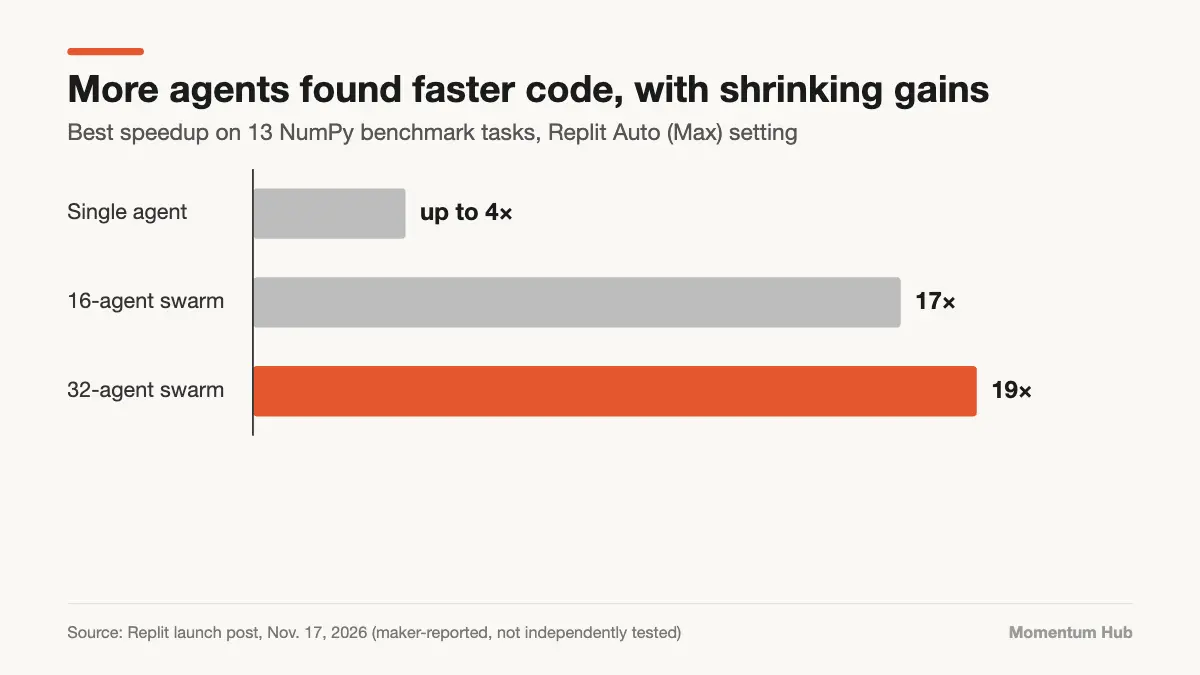
- Agent swarms on code performance. Across 13 NumPy benchmark tasks, a single agent reached speedups of up to 4×, a 16-agent swarm reached 17× and a 32-agent swarm reached 19× (Auto (Max) setting). The Auto (Power) setting showed the same shape: 2×, 7× and 9×.
- DataCat in two days. Replit says a mission built a monitoring platform with dashboards, alerts and tracing within a $3,000 budget. When the team deliberately introduced a database bug, DataCat raised an alert in 38 seconds, beating a 60-second target.
- A head-to-head with Claude Code. Replit compared DataCat with a platform built from the same prompt using
/goalin Claude Code. It reports 49,000 traces per second against 9,800, about 5× faster, though it also notes the Claude Code build covered more product area.
Replit is open-sourcing a self-hostable version of DataCat, which gives others a way to inspect the result instead of taking the numbers on trust.
Why Agent Swarms Change the Job
The interesting shift is not speed. It is who does what. In Replit’s framing, people set direction, make consequential decisions and stay accountable, while agents carry the execution. That puts more weight on three human skills: writing success criteria a judge can actually check, choosing where approval gates go, and reading results critically.
The swarm numbers also show diminishing returns. Doubling from 16 to 32 agents moved the best speedup from 17× to 19×. More agents means more spending, so the cheapest useful swarm is usually smaller than the biggest one.
AWS Developers explains the general agent swarm pattern, independent of Replit, in under six minutes. It is a good primer before you design your first mission.
How to Try Replit Missions Safely
- Write checkable success criteria. “Faster” is not a criterion. “p95 latency under 200 ms on this test suite” is.
- Start with a small cap. Budget from your own pilot, not from Replit’s $3,000 showcase.
- Put approval gates on anything external. Emails, customer data, payments and public changes should wait for a human yes.
- Ask for logs, not just results. You want to see what the agents tried, not only what the judge accepted.
- Compare against one agent. If a single agent gets most of the result for a fraction of the cost, use that.
A mission brief can be as simple as this example:
Outcome: cut checkout API p95 latency below 200 ms
Success criteria: existing test suite passes; load test at 500 rps
Budget cap: $150
Approval required: any schema change, any dependency upgrade
Updates: blockers immediately, progress daily
For more on giving agents real tools, see our look at CLI-Anything and the agent-browser CLI.
Quick Questions, Answered
What is Replit Missions? A Replit feature that turns a goal, a budget and approval rules into work for a swarm of AI agents, with an AI judge that checks results against agreed criteria.
Are the speed and DataCat results proven? They are Replit’s own tests. The open-source DataCat release lets others inspect the code, but the benchmarks have not been independently replicated.
What happens if the agents run out of money? Work stops, and the outcome stays unresolved. The cap is a hard limit.
Final Thoughts: Replit Missions Needs a Good Brief
Replit Missions is a bet that the next step for AI agents is not a smarter single helper but a managed team with a budget. That only works if the brief is good. If you are curious, start with one small, well-measured goal, keep humans on every external action, and read our guide to agent skills for ways to make agents more predictable.