
- 1. AI Labels Are Now Part of Everyday Reading
- 2. Summaries Are the Most Visible Form of AI-Generated News
- 3. Comfort With AI-Made News Is Very Low
- 4. Yet People Trust the Answers AI Gives Them
- 5. Labels Inform, but Do Not Protect
- 6. Human Accountability Is What Audiences Want
- Guidelines for Newsrooms and Communicators
- A Note on the Data
- Quick Questions, Answered
- Final Thoughts: Show the Human
AI-generated news is no longer rare or hidden. In a typical week, about a quarter of people now notice a label telling them AI was involved in something they read, and one in five sees an AI-written summary of the news. Familiarity has grown fast. Acceptance has not.
That is the picture in the Reuters Institute’s “Generative AI and News Report 2026,” covered by Nieman Lab on November 10. We looked at the report’s findings on search and discovery in AI as the gateway to news. This post focuses on a different question: what do audiences actually accept?
Key takeaways
- Across nine countries, 24% saw an AI label in the past week and 20% saw an AI news summary.
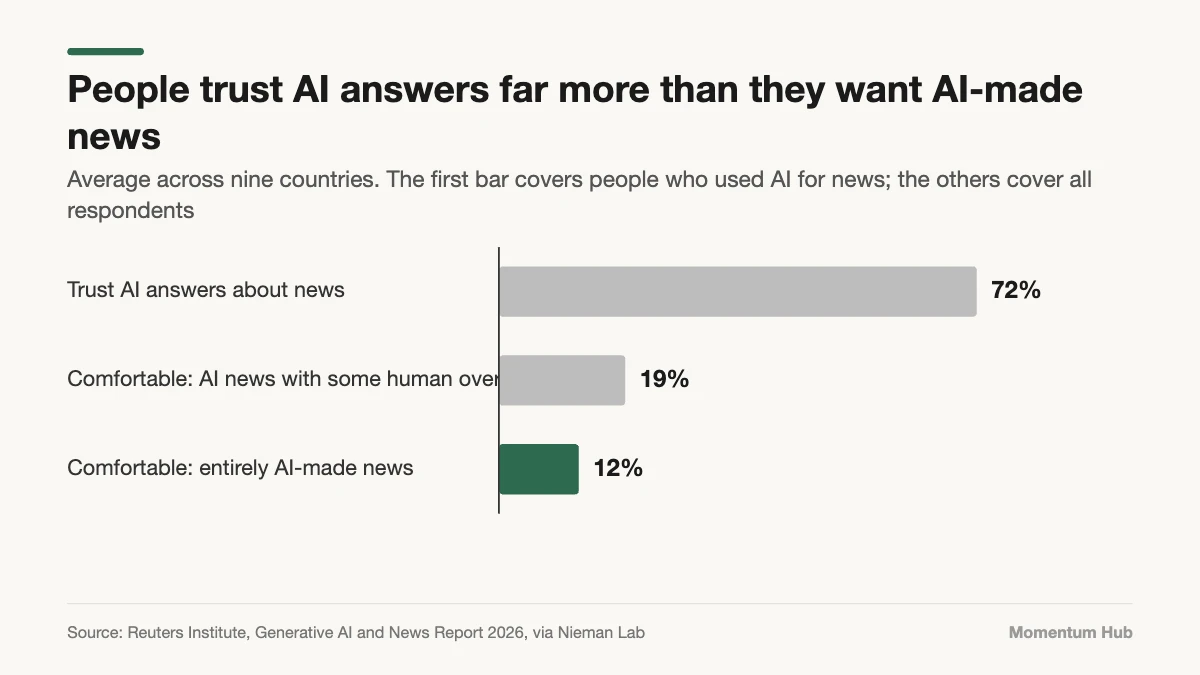
- Only 12% are comfortable with news made entirely by AI. With some human oversight, that rises to just 19%.
- People who use AI for information mostly trust its answers, including on news.
- Labels inform people but do not change how persuasive content is, according to separate research.
12%
Share of people, averaged across nine countries, who are comfortable with news made entirely by AI. Source: Reuters Institute, via Nieman Lab.
1. AI Labels Are Now Part of Everyday Reading
On average across the nine countries surveyed, 24% of people said they had seen a label noting that content was made with AI in the last week. A year or two ago this was a niche experience. Now it is routine.
That changes what a label means. When something is rare, it is a warning. When it is everywhere, it becomes background, and people stop reading it.
2. Summaries Are the Most Visible Form of AI-Generated News
One in five people, 20%, saw a bullet-point AI summary of a news story in the past week. For most audiences, this is what AI in journalism looks like: not a robot reporter, but a short box at the top of an article.
Summaries are useful, and they carry a quiet risk. A reader who stops at the summary never meets the nuance, the sourcing, or the caveats in the full story.
3. Comfort With AI-Made News Is Very Low
Here is the core finding. Only 12% of people say they are very or somewhat comfortable with news made entirely by AI. Adding “some human oversight” lifts that to just 19%.
The report’s authors, Felix Simon, Rasmus Kleis Nielsen, and Richard Fletcher, describe attitudes as entrenched. People are not warming to the idea as they see more of it.
4. Yet People Trust the Answers AI Gives Them
The same survey shows a striking contrast. Among people who used AI tools for factual questions, 75% trusted the answers. Among those who used AI to get news, 72% trusted what they got. About half of people in the countries with earlier data now use AI tools weekly, and the share using them for news has tripled in two years, from 3% to 9%.
So the public is skeptical of AI as an author of journalism and fairly trusting of AI as a personal assistant. People seem to draw a line between a tool they direct and a product made without a person behind it.
5. Labels Inform, but Do Not Protect
If audiences are uneasy, will a clear label fix it? Evidence suggests labels do less than hoped. A study in PNAS Nexus with 1,601 Americans found that telling people a message was AI-written did not reduce how persuasive it was or how accurate they judged it to be.
Labels are still worth having, because people have a right to know. They are just not a safety mechanism on their own. We covered the wider detection problem in detecting AI-generated content.
6. Human Accountability Is What Audiences Want
Put the findings together and a pattern appears. People accept AI help. What they resist is the absence of a responsible human. The jump from 12% to 19% with “some human oversight” is small, which suggests vague oversight is not enough. Audiences want to know who checked the work and who answers for it.
Guidelines for Newsrooms and Communicators
- Label AI involvement consistently, in plain words, in the same place every time.
- Say what the AI did. “Summary generated by AI and reviewed by an editor” tells people more than a generic tag.
- Keep a named person accountable for anything published, and make that visible.
- Use AI for formats, such as summaries, translations, and audio versions, more than for judgment.
- Publish a short, readable AI policy and link to it from your labels.
- Ask your own audience. Comfort varies by topic, and local feedback beats global averages.
A Note on the Data
The figures here are averages across nine countries, as reported by Nieman Lab from the Reuters Institute report. National results differ, and the trust figures apply only to people who already use AI for that purpose, who are likely to be more favorable. Check the full report before quoting numbers for a specific country.
Quick Questions, Answered
Do audiences reject all AI in journalism? No. They are more open to AI helping behind the scenes than to AI producing the journalism itself.
Will acceptance grow with exposure? So far it has not. The researchers describe attitudes as stable and negative, even as exposure rises.
Is a label enough to be ethical? It is necessary, not sufficient. People also want to know that a person is responsible for accuracy.
Final Thoughts: Show the Human
The lesson for AI-generated news is not to hide the machine or to apologize for it. It is to show the person. Audiences will accept a great deal of AI assistance when they can see who is accountable. That principle runs through our look at how AI is redefining the rules of communication, and through much of our AI and Communication section.