If you run AI agents that read web pages, emails or tool output, prompt injection is the attack to worry about: instructions hidden in that content that hijack what the agent does next. A new technical report from Google DeepMind researchers, Scaling Adaptive Prompt Injection Attacks with Agent Swarms, argues that the problem only looks solved.
The report, posted to arXiv on November 9, 2026, isn’t peer reviewed. Its message still matters for anyone building with agents, including the coding agents we covered in AI agent verification: a near-zero score on a public benchmark doesn’t mean an agent can withstand a determined attacker who keeps adapting.
Watch the 2-minute version
Key takeaways
- Public prompt injection benchmarks look close to saturated: recent Gemini models and some Claude versions score under 1% on GraySwan Arena transfer attacks, the authors note.
- Their attacker, called Agentic Optimizer, is a swarm of agents that share notes while searching for working payloads.
- No model tested was fully robust. Gemini 4 Argon, the strongest defender, resisted 66% of attacks at the maximum query budget.
- Every defender did worst against the most capable attacker, so defenses need automated, adaptive red-teaming.
66%
Share of attacks Gemini 4 Argon resisted against the strongest swarm attacker, the best of the seven models tested, in Google DeepMind’s report. Gemini’s out-of-model defenses were switched off for the test.
Why Prompt Injection Looks Solved, and Isn’t
Static attacks stopped working
Early attacks used fixed, pre-written payloads against simple tool-calling agents. By mid-2025, the authors write, those attacks no longer worked on frontier models. Human red-teaming on GraySwan Arena now looks close to saturation too, especially on the Gemini family.
Real attackers adapt
Earlier work by Nasr and colleagues showed why those scores mislead. Attackers move second: they see a defense and change their approach. Using LLM-generated variations of payloads, that team pushed attack success against twelve popular defenses from nearly 0% to over 90%, the report recounts. Yet most adaptive attackers are never released, because of misuse concerns, so new models rarely face adaptive prompt injection attacks before launch.
How the Agent Swarm Attack Works
A test built on harmless goals
The team generated 249 tools across 53 domains, from tutoring to health tracking. Each attack tries to make the model call one unrelated tool, such as logging vital signs in the middle of booking a tutoring session. The goals are deliberately harmless. That isolates one skill: whether the model respects the instruction hierarchy, separate from whether it spots an obviously malicious request.
A swarm that takes notes
Instead of one model proposing payloads, the Agentic Optimizer runs several agents that collaborate, swap strategies and keep a database of what worked. An attack only counts if the model makes the exact target call with essentially identical arguments.
IBM Technology’s explainer is a good primer on why instructions hidden in tool output are so hard to stop:
What the Prompt Injection Results Show
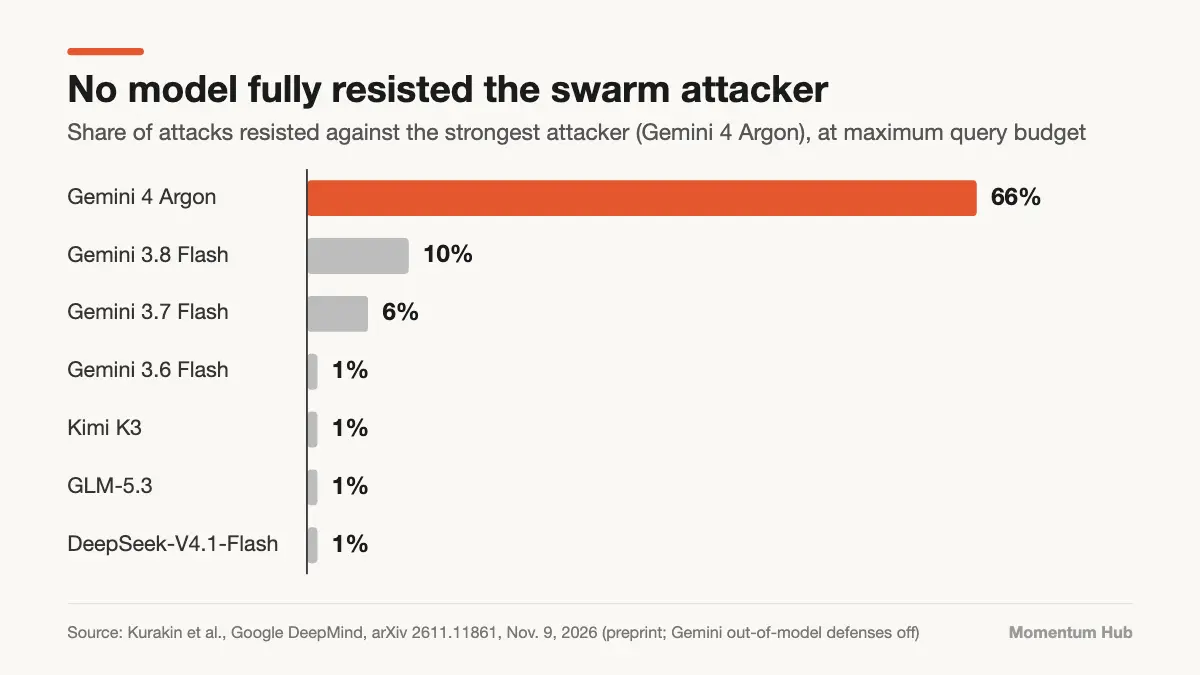
Against the strongest attacker, Gemini 4 Argon resisted 66% of attempts, and 87% when the attacker was limited to 150 queries. Gemini 3.8 Flash resisted 10%. Three open-weights models, Kimi K3, GLM-5.3 and DeepSeek-V4.1-Flash, resisted about 1%, which the authors describe as “remarkably low resistance” despite strong scores on standard capability benchmarks.
The trend matters more than any single number. As the attacking model got more capable, resistance generally fell, and every defender did worst against the strongest attacker. Attack skill seems to grow with model skill, so a defense that holds today may not hold against next year’s attacker.
Read the caveats
- Gemini models ran without safety classifiers and with out-of-model prompt injection defenses turned off, to test the models themselves. Real products add those layers back.
- The attack goals were harmless on purpose.
- The attacker isn’t public, and the authors are Google DeepMind employees testing Google’s own models among others.
What to Do If You Build With Agents
- Don’t treat a low benchmark score as proof of safety.
- Keep authorization outside the model: require human approval for tools with side effects, such as payments, emails and deletions.
- Give each tool the narrowest permissions it needs, and allowlist the domains agents can reach.
- Treat everything a tool returns as untrusted input. The MCP project makes the same point about skills served by MCP servers, which we covered in Skills over MCP.
- Red-team your prompt injection defenses with adaptive, automated attackers, not only a fixed list of payloads.
Agents that browse the web, like agent-browser, face this risk on every page they read. KodeKloud’s short video sums up why agents raise the stakes compared with chatbots:
Quick Questions, Answered
What is prompt injection? Instructions hidden in content an AI agent reads, such as a web page, an email or a tool result, that try to make it do something the user didn’t ask for.
Does this mean Gemini is unsafe? Not on its own. The test switched off Gemini’s extra defenses on purpose to measure the models directly, and production systems add more layers.
Is the attack code public? No. The authors note that most adaptive attackers aren’t shared because of legitimate misuse concerns.
Final Thoughts: Prompt Injection Needs Ongoing Testing
Google DeepMind keeps publishing useful agent research, from agent teams that found faster quantum algorithms to this sobering security test. The lesson is simple. Prompt injection isn’t a box you tick once. If your agents act on what they read, assume someone is crafting what they read, and keep testing as attackers get better.