
Black Friday has a new kind of shopper this year: an AI agent. On November 24, 2026, Walmart announced that customers can shop its deals through Meta Muse, Meta’s personal AI agent, which can find items, build a basket and complete the purchase inside the conversation.
Walmart is one of the first big retailers to let an outside agent go all the way to checkout. The most interesting part isn’t the agent. It’s the rules around it, the same theme we explored with Replit Missions, where agents work inside a budget you set. Here is how shopping with Meta Muse works, what it protects, and what it leaves unanswered.
Watch the 2-minute version
Key takeaways
- Meta Muse connects to the Walmart Agent Gateway, passes your shopping list to Walmart, and Walmart picks the matching products.
- You set up an Agent Profile on Walmart with a spending limit, and you can require approval before purchases.
- Muse doesn’t get your Walmart shopping history or other personal information, according to Walmart and TechCrunch.
- Amazon is going the other way, taking steps to stop third-party agents from buying for its customers.
3
Controls Walmart’s Agent Profiles give you over an AI agent: a spending limit, approval before purchases, and a history that shows which orders your agent made, per Walmart.
How Meta Muse Shops at Walmart
Muse asks, Walmart shops
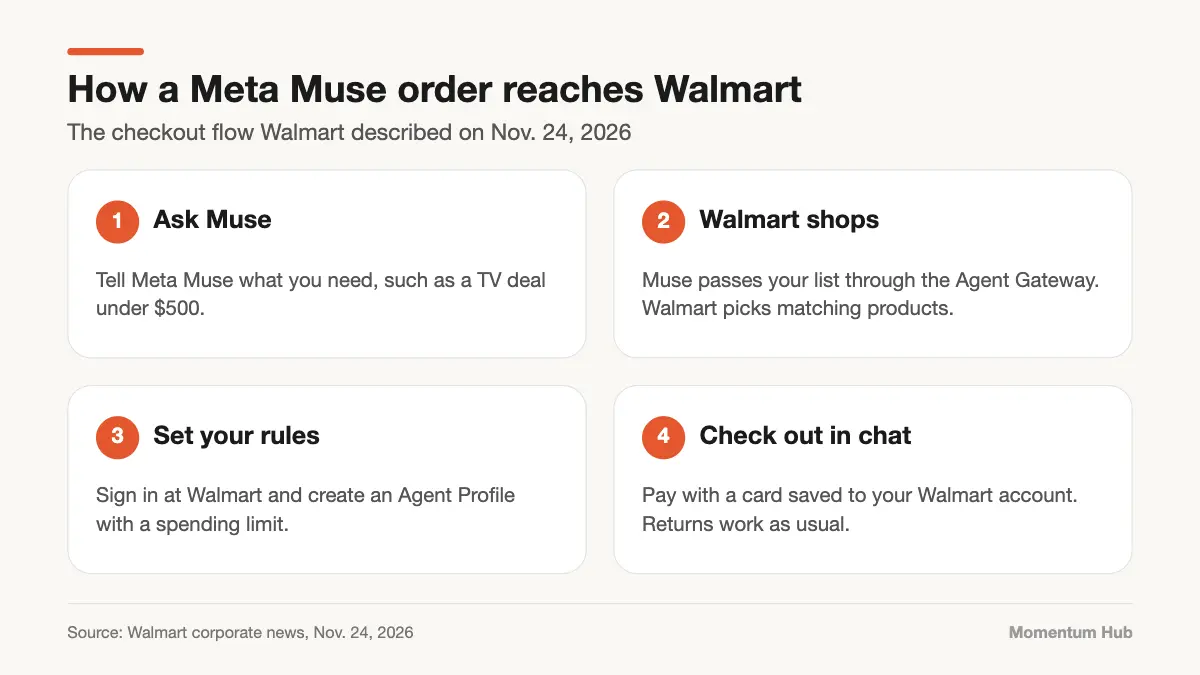
Walmart describes a clear division of labor. You tell Muse what you need, say a TV deal under $500 or the season’s hottest toys. Muse passes your list through the Walmart Agent Gateway, and Walmart does the shopping, returning products that match. Prices are the same as on Walmart.com, and membership perks such as free delivery still apply, Walmart says.
Checkout happens in the chat
The first time you add an item to your cart, Muse sends you to Walmart to sign in. There you set up an Agent Profile in your Walmart account, including a spending limit you’re comfortable with. Then you complete the purchase in the conversation with a card already saved to your Walmart account. If something isn’t right, Walmart’s return policy still applies.
What the Agent Gateway Protects
Walmart’s pitch is control. The gateway helps agents find products “without sharing customers’ broader purchase history,” the company says, and TechCrunch’s report adds that Muse doesn’t see your Walmart shopping history or other personal details. You can also delete the agent’s profile whenever you want.
The gateway itself launched in October, and Walmart plans to open it to more apps and agents, so Meta Muse is likely the first of several assistants that can shop there. TechCrunch notes that Instacart has also teamed up with Muse.
NBC10 Boston’s earlier segment on Walmart’s agent shopping plans captures how many shoppers feel about this: interesting, and a little scary.
Walmart vs Amazon: Two Bets on Agent Shopping
TechCrunch frames the launch as a split in strategy. Amazon has taken steps to stop third-party AI agents from making purchases for customers, while Walmart is leaning in with Meta Muse and its own assistant, Sparky. Open-source tools like agent-browser already let agents click through ordinary websites, so retailers are deciding now whether to block that or to offer a front door with rules attached. Walmart chose the door. For you as a shopper, the difference is practical: at Walmart your agent can finish the job, while at stores that block agents it has to hand the last step back to you.
What’s Still Unclear
Walmart’s announcement answers the basics, but a few important questions remain open:
- Walmart hasn’t said how many customers have linked an Agent Profile to Meta Muse.
- It hasn’t explained what happens if an agent is tricked mid-session by hidden instructions on a page, a risk security researchers call prompt injection.
- Commercial terms between Walmart and Meta, including any fees, aren’t public.
Those gaps are why the limits you set matter more than the agent’s judgment.
How to Set Up Meta Muse Shopping Safely
- Start with a low spending limit when you create the Agent Profile.
- Turn on approval before purchases, at least for your first few orders.
- Check your purchase history regularly for orders your agent made.
- Delete the Agent Profile when you’re done with holiday shopping.
Payment companies are building similar guardrails for agents. Stripe’s developer team shows how its Link agent wallet lets agents check out and subscribe. This is Stripe’s own product video:
If you work in retail or marketing, our guides to tracking AI search traffic and Black Friday pricing and brand trust pair well with this shift.
Quick Questions, Answered
Does Meta Muse see my Walmart order history? No, according to Walmart and TechCrunch. The gateway shares products, not your broader purchase history.
Can Meta Muse spend money without asking? Only within the spending limit you set, and you can require approval before every purchase.
Can I return something my agent bought? Yes. Walmart says its return policy still applies to agent orders.
Final Thoughts: Set the Rules Before the Agent Shops
Meta Muse at Walmart is an early look at how agent shopping may work: the agent talks, the retailer shops, and you set the limits. Treat the spending cap and the approval step as the real safety features, start small, and check what your agent bought. If your agent ever surprises you, the purchase history in your Walmart account is the first place to look.