
- 1. DuckDB 2.0 Can Act as a Server
- 2. Faster Reads With Asynchronous I/O
- 3. A First-Class VARIANT Type
- 4. Agent Mode for AI Coding Tools
- 5. Triggers Arrive
- 6. A New, Extensible SQL Parser
- What to Check Before You Upgrade
- A Safe Upgrade Plan
- Where This Fits
- Quick Questions, Answered
- Final Thoughts: A Bigger Duck, Same Idea
DuckDB 2.0 is the biggest release in the history of the small analytics database that keeps turning up in places servers used to be. It shipped on October 21, 2026 as a long-term support version, and a month on, with early reviews and benchmarks in, it is a good time to ask what is actually worth adopting.
The team calls it their largest feature release so far, built from close to 20,000 commits since version 1.5. This guide covers the six changes that matter most, drawing on the official announcement, and ends with a safe upgrade plan.
Key takeaways
- DuckDB 2.0 can now run as a server, so several processes can read and write the same database.
- Asynchronous I/O speeds up reads of Parquet and CSV files, especially from cloud storage.
- Agent Mode changes command-line output when an AI coding agent is driving, cutting what the model has to read.
- Files created by 2.0 cannot be read by older versions, so plan the upgrade instead of drifting into it.
59%
Reduction in the amount of DuckDB output an AI model had to read with Agent Mode on, in the authors’ own TPC-H experiments. Source: the DuckDB 2.0 announcement, as summarized by daily.dev.
1. DuckDB 2.0 Can Act as a Server
DuckDB made its name as an embedded database: it runs inside your application or notebook, with no server to manage. The trade-off was that a database file could have only one writer at a time.
Version 2.0 ships a polished version of the Quack protocol, which lets DuckDB run in a traditional client-server setup. A new CONNECT statement attaches to a remote database, and the command line gains -serve and -connect options to start or join a server. For small teams, this removes a common reason to move to a heavier database.
2. Faster Reads With Asynchronous I/O
The second headline is speed. DuckDB 2.0 reads Parquet and CSV files asynchronously, which helps most when the data lives in cloud object storage and each request involves a network round trip.
There is also a new remote pushdown optimizer for PostgreSQL and MySQL. It sends queries to the remote server to run there, instead of pulling whole tables over the network first.
3. A First-Class VARIANT Type
Semi-structured data, such as JSON events from an app, has always been awkward in a strictly typed database. The VARIANT type gives it a proper home, so mixed-shape records can be stored and queried efficiently without flattening everything in advance.
If your pipelines spend effort wrangling JSON into columns before analysis, this is the feature to test first.
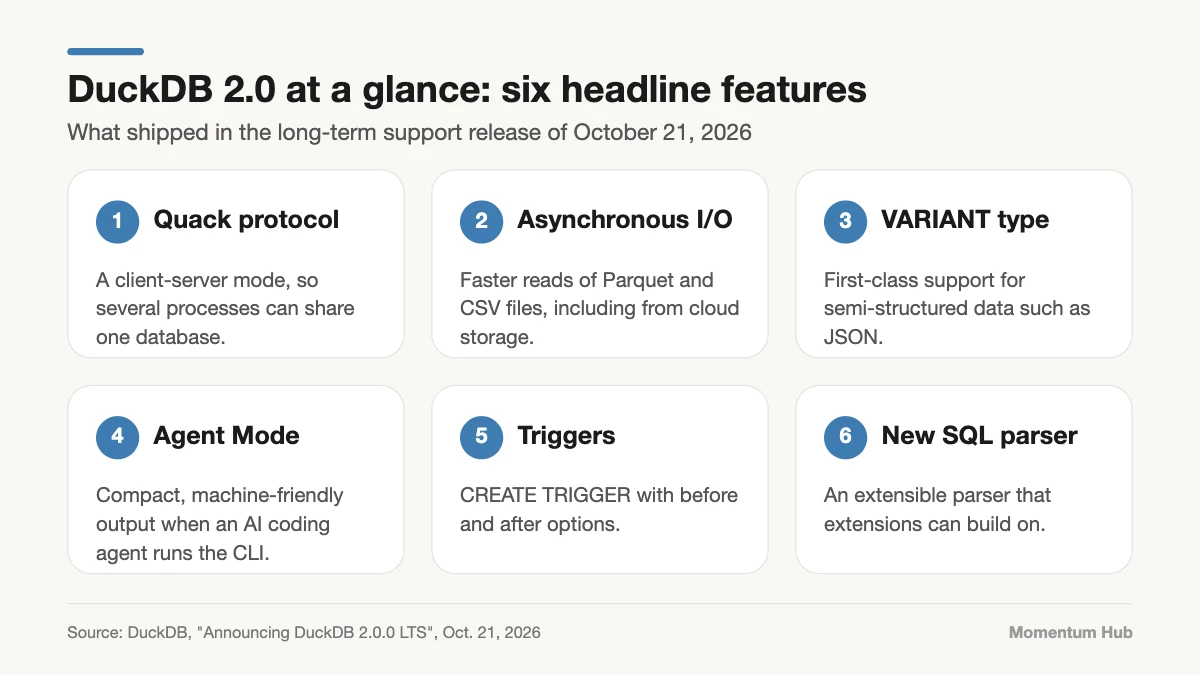
4. Agent Mode for AI Coding Tools
This one is a sign of the times. DuckDB’s command-line tool now detects when an AI coding agent is running it and switches to compact, machine-friendly output, with errors in a structured format.
The reason is cost and accuracy. Agents read every character a tool prints. Tables drawn for human eyes waste the model’s attention. In the authors’ own tests, Agent Mode reduced the output a model had to read by 59%.
5. Triggers Arrive
DuckDB 2.0 adds CREATE TRIGGER, with before and after triggers at the row or statement level. Triggers let the database react automatically to changes, for example by writing an audit record whenever a row is updated.
This is a familiar feature from larger databases, and its arrival is another step in DuckDB’s move from a clever analytical tool to a more complete system.
6. A New, Extensible SQL Parser
Under the surface, 2.0 moves to an extensible parser that had been opt-in in earlier versions. For most users the effect should be invisible. For anyone running unusual or hand-tuned SQL, it is the change most likely to produce a surprise, so it belongs on your test list.
What to Check Before You Upgrade
Two compatibility points stand out in coverage of the release.
- File format. Versions of DuckDB before 2.0 cannot read database files created by 2.0. If different tools in your stack bundle different DuckDB versions, upgrade them together.
- Support window. As a long-term support release, 2.0 is supported until at least October 2027, which makes it a reasonable version to standardize on.
A Safe Upgrade Plan
- Copy a representative database and run your full query suite against it on 2.0 before touching production.
- Pin the client library version in every project, so upgrades happen on purpose.
- Benchmark your slowest cloud-storage queries before and after. Async I/O gains vary by workload.
- Try server mode with one small team workflow before relying on it widely.
- Pilot Agent Mode on non-production data if your team uses AI coding assistants.
- Keep a backup in a format older versions can read until every tool has moved.
- Consider waiting for the first patch release if you run business-critical jobs.
Where This Fits
DuckDB 2.0 strengthens the case for doing more analysis close to the data, on a laptop or a single machine, before reaching for a large platform. It does not replace a warehouse for big, shared, governed data. We compared those options in data lake or data warehouse, and covered the surrounding architecture in cloud data engineering.
Quick Questions, Answered
Is DuckDB 2.0 safe for production? It is a long-term support release, which signals stability. Test your own workloads first, especially around the new parser and file format.
Does server mode make DuckDB a replacement for PostgreSQL? Not for transactional applications. It makes shared analytical work easier.
Do I need Agent Mode if I do not use AI tools? No. It only activates when an agent is driving the command line.
Final Thoughts: A Bigger Duck, Same Idea
DuckDB 2.0 adds a lot, but the core idea has not changed: make analytics simple and fast where the data already is. The new server mode and agent support widen where that idea applies. Upgrade deliberately, and test before you trust. For more, see our guide to leak-free data pipelines and the rest of our Data Engineering section.