- 1. False News Can Outrun the Truth
- 2. But Most People See Very Little of It
- 3. Demand Matters as Much as Algorithms
- 4. Crowd Fact-Checks Work When They Arrive in Time
- 5. Small Nudges Can Improve What People Share
- 6. AI Cuts Both Ways
- What Misinformation Research Still Cannot See
- How to Use These Findings at Work
- Key Terms in Misinformation Research
- Quick Questions, Answered
- Final Thoughts: Precision Beats Panic
Misinformation research has grown from a niche topic into one of the most active areas of computational communication, and its findings are more precise, and more surprising, than most public debate suggests. Yes, false stories can travel fast. But who actually sees them, how much, and what reduces their reach are questions with real numbers behind them now.
Those numbers matter if you work in communication, because the popular picture leads to poor decisions. It overstates some risks and misses others. This guide, part of our Computational Communication section, walks through six findings from large studies and what each one means in practice.
Key takeaways
- False news can spread faster than true news, but most people see very little of it.
- Exposure and sharing are heavily concentrated in a small, highly engaged group.
- Community fact-checks cut engagement sharply once attached, though they often arrive late.
- AI can reduce false beliefs in careful dialogue, and the same persuasive power can be turned the other way.
1. False News Can Outrun the Truth
The study that set the tone was published in Science in 2018. Researchers at MIT analyzed about 126,000 news stories shared on Twitter over more than a decade. False stories reached more people and spread faster than true ones, and were about 70% more likely to be retweeted.
The cause was not mainly bots. It was people. False stories tended to be more novel and to provoke stronger emotions such as surprise and disgust. That finding still shapes misinformation research today: the problem is as much about human attention as about technology.
2. But Most People See Very Little of It
A year later, another Science study looked at who was actually exposed to fake news sources on Twitter during the 2016 US election. The concentration was extreme. Just 1% of users accounted for 80% of exposures, and 0.1% accounted for nearly 80% of the sharing.
A 2024 review in Nature pulled together the evidence since then. Its authors, including Ceren Budak and Duncan Watts, concluded that average exposure to false and inflammatory content is low, and that it is concentrated among a narrow group with strong motivations to seek it out. For a typical user, misinformation is a small slice of what they see.
This does not make the problem trivial. A small, intensely exposed group can still do real harm. But it changes the target, from “everyone is drowning in fake news” to “a specific audience is deeply immersed in it.”
3. Demand Matters as Much as Algorithms
The same Nature review pushes back on a popular assumption: that recommendation algorithms are the main reason people encounter harmful content. The evidence it reviews suggests that people’s own choices, the accounts they follow and the things they search for, play a larger role than passive exposure.
That is an uncomfortable finding, because algorithms are easier to blame and easier to regulate than preferences. It is also why communication strategies that only “correct the feed” tend to disappoint. This USENIX keynote gives a clear overview of the science of understanding and reducing misinformation.
4. Crowd Fact-Checks Work When They Arrive in Time
Community Notes on X lets users propose and rate context that appears under a post. Does it work? A 2025 study in PNAS offers the strongest evidence so far, comparing posts that received a note with carefully matched posts that did not.
After a note was attached, posts received 46.1% fewer reposts, 44.1% fewer likes, 21.9% fewer replies, and 13.5% fewer views on average. The drop was largest for signals of endorsement, such as reposts and likes.
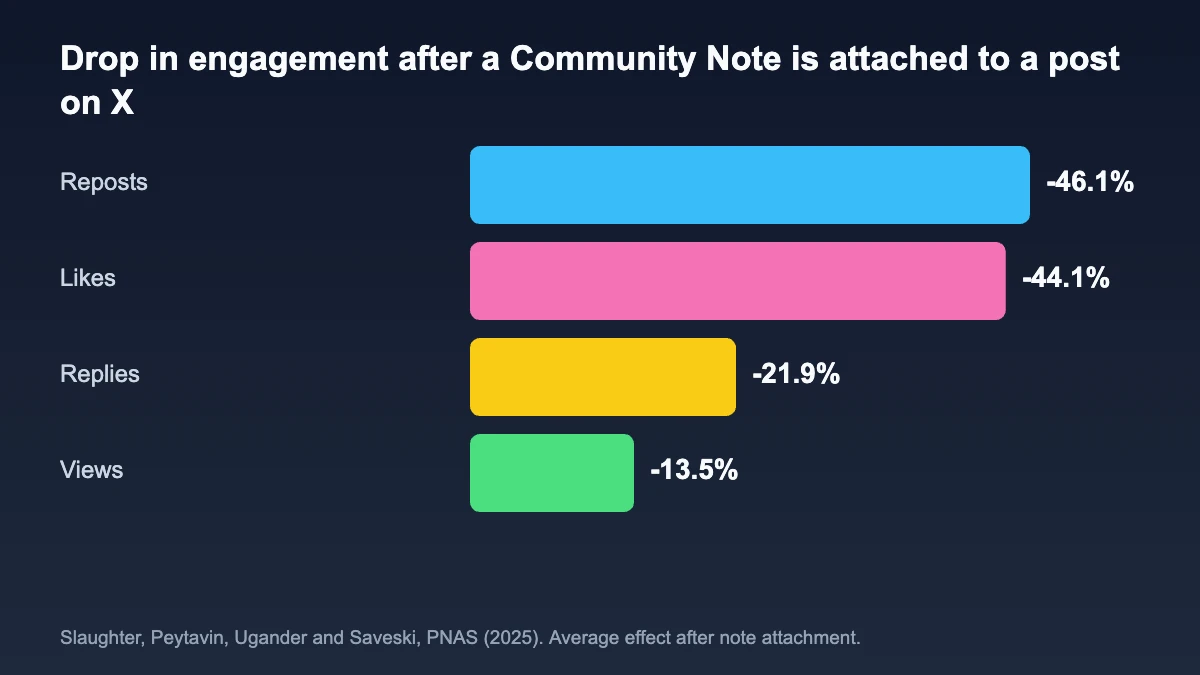
The limit is speed. Measured across a post’s whole life, the reductions were much smaller, 11.6% for reposts and 5.5% for views, because most engagement happens in the first hours, before a note appears. Fast correction matters more than perfect correction.
5. Small Nudges Can Improve What People Share
Not every solution needs to label or remove content. A 2021 study in Nature found that many people share false headlines not because they believe them, but because they are not thinking about accuracy at that moment. Simply prompting people to consider whether a single headline was accurate improved the quality of news they shared afterwards.
The effect of any one nudge is modest. But it shifts the framing in a useful way. Much sharing of false content is inattentive, not malicious, and design choices that slow people down can help.
6. AI Cuts Both Ways
The newest strand of misinformation research involves AI as a participant. In a 2024 Science study, 2,190 people who believed a conspiracy theory discussed it with a chatbot that responded with tailored evidence. Belief dropped by about 20% on average, and the effect was still there two months later.
That is encouraging, and it has a mirror image. A 2025 experiment with 76,977 participants and 19 language models found that specific training and prompting methods made AI up to 51% and 27% more persuasive. When the researchers checked 466,769 claims the models made, the more persuasive setups were also systematically less accurate. A tool that can talk people out of false beliefs can, configured differently, talk them into them.
What Misinformation Research Still Cannot See
Honest summaries include the gaps.
- Most large studies are from the United States and focus on text posts on a few platforms.
- Private messaging apps, short video, and audio are far harder to study.
- Researcher access to platform data has narrowed since 2023, which makes independent checking harder.
- Measuring exposure is easier than measuring harm. Seeing a false claim is not the same as believing or acting on it.
How to Use These Findings at Work
- Find the specific audience at risk instead of messaging to everyone.
- Respond quickly. An early, clear correction beats a perfect one that arrives after the peak.
- Give reasons and evidence, not just a “false” label. Tailored explanation is what worked in the chatbot study.
- Avoid repeating a false claim in your headline when you correct it.
- Build accuracy prompts into your own workflow, for example a pause before reposting.
- Treat AI-written persuasion with care, and check its claims before you publish.
We looked at the organizational side in how misinformation reaches the boardroom, and at the pressures on trustworthy local reporting in what is happening to local news traffic.
Key Terms in Misinformation Research
Misinformation research has its own vocabulary, and the distinctions are not just academic.
- Misinformation and disinformation. Misinformation is false or misleading content. Disinformation is the subset spread with intent to deceive.
- Exposure. Whether content appeared in front of someone. It is not the same as reading, believing, or acting on it.
- Engagement. Visible reactions such as likes, replies, and reposts. Often used as a stand-in for attention.
- Accuracy prompt. A small reminder to think about whether something is true before sharing it.
- Prebunking. Warning people in advance about a false claim or manipulation technique, before they meet it.
- Synthetic control. A statistical method that builds a comparison case from similar untreated examples. The Community Notes study used it.
Much confusion in public debate comes from mixing up exposure with belief. Good misinformation research keeps them apart, and so should anyone citing misinformation research in their own work.
Quick Questions, Answered
Is misinformation a smaller problem than we thought? For the average person, exposure is lower than headlines imply. For heavily exposed groups, and around events such as elections or health scares, it remains serious.
Do fact-checks backfire? The weight of current evidence says corrections generally reduce false beliefs. The larger practical issue is reaching people quickly enough.
Will AI make things worse? It raises the ceiling on both persuasion and correction. Which one wins depends on how the systems are built and used.
Final Thoughts: Precision Beats Panic
The most useful thing misinformation research has done is replace a vague fear with specific, testable claims. False content spreads fast, reaches a concentrated audience, responds to timely correction, and is now shaped by AI on both sides. Each of those points suggests a different response. As more people get their information through AI systems, a shift we covered in AI as the new gateway to news, that precision will matter even more.