Headlines about AI harms tend to come in two flavors: alarm and dismissal. Two reviews published this week try something more useful. They ask what the evidence actually shows.
The first, in Nature Human Behaviour on November 24, 2026, comes from researchers at the UK AI Security Institute, with Christopher Summerfield as first author. The second, a systematic review of chatbot-enabled AI harms in AI and Ethics published November 27, is by Gordon Amidu of Indiana University Bloomington. Both sit behind paywalls, so this post works from their published abstracts and article details, and we’ll flag where that limits what we can say.
Watch the 90-second version
Key takeaways
- AI systems are now used by one billion people worldwide, the Nature Human Behaviour review notes.
- Testing eight popular concerns about AI harms, it finds limited evidence for the strongest claims, while stressing that the research is still young.
- The AI and Ethics review of 71 studies links chatbots to misinformation, privacy violations, help with cyberattacks, and fraud.
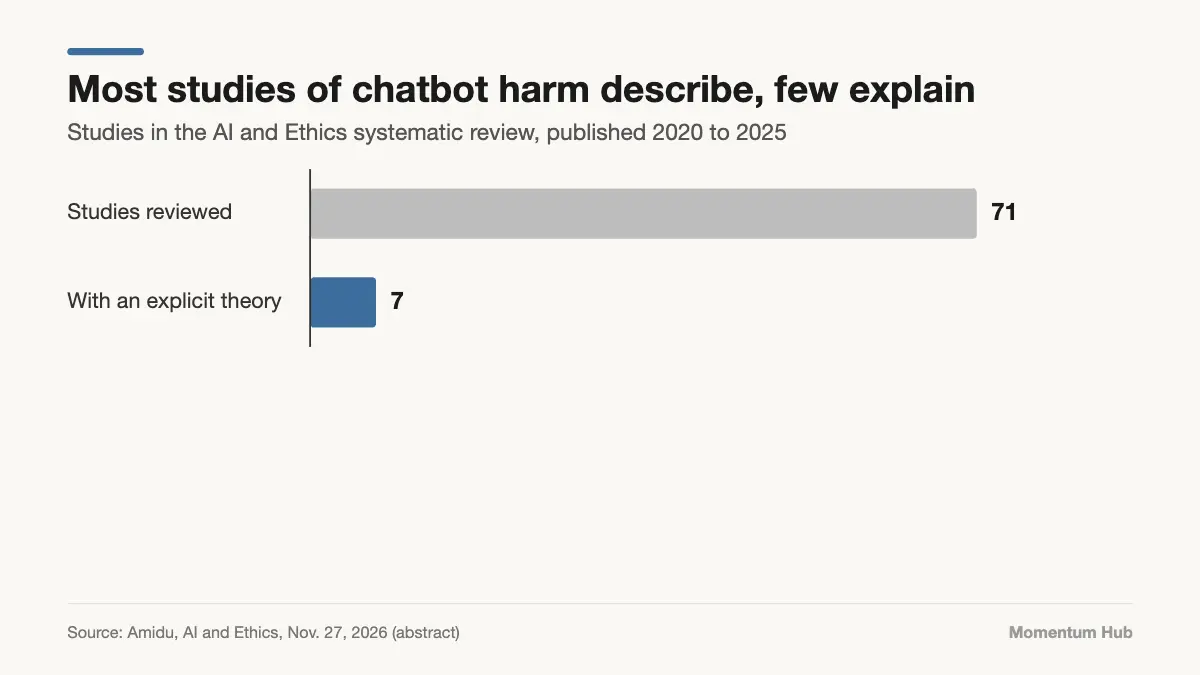
- Only 7 of those 71 studies used an explicit theoretical framework, so the field remains mostly descriptive.
7 of 71
Studies in the AI and Ethics review that applied an explicit theoretical framework, about one in ten, per the review’s abstract.
Eight Fears About AI Harms, Tested
The popular concerns
The Nature Human Behaviour review, Empirical evidence for eight ways that AI is impacting people, starts from the narratives you’ve probably heard: that AI may be undermining our cognitive abilities, polluting the information ecosystem, corroding human relationships and damaging mental health, and that it leaves us open to persuasion, manipulation, emotional dependence and social engineering.
What the evidence base looks like
To test these claims, the authors pull together four kinds of evidence: model evaluations, user studies, analyses of consumer chatlogs, and agent-based simulations. Each answers a different question: evaluations show what a model can do, while user studies and chatlogs show what happens when people actually use it. The review draws on 190 references. Their conclusion: “limited evidence for the strongest narratives of concern.” They’re just as clear that the research is young and that many uncertainties remain.
What 71 Studies Say About Chatbot Harms
Harms with evidence behind them
Following PRISMA guidelines, the AI and Ethics review searched six academic databases for studies published from 2020 to 2025. Across technical, behavioral and societal dimensions, it links AI chatbots to the spread of mis- and disinformation, privacy violations, the facilitation of cyberattacks, and fraud. ChatGPT and other OpenAI models were the most studied platforms.
A field short on theory
Only 7 of the 71 studies applied an explicit theoretical framework. The author describes the field as largely exploratory and descriptive, and adds that any response should be weighed against the benefits chatbots bring in areas like healthcare, education and customer service. For a topic as important as AI harms, that theory gap matters.
Sasha Luccioni’s TED talk makes a related case: the most useful conversation about AI risk focuses on impacts we can measure today:
Where the Two Reviews Agree
Read together, the two reviews push against easy stories. Some AI harms are real and documented, especially around misinformation and fraud. The strongest claims about what AI is doing to our minds and relationships, though, run ahead of the data so far. Both point to the same fix: longer studies, stronger designs, and theory that explains why effects happen, not just that they do. There is also a timing problem. Research takes years to design, run and publish, while AI products change every few months, so the evidence will always trail the technology a little.
For communication researchers, that’s an opening. Methods the field already uses, from text as data to silicon samples, can help test these claims more rigorously. Our earlier looks at AI companions and AI persuasion and DebunkBot dig into two of the eight concerns.
NBC News covered one concrete case of chatbot misinformation, in which researchers found AI chatbots citing spoofed campaign websites ahead of the midterms:
How to Read the Next AI Harms Headline
- Ask what kind of evidence it rests on: a lab evaluation, a user study, chatlogs or a simulation.
- Check whether the effect was measured in people or inferred from how a model behaves.
- Look at the time frame. A one-off survey can’t show long-term change.
- Notice what’s missing. The AI and Ethics review only covers studies through 2025, before today’s AI agents took off.
- Weigh harms against documented benefits, as the AI and Ethics review recommends.
Quick Questions, Answered
Does research show AI is harming people? Some AI harms are documented, especially misinformation, privacy problems and fraud. The strongest claims about our minds and relationships have limited support so far.
Who wrote the Nature Human Behaviour review? A team from the UK AI Security Institute in London, with Christopher Summerfield as first author.
Why does theory matter? Without it, studies can describe harms but not explain or predict them, which makes them harder to prevent.
Final Thoughts: AI Harms Deserve Better Evidence
Neither review says AI is harmless, and neither confirms the scariest stories. That middle ground is less exciting, but it’s where good decisions get made. When the next headline about AI harms lands, ask what was measured, in whom, and for how long, then decide how worried to be.