When a crisis breaks, AI-generated misinformation can spread faster than official updates. A simple assumption follows: the more fakes people notice, the more they will check what they see. A new study published Nov. 24, 2026 in Frontiers in Communication suggests it is not that simple. Noticing AI fakes did not, on its own, make people more willing to verify information. Feeling the threat did.
The study, by first author Feras Al Kharraz and seven co-authors, surveyed social media users in the United Arab Emirates. It adds to what we know about detecting AI-generated content by asking a different question: what pushes ordinary users to check?
Key takeaways
- Researchers surveyed 320 adult social media users in the UAE and analyzed the results with PLS-SEM, a statistical modeling method.
- Perceived exposure to AI-generated misinformation during crises did not directly predict intentions to verify information.
- Exposure raised perceived threat, and threat predicted verification. The indirect effect was β = 0.239 (p < 0.001).
- Critical AI literacy strengthened the direct link slightly. The study is cross-sectional and self-reported, so read it as suggestive.
0.239
Size of the indirect effect running from perceived exposure to AI-generated misinformation, through perceived threat, to verification intentions (p < 0.001), in the Frontiers in Communication study.
What the Researchers Tested
The goal was to understand why some people respond to AI-generated misinformation by checking while others keep scrolling. That question matters most in crises, when uncertainty and urgency push people to rely on whatever is circulating fastest.
The study drew on Protection Motivation Theory, which looks at how people weigh a threat and their ability to respond to it. The team measured four things in a cross-sectional online survey:
- Perceived exposure: how often people believed they had seen crisis content that was misleading and made or altered with AI.
- Perceived misinformation threat: how serious they judged the consequences, such as confusion, harmful decisions or risks to public safety.
- Verification intentions: their stated willingness to check official sources, compare reports or use fact-checking tools.
- Critical AI literacy: their understanding of how AI creates content and where it fails.
What the Study Found About AI-Generated Misinformation
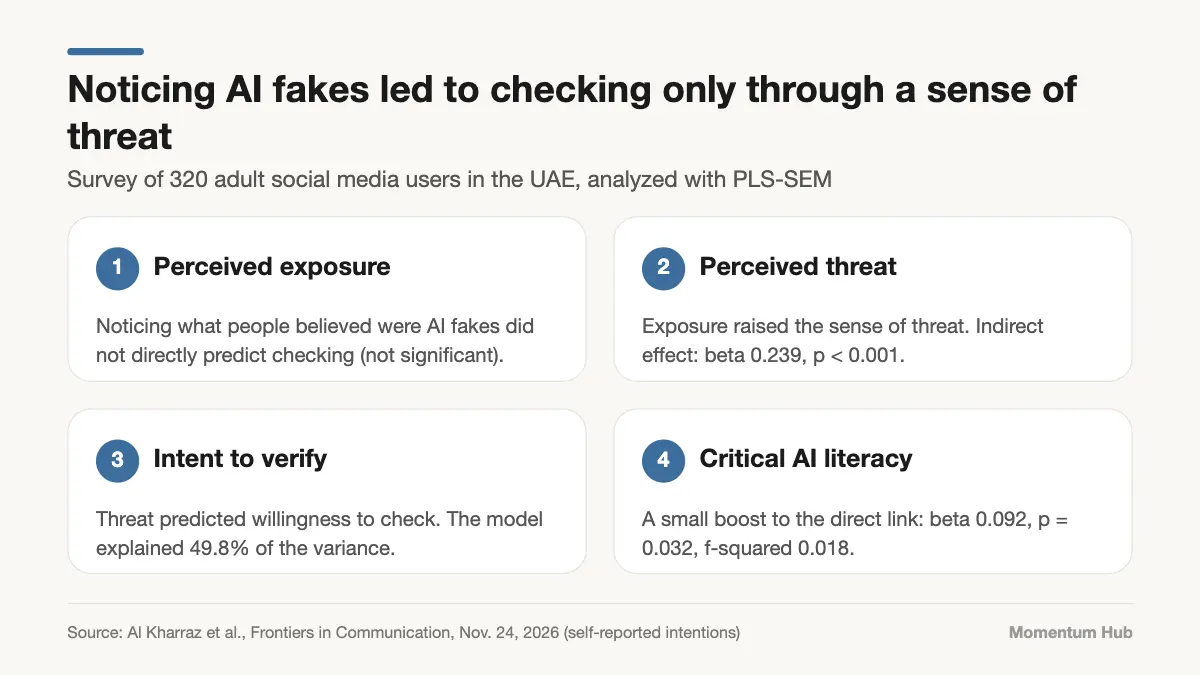
The direct path from exposure to verification was not statistically significant. In plain terms, simply noticing AI fakes did not make people more likely to check. But exposure was linked to a stronger sense of threat, and threat was linked to verification. That indirect path was significant.
Critical AI literacy mattered a little. People with higher literacy showed a stronger link between exposure and verification (β = 0.092, p = 0.032), but the effect size was small (f² = 0.018). Overall, the model explained 49.8% of the variance in verification intentions and 39.7% in perceived threat.
NOVA’s explainer on how deepfakes are made and detected is a good companion to these findings.
Read the Results With Care
The authors are upfront about the limits, and they matter:
- One country, one survey. 320 respondents in the UAE, at one point in time. The design cannot show cause and effect.
- Self-reports. “Exposure” is what people believe they saw, not verified exposure. “Verification” is an intention, not observed behavior.
- Measurement issues. The authors flag low internal consistency for the verification measure and elevated HTMT values, a sign that some measures may overlap.
Treat it as a useful signal that fits other research, not as a final answer. For a broader view, see our summary of misinformation research.
What Crisis Communicators Can Do With This
If exposure alone does not drive checking, warnings that only say “watch out for AI fakes” may fall flat. The findings point to a better approach.
- Explain the stakes concretely. Say what could go wrong if a fake is believed: a wrong evacuation route, a false price, a fake donation link.
- Pair every warning with a next step. Name the official source to check, and make it easy to reach.
- Teach how AI fakes fail. Short, practical AI literacy tips give people the confidence to check.
- Repeat the verification route. In a fast-moving crisis, the same trusted link, posted often, beats a long explainer.
A digital forensics reporter from ABC News Verify shows what checking looks like in practice.
Our coverage of the DebunkBot study shows another way AI can help correct false beliefs during fast-moving events.
Quick Questions, Answered
Does seeing AI-generated misinformation make people check facts? Not directly, in this study. People intended to check more when they felt the misinformation posed a real threat.
What is critical AI literacy? Understanding how AI generates or changes content, recognizing its limits and judging its outputs critically.
How strong is the evidence? Moderate. It is a peer-reviewed study with a clear model, but one country, self-reported answers and a modest sample limit how far it generalizes.
Final Thoughts: Make the Threat Real and the Check Easy
AI-generated misinformation is a crisis-communication problem, not just a technology problem. This study suggests people verify when they understand the stakes and know how to check. If you communicate during emergencies, design every warning around those two things. And because audiences already trust AI-made news less, as our piece on AI-generated news audiences shows, clear human guidance matters even more.