
- 1. A Third of Employees Are Now Frequent Users
- 2. Research Is the Biggest Time Saver
- 3. Writing Time Is Down for Nearly Half
- 4. Meetings Have Barely Moved
- 5. Review Is the Hidden Cost
- 6. Thinking Is Not Getting Easier for Most
- 7. Expectations Are Rising With Use
- What This Means for Communication Teams
- A Note on the Evidence
- Quick Questions, Answered
- Final Thoughts: Spend the Saved Time Well
AI at work has been sold on a big promise: give routine tasks to the machine and get your day back. New Gallup data offers one of the clearest pictures yet of whether that is happening. The answer is yes for some tasks, no for others, and the pattern says a lot about where communication effort really goes.
The study, published by Gallup on November 16, 2026, surveyed U.S. employees in August. Here are seven numbers from it, and what they mean for anyone who writes, reviews, or manages for a living.
Key takeaways
- About a third of U.S. employees now use AI a few times a week or more.
- Among those frequent users, roughly half spend less time gathering information and writing.
- Meetings and collaboration are almost untouched: about eight in ten report no change.
- Review time is a wash, and a third of frequent users feel pressure to use AI to keep up.
47%
Share of frequent AI users who say they now spend less time writing and drafting. Only 7% say they spend more. Source: Gallup.
1. A Third of Employees Are Now Frequent Users
Gallup found that 32% of U.S. employees use AI a few times a week or more, up two points in a single quarter, and 16% use it every day. Just over half, 53%, use it at least a few times a year.
The gap by job type is large. In roles that can be done remotely, 49% are frequent users. In on-site roles, it is 22%. AI at work is still mostly a desk-job story.
2. Research Is the Biggest Time Saver
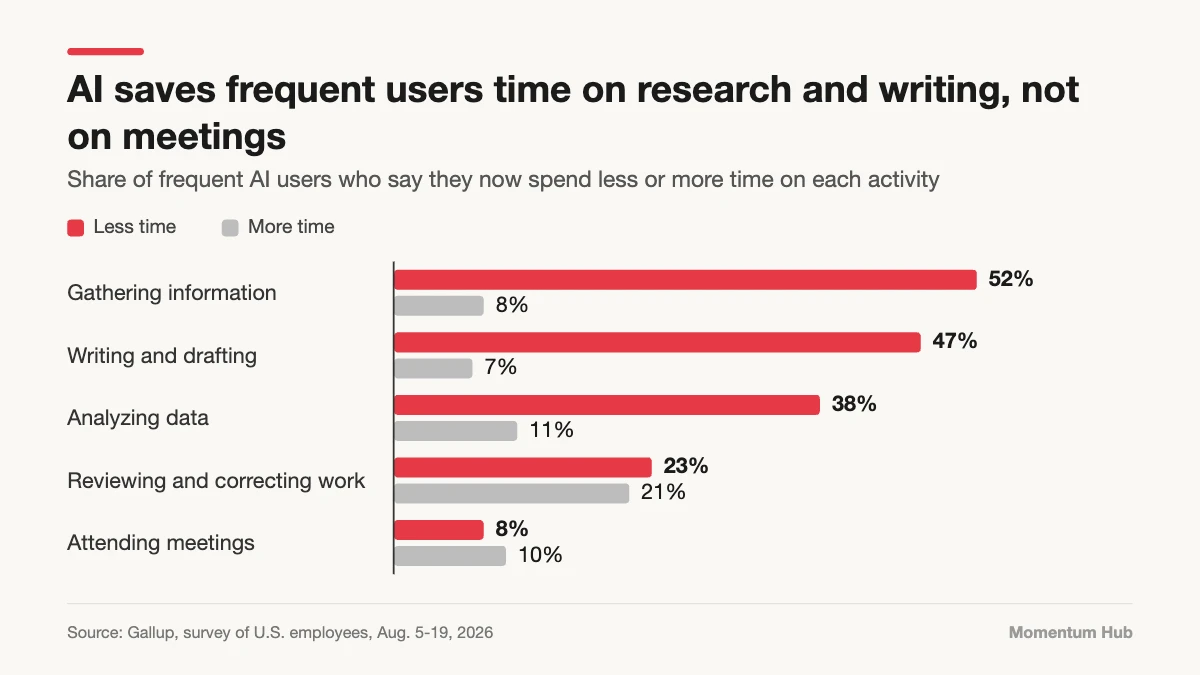
Among frequent users, 52% say they spend less time gathering information than before, and only 8% spend more. Finding, summarizing, and comparing sources is where AI helps most.
That deserves a caution. Faster research is only better research if the sources are checked. Speed makes it easy to skip that step.
3. Writing Time Is Down for Nearly Half
On writing and drafting, 47% of frequent users report spending less time, 47% about the same, and 7% more. For communicators, this is the headline. The first draft, once the slowest part of the job, is getting cheaper.
4. Meetings Have Barely Moved
Here the promise runs out. Among frequent users, 83% say they spend about the same time in meetings, and 78% say the same about collaborating with coworkers. Slightly more people report extra meeting time (10%) than less (8%).
This makes sense. Meetings are about agreement, trust, and decisions, and those are human bottlenecks. A tool that writes faster does not make a group decide faster.
5. Review Is the Hidden Cost
Time spent reviewing and correcting work splits almost evenly: 23% of frequent users spend less, 21% spend more. In other words, some of the time saved in drafting comes back as checking.
This is the part many teams do not plan for. Someone still has to read the output carefully, and careful reading is a skill.
6. Thinking Is Not Getting Easier for Most
Asked about mental effort, 65% of frequent users say it is about the same as before. About one in five (21%) say their work takes less effort, and 14% say it takes more. AI is shifting where the effort goes, from producing to judging, more than removing it.
7. Expectations Are Rising With Use
Among frequent users, 36% agree that AI has raised expectations for how much they produce each day, compared with 16% of infrequent users. And 33% of frequent users feel pressure to use AI to keep up, about twice the share among infrequent users.
That is the trade to watch. Time saved on drafting can be spent on better work, or it can simply be absorbed by a higher quota.
What This Means for Communication Teams
- Move the time you save on drafting into review. Make checking a named step with an owner.
- Do not expect AI to fix your meeting load. Fix that with agendas, decisions in writing, and fewer attendees.
- Set a quality bar before a quantity target. Agree what “good” looks like for AI-assisted work.
- Talk openly about expectations, so saved time is not silently converted into extra output.
- Train people to review: fact-checking, source-checking, and spotting confident errors.
- Keep practicing first drafts without AI sometimes. The skill fades if it is never used.
We looked at the human side of this in the 5Cs of human communication skills, and at how to start well in how people actually work with AI.
A Note on the Evidence
These figures are self-reported. People are describing their own sense of where time goes, not a stopwatch. They also describe frequent users, who may differ from other workers in role and seniority. The direction is credible. The exact percentages should be held loosely.
Quick Questions, Answered
Is AI making people more productive? For research and drafting, many frequent users say they are faster. Whether total output or quality improves depends on what happens to the time saved.
Why have meetings not shrunk? Because the slow part of a meeting is people reaching agreement, which writing tools do not speed up.
Should managers require AI use? Pressure without support tends to backfire. Our piece on how managers talk about AI explains why.
Final Thoughts: Spend the Saved Time Well
The Gallup data on AI at work describes a quiet shift. Writing is getting faster, reviewing matters more, and the hours spent talking to each other have not changed at all. Teams that treat the saved time as room for better thinking, not just more output, will get the most from it. For more, visit our Pro Communication section.