- Why "Soft Skills" Stopped Being Soft
- Curiosity: Ask Better Questions
- Courage: Decide Without Perfect Information
- Creativity: Imagine What Does Not Exist Yet
- Compassion: Care That Is Not Simulated
- Communication: Turning Words Into Shared Meaning
- How to Practice the 5Cs This Week
- Quick Questions, Answered
- Final Thoughts: Your Edge Is Human
When AI can draft the email, summarize the meeting, and build the slide deck, what is left for you? Quite a lot, it turns out. The human skills that are hardest to automate are the ones that make you good to work with.
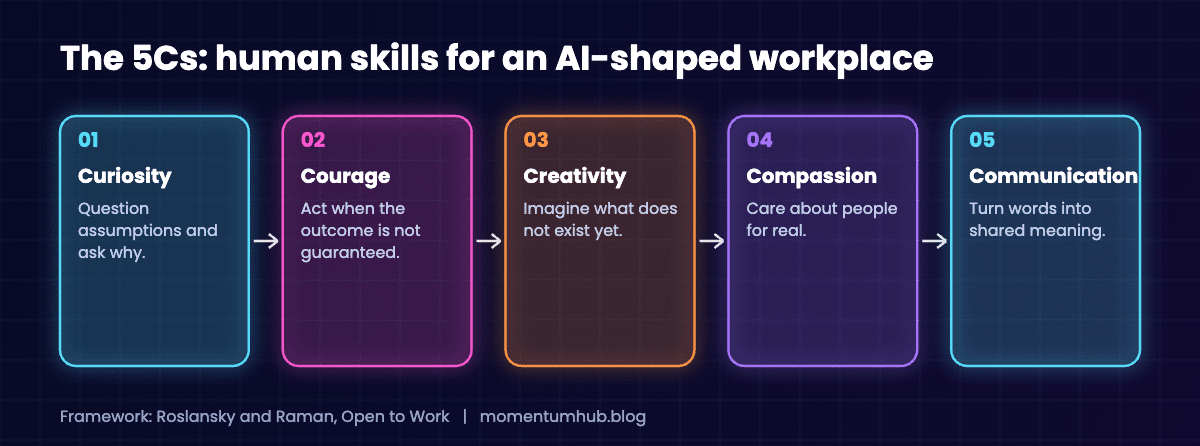
LinkedIn CEO Ryan Roslansky and Aneesh Raman, LinkedIn’s chief economic opportunity officer, give those skills a memorable name: the 5Cs. In an excerpt from their book Open to Work, published by Microsoft WorkLab, they argue that curiosity, courage, creativity, compassion, and communication are the human edge at work. Here is how each one shows up in everyday professional communication.
Key takeaways
- The 5Cs are curiosity, courage, creativity, compassion, and communication.
- The authors argue these skills grow more valuable as AI takes over routine work.
- Communication was the most in-demand skill on LinkedIn globally in 2024, according to the article.
- You build the 5Cs through real challenges and relationships, not a weekend course.
Why “Soft Skills” Stopped Being Soft
For years, we filed these abilities under “nice to have.” The authors flip that. As AI handles more routine work, they argue, human skills become harder to build and more valuable to have. Their advice is blunt: stop competing with AI on efficiency and design your work around human strengths.
Microsoft’s 2026 Work Trend Index frames the same moment around agents and human agency. The more capable the tools become, the more your judgment decides what they are pointed at.
Curiosity: Ask Better Questions
Curiosity, in their framing, means questioning why things are the way they are and testing assumptions. In practice, it is the difference between accepting the first AI answer and asking, “What would change this conclusion?”
Curious communicators also listen differently. They ask follow-up questions, which is the heart of active listening.
Courage: Decide Without Perfect Information
Courage is acting when the outcome is not guaranteed. AI can lay out options. It cannot own the decision, deliver hard news to a client, or say “I disagree” in a tense meeting.
This is where feedback lives too. Giving it honestly, and receiving it without defensiveness, takes practice. Our guide to mastering feedback is a good place to start.
Creativity: Imagine What Does Not Exist Yet
The authors separate real creativity from recombination. Imagining possibilities that never existed is different from remixing what already does. So use AI to generate twenty variations, then do the human part: choose the one worth pursuing and explain why it matters.
Compassion: Care That Is Not Simulated
A chatbot can produce a sympathetic sentence. Compassion, as the authors define it, means actually caring about another person. Colleagues can tell the difference, especially under pressure, when emotional labor is highest.
A simple test: before you send a difficult message, ask what the reader is worried about, then address that first.
Communication: Turning Words Into Shared Meaning
The fifth C is the one this site is built around. The authors describe communication as turning language into shared meaning, not just translating words. It was also the top in-demand skill globally on LinkedIn in 2024, according to the article.
AI makes producing words effortless, which makes shared meaning scarcer. The person who can align a room, clarify a decision, or explain a tradeoff becomes more valuable, not less.
How to Practice the 5Cs This Week
The authors are clear that these skills cannot be picked up in a weekend workshop. They grow through connection and challenge. So start small:
- Curiosity: ask one “why do we do it this way?” question in your next meeting.
- Courage: give one piece of honest, kind feedback you have been postponing.
- Creativity: generate options with AI, then write your own version from scratch.
- Compassion: open one hard message by naming the other person’s concern.
- Communication: end one meeting by restating the decision in a single sentence.
Quick Questions, Answered
What are the 5Cs? Curiosity, courage, creativity, compassion, and communication. The framework comes from Ryan Roslansky and Aneesh Raman’s book Open to Work.
Can these skills be learned quickly? The authors say no. They develop over time through hard problems, real relationships, and testing ideas in real settings.
Where should I start? Pick one C and one small action this week, such as asking a better question or restating a decision clearly at the end of a meeting.
Final Thoughts: Your Edge Is Human
Tools will keep getting faster. Your most valuable skills are the ones that make speed worth something: asking, deciding, imagining, caring, and connecting.
Which of the five will you practice first?