- 1. The Open Era Ended in Stages
- 2. Twitter Put a Price on Research
- 3. CrowdTangle Closed Before a Major Election
- 4. Europe Turned Access Into a Legal Right
- 5. The Rules Are Starting to Be Enforced
- 6. Researchers Are Building Other Routes
- Why This Matters Outside Universities
- What You Can Do Now
- Key Terms in Social Media Data Access
- Quick Questions, Answered
- Final Thoughts: No Data, No Accountability
Social media data access is the unglamorous foundation of almost everything we know about online communication. Every study of misinformation, echo chambers, or viral news depends on someone being able to see what was posted, by whom, and how far it travelled. Over the past few years that foundation has been cracking, and the consequences reach well beyond universities.
When researchers and journalists lose access, the public loses its independent view of what happens on platforms that billions of people use. This guide, part of our Computational Communication section, covers six facts about how we got here and what is replacing the tools that disappeared.
Key takeaways
- Between 2023 and 2024, the main free windows into X, Reddit, Facebook, and Instagram were closed or restricted.
- The number of studies using Twitter data fell after the platform began charging for it.
- The EU Digital Services Act now gives vetted researchers a legal right to request platform data.
- Alternatives such as data donation are growing, but each comes with trade-offs.
1. The Open Era Ended in Stages
For about a decade, Twitter was the model organism of social research. Its data was public, well documented, and free for academics. A 2024 analysis counted 33,306 studies based on Twitter data across 16 disciplines, with the number growing by a median of 25% a year from 2006 to 2023.
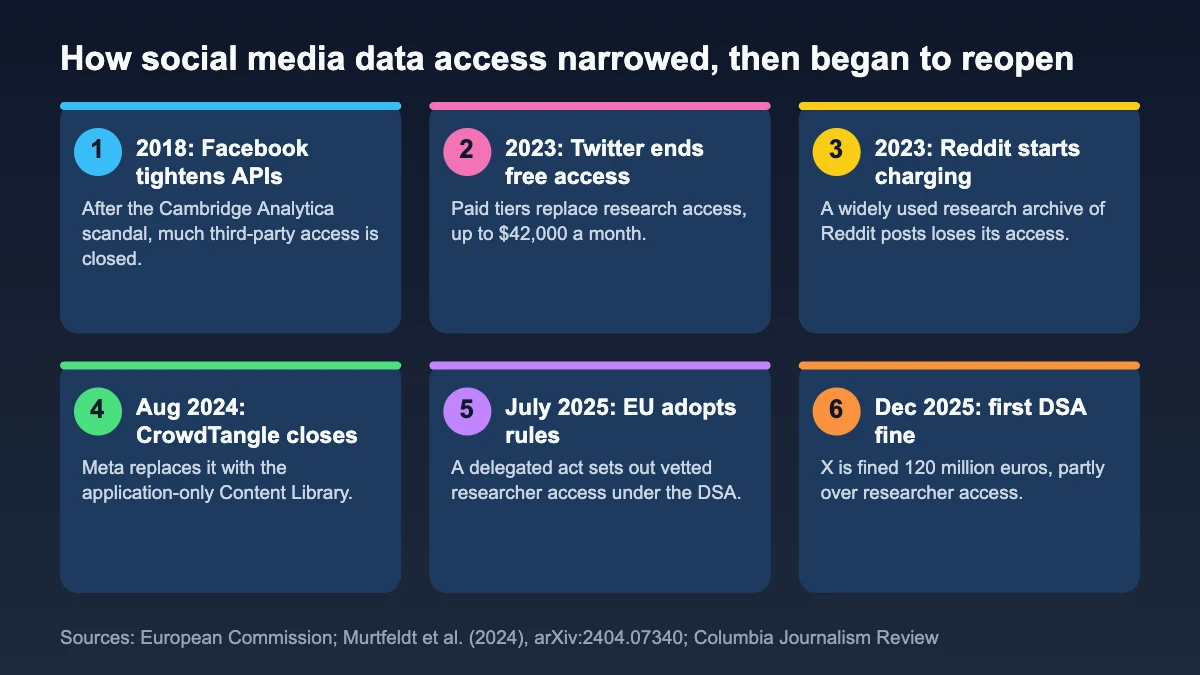
Facebook was always harder. After the Cambridge Analytica scandal in 2018, it shut down much of the access outside developers had, a moment some researchers called the “APIcalypse.” What remained for most people was CrowdTangle, a monitoring tool Meta had bought in 2016 that showed how public posts were performing.
2. Twitter Put a Price on Research
In early 2023, the company now called X ended free access to its data interface. The top tier was priced at $42,000 a month, far beyond almost any research budget.
The effect showed up quickly. The same 2024 analysis found that the number of Twitter-based studies fell by 13% after the charges began, and its authors expect further decline, since much recent work still relied on data collected before the shutdown. Reddit followed with its own charges in 2023, which also cut off a popular research archive of the site.
3. CrowdTangle Closed Before a Major Election
Meta shut down CrowdTangle on August 14, 2024, less than three months before the US presidential election and despite appeals from researchers and journalists. Its replacement, the Meta Content Library, is more limited in who can use it.
As the Columbia Journalism Review reported, access requires an application through an independent partner at the University of Michigan, and it is open to academic and nonprofit researchers, not to most newsrooms. The new tool does include data CrowdTangle never had, such as comments on public posts. But the easy, real-time view that reporters used to track viral falsehoods is gone.
4. Europe Turned Access Into a Legal Right
The most important counterweight is Article 40 of the EU Digital Services Act. It requires very large platforms and search engines to share data with approved researchers who study systemic risks in the EU, such as the spread of illegal content or threats to elections.
The details arrived in a delegated act adopted on July 2, 2025. Researchers apply to a national regulator, known as a Digital Services Coordinator, which vets the project and its data protection plan. A dedicated portal handles applications and communication with platforms. According to the Commission, the first researchers could be vetted from October 2025. This explainer from the Weizenbaum Institute walks through how Article 40 works.
5. The Rules Are Starting to Be Enforced
A right on paper only matters if someone enforces it. On December 5, 2025, the European Commission fined X 120 million euros in its first non-compliance decision under the Act. One of the three breaches was a failure to give researchers access to the platform’s public data. The Commission noted, for example, that X’s terms prohibit eligible researchers from independently accessing public data, including through scraping.
Whatever one thinks of the politics, the decision signals that data access is being treated as an obligation, not a favor. The practical side of applying is covered in this second session from the same institute.
6. Researchers Are Building Other Routes
While the legal path matures, researchers have been inventing workarounds for social media data access.
- Data donation. Privacy law in many places lets users download their own platform data. Volunteers can then share it with a research project. This gives rich, consented data, though from people willing to take part.
- Platform research programs. Tools such as Meta Content Library and the TikTok Research API offer approved access, on the platform’s terms.
- Browser tools and panels. Participants install software that records what they are shown, which captures exposure, not just public posts.
- Shifting platforms. Some researchers have moved to more open networks, which are easier to study and less representative of the wider public.
Each route answers some questions and leaves others out of reach. None restores the simple, broad access of a decade ago.
Why This Matters Outside Universities
If you work in communications, marketing, or news, the squeeze on social media data access affects you directly.
- Independent checks on platform claims are rarer, so treat platform-supplied statistics with care.
- Social listening tools depend on the same shrinking access. Ask vendors exactly which sources they can still see.
- Findings based on older Twitter data may not describe today’s platforms.
- Newsrooms have lost a key early-warning system for viral rumors, a pressure that adds to those we described in the state of local news traffic.
There is a governance lesson here too. Access with strong safeguards is possible, as the growing field of secure data practice shows. We covered the technical side in zero-trust data engineering.
What You Can Do Now
- When you read a platform study, check when and how the data was collected.
- If you run research, budget time for access applications. They can take months.
- Consider data donation for questions about what people actually see.
- Document your collection methods fully, so others can judge and repeat the work.
- Support transparency rules in the places you operate. Access has rarely expanded voluntarily.
Key Terms in Social Media Data Access
Policy debates about social media data access use precise terms. Here are the main ones.
- API. An application programming interface, the official channel through which software requests data from a platform.
- Scraping. Collecting data by automatically reading web pages, without using an official channel.
- Data donation. People requesting their own data from a platform and choosing to share it with researchers.
- Vetted researcher. Under the Digital Services Act, a researcher approved by a national regulator to request platform data.
- Systemic risk. The category of harm the Act targets, such as risks to elections, public health, or minors.
- Very large online platform. A service with at least 45 million monthly users in the EU, which carries the strictest duties.
Every route to social media data access involves a trade-off between openness, privacy, and control. Knowing the terms makes it easier to see who is making which trade.
Quick Questions, Answered
Can researchers outside the EU use the Digital Services Act? The Act focuses on research into risks within the EU, but applicants do not all have to be based there. The vetting conditions are what matter.
Is scraping a solution? It is legally and ethically contested, and platforms often prohibit it in their terms. It is not a stable foundation for a research program.
Did Meta’s replacement tool fix the gap? Partly. It offers some richer data but to a narrower group, through a slower process.
Final Thoughts: No Data, No Accountability
Debates about social media often run ahead of the evidence, and shrinking social media data access makes that worse. The good news is that the trend is no longer one-way. Legal rights in Europe, new donation methods, and the first enforcement actions are beginning to rebuild what was lost. The next few years will show whether that is enough. For the bigger picture of how data shapes what we can know about communication, see our overview of AI and big data in communication research.