


If the job market were a group project, healthcare would be the one doing most of the work. That is not a joke. It is what the numbers on healthcare jobs say, and it is changing how people think about their next career move.
Two recent Indeed Hiring Lab analyses tell the story: the October jobs report and a third-quarter healthcare update. The picture is more nuanced than “go into healthcare,” so let’s walk through it with the same care we used in career cartography.
Key takeaways
- Health care and social assistance added about 60% of all US jobs over the past twelve months.
- Postings for physicians and therapy roles are nearly double their February 2020 levels.
- Not every corner is growing: nursing, medical technician, and dental postings fell year over year.
- Healthcare hiring has been slowing, so timing and specialty matter.
The Sector Carrying the Job Market
Over the past twelve months, US employers added 885,000 jobs. Health care and social assistance accounted for 519,000 of them, roughly 60%. When one sector contributes that much, it shapes opportunities for everyone, including people who never planned to work near a hospital.
Where Demand Is Strongest
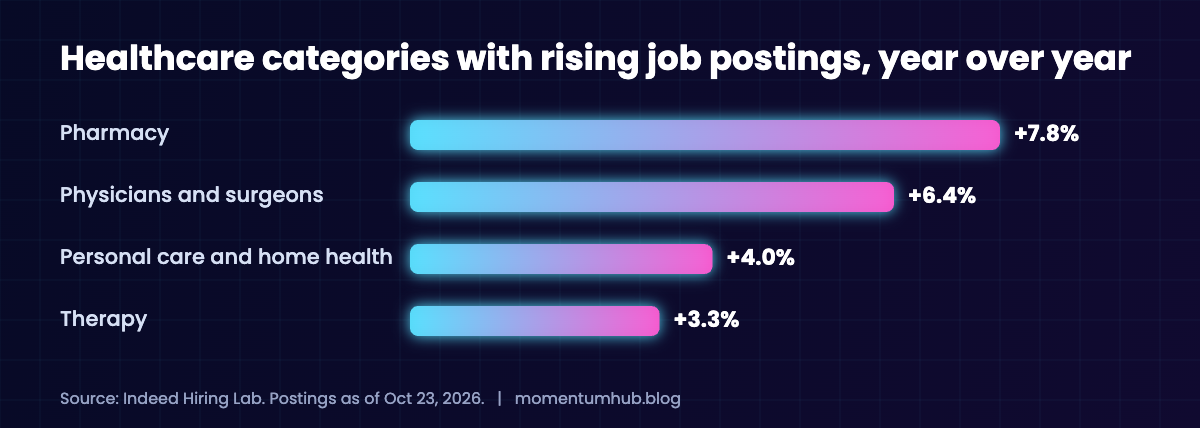
Compared with February 2020, postings for physicians and surgeons are up 96.1%, and therapy roles are up 90.9%. Year over year, pharmacy postings rose 7.8%, physicians and surgeons 6.4%, personal care and home health 4.0%, and therapy 3.3%.
Where It Is Cooling
The same report shows soft spots. Nursing postings fell 1.7% from a year ago, medical technician postings fell 2.7%, and dental postings dropped 13.5%. Every healthcare category is still above its pre-pandemic level, but the direction has turned for some.
The sector’s hiring rate was 2.9% in September, slightly below its 2019 average and down from 3.5% a year earlier. Indeed’s analyst describes the market as continuing to slow.
Pay: Modest and Mixed
Wage growth is not spectacular. Posted wages for nursing grew 1.8% year over year in September, up from a low of 1.0% in the spring. Personal care and home health grew 2.5%, its weakest pace since before the pandemic. If pay is your main motive, look closely at the specific role.
You Do Not Need to Be a Clinician
Hospitals and health systems hire for technology, data, finance, operations, communications, and training. If you have AI skills or analytics experience, those are increasingly useful in healthcare settings, as we explored in AI in healthcare.
A Simple Plan for Exploring the Move
- List your transferable skills: project management, data analysis, customer service, compliance.
- Pick two or three target roles and read ten job postings for each to spot common requirements.
- Talk to two people already in those roles before paying for any certification.
- Check local demand. Healthcare hiring varies a lot by region and specialty.
- Start with a short credential or volunteer experience to test the fit.
Questions to Ask Before You Commit
Before you invest in a new credential, pressure-test the plan. How long does the training take, and what does it cost? Is the role growing in your region or only nationally? What does a typical week look like, including nights and weekends?
Answering these honestly protects you from chasing a headline. A growing sector still contains roles that are a poor fit for your life.
Quick Questions, Answered
How much of US job growth is healthcare? About 60% of the 885,000 jobs added over the past twelve months, according to Indeed’s analysis.
Are all healthcare jobs growing? No. Postings for nursing, medical technician, and dental roles fell compared with a year ago.
Is healthcare pay rising fast? Not broadly. Posted wage growth was 1.8% for nursing and 2.5% for personal care and home health in September.
Final Thoughts: Go Where the Growth Is, With Eyes Open
Healthcare offers something rare right now: steady demand. It also asks for patience, credentials in many roles, and realistic pay expectations.
Treat it like any good career decision. Map the terrain, test before you commit, and build on the skills you already have.


