- The Numbers: A Tough Summer for Local Sites
- Why Google Referrals Keep Shrinking
- Tactic 1: A Faster, Simpler Site
- Tactic 2: Give Readers a Reason to Participate
- Tactic 3: Own the Story Only You Can Tell
- Beyond Tactics: Apps, Policy, and Money
- What This Means for Small Publishers and Creators
- Final Thoughts: Local Still Wins When It Feels Local
If you run a local news site, or any small publication, 2026 has probably felt like pushing a boulder uphill. Local news traffic from search, which used to arrive on its own, is thinning out. But a few small publishers posted eye-catching gains this summer, and how they did it is worth studying.
A new Nieman Lab analysis of Similarweb estimates lays out both sides: the decline and the bright spots. Let’s look at what the numbers say and which tactics you can borrow, whether you publish a town newspaper or a creator-led newsletter.
Key takeaways
- Most top local newspaper sites drew less traffic in July through September 2026 than a year earlier.
- Shrinking Google referrals are a big part of the story, as more people see AI answers in search.
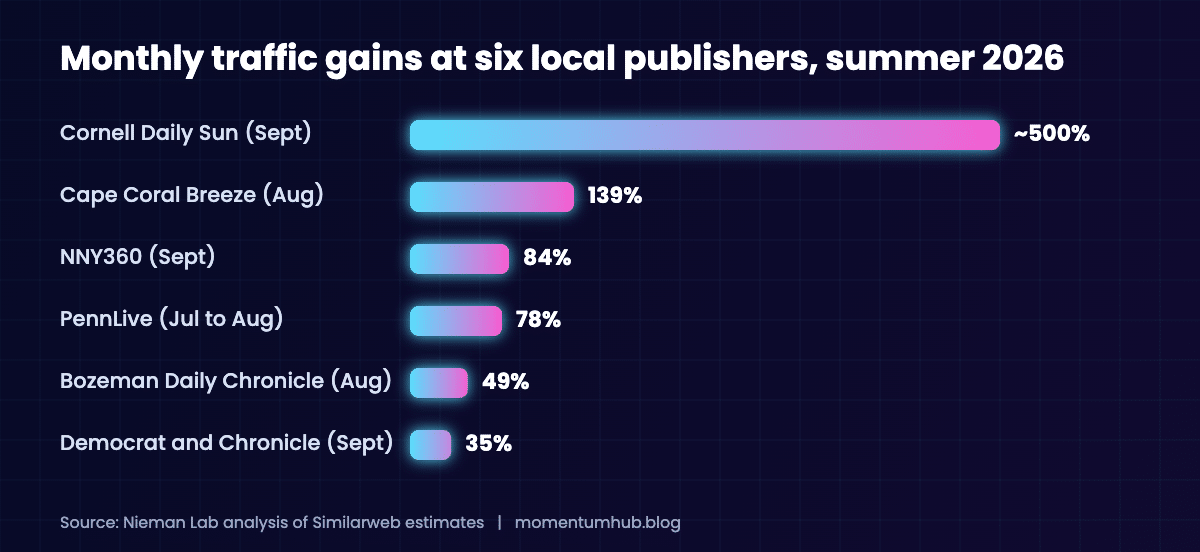
- A faster site, a community contest, and one must-read story each produced double- or triple-digit gains.
- None of the wins came from chasing an algorithm. They came from giving locals a reason to show up.
The Numbers: A Tough Summer for Local Sites
Nieman Lab compared monthly visits for top local newspaper sites and found most were lower in July, August, and September than in the same months of 2025. PennLive is a clear example. It drew about 8.2 million visits in August 2026, compared with about 12.5 million a year earlier.
The analysis attributes much of the drop to shrinking referrals from Google. That matches what many publishers describe: the same stories, the same effort, and fewer people arriving from search. Even PennLive’s strong month, up 78% from July to August, left it well below the previous year.
Why Google Referrals Keep Shrinking
Search itself has changed. In the Reuters Institute’s 2026 report on generative AI and news, 57% of people surveyed across nine countries said they had seen or used AI-generated search answers in the past week. When the answer sits on the results page, fewer readers click through.
This is the same force we explored in algorithmic sensemaking: platforms decide what people see first. For publishers, it means search can no longer be the whole plan.
Tactic 1: A Faster, Simpler Site
The Bozeman Daily Chronicle launched a redesigned site on August 3 with fewer news categories, lighter pages, and a more modern layout. Traffic rose about 49% that month, and its parent company plans to bring the design to its other papers.
The lesson is unglamorous but powerful. Speed and clarity are features. If your homepage takes five seconds to load or offers twenty menu choices, fix that before you write another headline. Readers rarely tell you a site feels heavy. They just stop coming.
Tactic 2: Give Readers a Reason to Participate
The Cape Coral Breeze, a weekly, saw visits jump about 139% in August thanks to its “Best of Cape Coral” voting contest. Votes climbed to roughly 150,000 from 92,000, and the team routed voters through the homepage so they would also see the news.
Participation beats passive reading. It is the same dynamic behind user-generated content: people return to things they helped shape. A contest, a reader poll, or a community photo call can all do this work, as long as the path leads back to your journalism.
Tactic 3: Own the Story Only You Can Tell
The Cornell Daily Sun, a student paper, gained about a million visits in September, a rise of nearly 500%, after its coverage of the Cornell 7 lawsuit and an accompanying editorial. It is the kind of story a local newsroom is best placed to cover in depth.
Every community has stories like this. When you are the newsroom closest to the event, your reporting becomes the destination, and no AI summary can replace being there.
Beyond Tactics: Apps, Policy, and Money
Bigger players are rethinking their foundations too. NPR’s new strategic plan makes fixing its app a key priority, a sign that direct relationships matter more when referral traffic fades. In Canada, the new federal budget would make a local reporting program permanent and extend a 35% tax credit on newsroom salaries.
Not every signal is positive. Some journalism organizations are canceling conferences and cutting staff as event costs rise and funding falls. The business remains fragile, which is exactly why small, repeatable wins matter.
What This Means for Small Publishers and Creators
Three questions are worth asking this week. Is my site fast and simple enough to enjoy? What can my audience do here besides read? And what story can only I tell?
Then build channels you control, like email, an app, or a community space. Solid SEO strategies still help, but they work best as one channel among several. If one platform changes its rules tomorrow, you want the relationship with your readers to survive it.
Final Thoughts: Local Still Wins When It Feels Local
The traffic chart looks grim until you zoom in. The publishers that grew did it by being faster, more participatory, and more essential to the people nearby.
Search may send fewer visitors next year. A reason to come back is something no algorithm can take away. What is yours?