- 1. Postings Have Turned Positive
- 2. Hiring Remains Slow
- 3. Long Searches Are Common
- 4. Workers Are Restless but Staying Put
- 5. Geography Matters More Than the National Number
- 6. Tech Is Recovering From a Low Base
- What Could Happen in 2027
- How to Plan Your Next Move
- Caveats on the Data
- Quick Questions, Answered
- Final Thoughts: Move Before the Crowd
The job market 2027 outlook arrived this week, and it describes a strange moment. Job postings are rising again for the first time in years. Yet workers are staying put, and many who are looking have been looking for a long time.
On November 18, 2026, Indeed Hiring Lab and Glassdoor published a joint report titled A restless labor market, with a companion piece on local job markets. Together they offer six signals for anyone planning a move next year. They also update the picture we drew in the tech job market in late 2026.
Key takeaways
- Indeed job postings were up 3.1% year over year in late October, the first positive trend in nearly four years.
- Hiring is still slow. Employers added 696,000 jobs in the first three quarters of 2026.
- Workers are restless but not moving. The quits rate was 2.1% in September, well below its 2022 peak.
- Where you live matters. Postings are above their pre-pandemic level in 78% of US metro areas, but not in several large coastal cities.
+3.1%
Year-over-year change in US job postings on Indeed through October 23, 2026, the first positive reading in nearly four years, according to Indeed Hiring Lab.
1. Postings Have Turned Positive
The headline signal for the job market 2027 is simple. Employers are advertising more jobs than a year ago. Indeed’s postings index grew year over year in September for the first time since 2022, and a later update put the gain at 3.1% through October 23.
Postings are not hires. They are a sign of intent. Still, intent has been missing for a long time.
2. Hiring Remains Slow
The report notes that employers added 696,000 jobs in the first three quarters of 2026, only a slight improvement on 2025. The unemployment rate stayed between 4.1% and 4.4% all year.
Economists call this a low-hire, low-fire market. Layoffs have stayed low, and so has hiring. If you have a job, you probably kept it. If you needed one, the search was hard.
3. Long Searches Are Common
Among unemployed workers, 27.6% had been out of work for 27 weeks or more. The report says that is the highest share since 1950 outside the period right after a recession.
If your search is taking months, the data says you are not alone, and it is not a verdict on you. Budget for a long search, and keep your skills visible while you look.
4. Workers Are Restless but Staying Put
The quits rate was 2.1% in September 2026, down from a peak of 3.3% in April 2022. At the same time, 21% of Glassdoor reviewers said they were dissatisfied with their career opportunities, up from 17% in 2022.
That gap is the restlessness in the title. Many people want to move and have not. When hiring picks up, the authors expect some of that pent-up turnover to release, which would open more roles in turn.
5. Geography Matters More Than the National Number
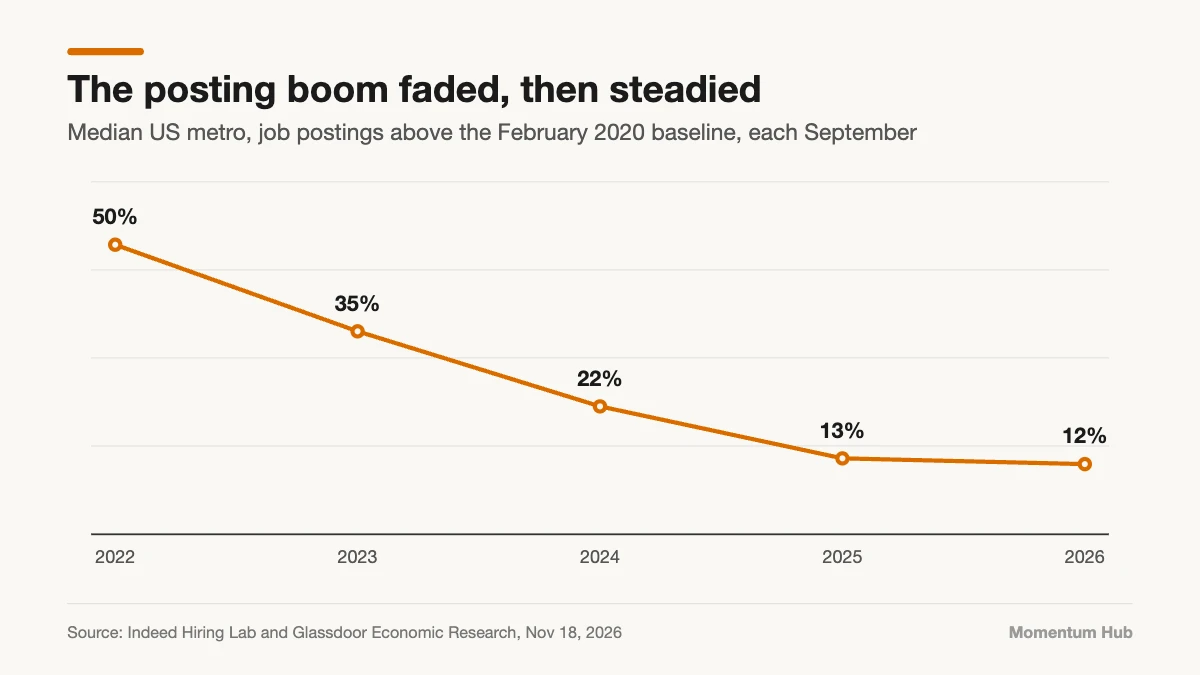
Postings were above their February 2020 level in 299 of 385 metro areas, about 78%. But the median metro’s lead over that baseline has shrunk from about 50% in 2022 to about 12% now.
The spread is wide. Anchorage was about 74% above its baseline. Dallas, Austin, and Houston were 12% to 15% above. Seattle and San Francisco were roughly 30% below, and Los Angeles and New York about 15% below.
6. Tech Is Recovering From a Low Base
In a November 12 update, Indeed Hiring Lab reported that software development postings were up 23.8% year over year. They were still 19.2% below their early 2020 level. Data and analytics postings remained 37.6% below.
So tech hiring is improving, and it is far from the boom years. If you are weighing a different field, our guide to healthcare jobs for career changers covers one of the steadier options.
What Could Happen in 2027
The authors do not give a number. They describe two paths:
- Upside: postings and employer confidence keep rising, hiring rebounds, and the people who have been waiting finally move.
- Downside: high energy prices, expected interest rate rises, and a costly, debt-funded AI buildout push employers toward layoffs.
They suggest financial markets will have a lot to do with which path wins. Treat any confident prediction about the job market 2027, including cheerful ones, with care.
How to Plan Your Next Move
- Start now if you plan to move. The local report suggests job seekers may face less competition before others notice the upturn.
- Check your own metro, not the national average. Search postings for your role and city, and compare with six months ago.
- Widen the map. If your city is below its baseline, look at remote roles and growing metros.
- Refresh the basics: a clear resume, two strong stories for each skill, and practice with common interview questions.
- Keep a cash buffer for a search that could run six months.
- If you are employed and restless, have the growth conversation with your manager before you leap.
- Map where you want to be in three years. Our guide to career cartography can help.
Caveats on the Data
- Indeed’s figures cover postings on Indeed, not all openings.
- Postings do not equal hires, and some stay open for a long time.
- Glassdoor confidence measures come from people who leave reviews, who may differ from workers overall.
- The outlook is a scenario, not a forecast with odds attached.
Quick Questions, Answered
Is the job market improving? Postings are rising year over year for the first time in nearly four years. Hiring has not yet followed at the same pace.
Should I wait until 2027 to look? The local report suggests the opposite. Starting early may mean less competition.
Which cities are strongest? In this data, many Sun Belt and smaller metros are above their pre-pandemic level, while Seattle and San Francisco remain well below.
Final Thoughts: Move Before the Crowd
The job market 2027 could break either way, and no one can promise which. What you control is timing and preparation. Check your local numbers, get your materials ready, and start conversations now, while most people are still waiting to see what happens.