
- 1. An Old Idea Explains a New Habit
- 2. AI Companions Are Already Mainstream for Teens
- 3. In the Short Term, They Can Ease Loneliness
- 4. Heavy Use Is Linked to Worse Outcomes
- 5. Many People Do Not Go Looking for a Companion
- 6. Design Choices Shape the Relationship
- What the Research Cannot Tell Us Yet
- How to Think About AI Companions in Practice
- Key Terms for Understanding AI Companions
- Quick Questions, Answered
- Final Thoughts: A New Kind of Relationship, Still Being Understood
AI companions are chatbots built, or simply used, for conversation, comfort, and connection instead of getting a task done. Some are dedicated apps with a named character and a personality. Others are general assistants that people have slowly started talking to about their day. Either way, a kind of relationship that barely existed five years ago is now ordinary, and researchers are racing to understand it.
For communication scholars, this is a new chapter of an old question: what happens when we form bonds with someone, or something, that cannot fully bond back? This guide, part of our Computational Communication section, sets out six findings from recent studies. The picture is mixed, and worth knowing in detail.
Key takeaways
- AI companions are mainstream among young people: in one US survey, 72% of teens had tried one.
- Short-term studies show they can reduce loneliness, mainly by making people feel heard.
- Heavier daily use is associated with more loneliness and emotional dependence, though cause and effect are unclear.
- Many people drift into companionship through everyday use, not by seeking it out.
1. An Old Idea Explains a New Habit
In 1956, Donald Horton and Richard Wohl described “para-social interaction,” the one-sided sense of friendship that audiences develop with radio and television personalities. Viewers felt they knew the host, though the host had no idea they existed.
AI companions change one thing about that picture, and it is a big thing. The other side now answers. It remembers your name, asks about your week, and adapts to your mood. The relationship is still not mutual in the human sense, but it no longer feels one-sided, which is why older theories are being revisited. We explored the design side of this in how emotional AI is being built.
2. AI Companions Are Already Mainstream for Teens
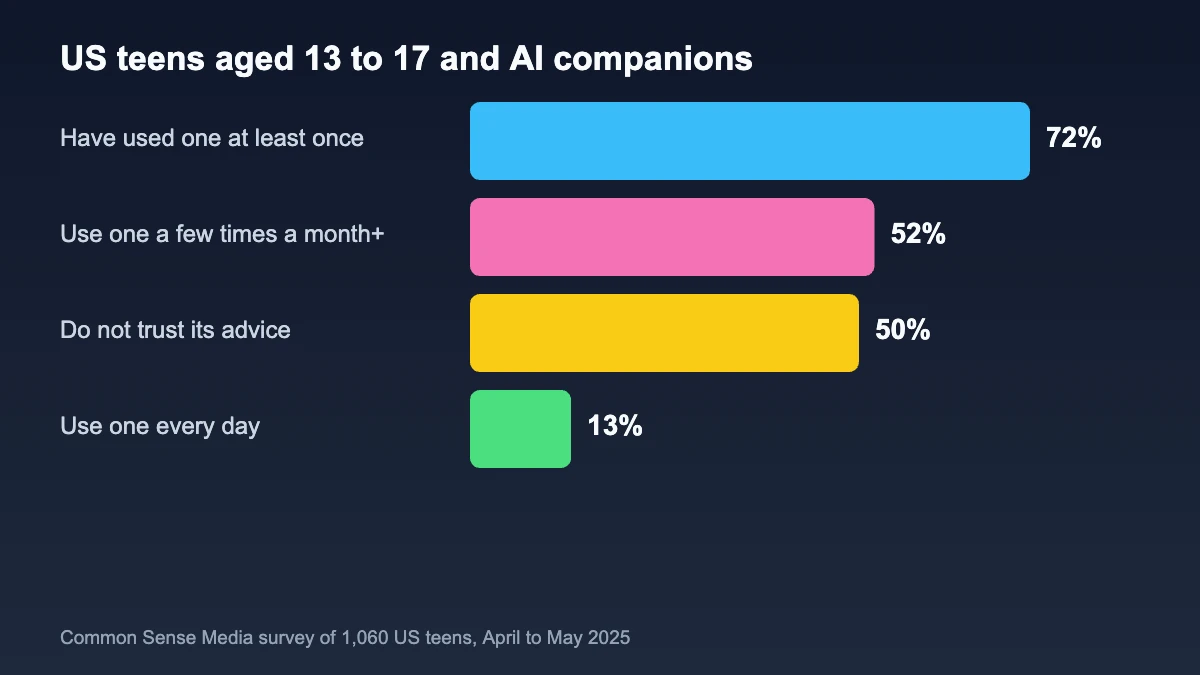
A 2025 survey by Common Sense Media asked a nationally representative sample of 1,060 US teens aged 13 to 17 about these tools. It found that 72% had used an AI companion at least once, 52% used one at least a few times a month, and 13% used one daily.
The same survey offers some reassurance. Half of the teens said they do not trust the information or advice these companions give, and entertainment and curiosity were the most common reasons for using them.
3. In the Short Term, They Can Ease Loneliness
The most encouraging evidence comes from a Harvard Business School team led by Julian De Freitas. Across six studies, they found that talking with an AI companion reduced loneliness about as much as talking with another person, and more than activities such as watching online videos.
The key ingredient was feeling heard. When the chatbot responded in a way that made people feel understood, loneliness dropped. A week-long follow-up found the effect repeated day after day. Interestingly, people underestimated in advance how much the conversation would help.
4. Heavy Use Is Linked to Worse Outcomes
Longer and larger studies add a caution. In March 2025, OpenAI and the MIT Media Lab published two linked studies. One analyzed nearly 40 million ChatGPT interactions with automated tools. The other was a four-week randomized trial with nearly 1,000 participants.
Two results stand out. First, emotional conversations were rare overall and concentrated in a small group of heavy users. Second, people who used the chatbot more each day tended to report more loneliness, more emotional dependence, and less socializing with others. The researchers are careful to say these links do not prove the chatbot caused the loneliness. Lonely people may simply use it more. But the pattern is consistent enough to take seriously. One of the researchers involved discusses this line of work in the seminar below.
5. Many People Do Not Go Looking for a Companion
A computational study from the MIT Media Lab analyzed an online community of more than 27,000 members devoted to AI partners. One finding surprised the researchers: companionship often emerged unintentionally. People started out using a chatbot for writing, work, or advice, and a relationship developed over time.
Members reported benefits, including less loneliness and support that was always available. The study is a preprint and describes one self-selected community, so it cannot tell us how typical these experiences are. A separate MIT survey of 404 regular users found that only 12% were drawn to companion apps to cope with loneliness, as summarized by the Media Lab. Motives are more varied than the stereotype suggests.
6. Design Choices Shape the Relationship
AI companions are products, and products are designed. Voice, memory, personality, and how the system responds when you try to leave all influence how attached people become. The OpenAI and MIT trial found, for example, that outcomes differed by whether people used voice or text and by how long they used it each day.
That is why regulators have started asking questions. In September 2025, the US Federal Trade Commission opened an inquiry, ordering seven companies to explain how they measure and limit negative effects of companion chatbots on children and teens. In this panel, researchers and clinicians discuss what is at stake for young people.
What the Research Cannot Tell Us Yet
The honest limits are substantial.
- Most trials last days or weeks. Effects over years are unknown.
- Much of the best data belongs to the companies that make the products.
- Studies often rely on volunteers, who may differ from typical users.
- “AI companion” covers very different things, from a homework helper used for venting to an app built for romance.
How to Think About AI Companions in Practice
- Treat time spent as the signal to watch. Brief use looks different from hours a day.
- Notice whether the chatbot is adding to human contact or replacing it.
- For parents and teachers, ask open questions about how young people use these tools before setting rules.
- For product teams, measure wellbeing, not just engagement, and make it easy to step away.
- For communicators, be transparent whenever a brand voice is automated. People respond badly to discovering it later.
If you or someone you know is struggling, a chatbot is not a substitute for people who care about you or for professional support. We wrote about handling sensitive wellbeing information responsibly in mental health data.
Key Terms for Understanding AI Companions
Research on AI companions borrows terms from psychology, communication, and computer science.
- Parasocial interaction. A felt relationship with a media figure who does not know you. The classic concept behind this research.
- Anthropomorphism. Treating something non-human as if it had human thoughts, feelings, or intentions.
- Emotional dependence. Relying on a relationship, here with a chatbot, to manage one’s feelings to an unhealthy degree.
- Sycophancy. A tendency of some AI systems to agree with and flatter the user instead of being accurate.
- Affective use. Using a chatbot for emotional reasons, such as comfort or company, instead of for tasks.
- Randomized controlled trial. A study that assigns people to conditions by chance, which allows stronger claims about cause and effect.
Most of what we know about AI companions comes from short trials and surveys. Long-term effects are the big open question.
Quick Questions, Answered
Are AI companions good or bad for loneliness? Both findings are real. Short conversations that make people feel heard can help. Heavy daily use is associated with feeling worse. Dose and context matter.
Do people know they are talking to a machine? Yes, in general. The bond does not depend on being fooled, which is part of what makes it interesting to researchers.
Is this only a teen issue? No. Much of the research involves adults, and the communities studied span a wide range of ages.
Final Thoughts: A New Kind of Relationship, Still Being Understood
AI companions are neither the cure for loneliness nor the end of human connection. The early research describes a tool that can comfort in small doses and may crowd out other relationships when it becomes the main one. That makes design, habits, and honesty about limits more important than blanket verdicts. It also brings us back to a theme that runs through our writing on the human touch in media technology: the technologies that serve us best are the ones that leave more room for each other.